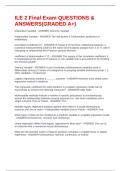
ILE 2 Final Exam QUESTIONS &
ANSWERS(GRADED A+)
Dependent Variable - ANSWER Outcome Variable
Independent Variable - ANSWER The risk factors & Confounders; predictors or
explanatory
Correlation Coefficient (r) - ANSWER A measure of the linear relationship between 2
numerical measurements made on the same set of subjects (ranges from -1 to +1 with 0
indicating no relationship) AKA Pearson product Moment
coefficient of determination (r^2) - ANSWER The square of the correlation coefficient. It
is interpreted as the amount of variance in one variable that is accounted for by knowing
the second variable
Dummy Variable - ANSWER A set of indicators (dichotomous) variables used to
differentiate among 2+ levels of a categorical or grouping variable (reference group = 1;
other variables = 0 (dummy))
Logistic regression predicts a ______ outcome - ANSWER Nominal; most widely used
regression method in medicine
The regression coefficient for each predictor in a logistic regression model can be
exponential to achieve the following measures? - ANSWER Odds Ratio
Multivariable methods include a number of specific procedures to simultaneously
assess the relationships between several exposure (i.e. risk factor variables) and a
single outcome (True or False) - ANSWER True
Multiple logistic regression analysis applies when there is a single dichotomous
outcome and one or more—t independent variable (true or False) - ANSWER True
What types of data can be included as a predictor variable in a logistic regression model
- ANSWER Dichotomous, nominal, and continuous
Linear regression differs from logistic regression in what way? - ANSWER The use of
an outcome that is numerical versus dichotomous
What are the possible scales of data for predictor variables in multiple linear or logistic
regression - ANSWER Dichotomous, nominal, continuous, or ordinal
,Multivariable methods include a number of specific procedures to simultaneously
assess the relationships between several exposure or risk factor variables and a single
outcome (True or False) - ANSWER True
A linear regression equation, and multiple linear regression equations can be used to
calculate y if one is given the x values. However, a logistic regression equation cannot
be used to calculate y when on is given x value (True or False) - ANSWER False
For a linear regression, b1 is the estimated Y-intercept, and b0 is the estimated slop of
the regression line (True or False) - ANSWER False
b0 = y-intercept
b1 = slope
A regression line describes the relationship between the dependent and independent
variables and can be used to estimate specific points for x or y, provided an individual is
supplied with the values of all the other variables but one (True or False) - ANSWER
True
Which of the following is a procedure that assigns 0 or 1 to a nominal variable so that it
may be used in a regression analysis - ANSWER Dummy coding
Covariate is a variable that is used to predict any of the other independent variables in a
multivariable analysis (True or False) - ANSWER False
Adjusted analysis, or adjustment is the process of taking into account covariates or
cofounding variables (True or False) - ANSWER True
What data types are possible for the outcome variable in a linear regression model -
ANSWER Continuous (NOT categorical or Nominal)
Which of the following regression techniques is used to relate several risk factors or
exposures, considered simultaneously, to survival time? - ANSWER Cox proportional
hazards analysis
In survival analysis, which of the following measures of effect describes the risk of
suffering the event of interest (given that the participant has survived up to a specific
time) in one group compared to the risk in the second group? - ANSWER Hazard Ratio
In survival analysis, the probability that a person survives past a certain time point is
best known as which of the following? - ANSWER Survival Function
What is time-to-event variables? - ANSWER A variable that reflects both time &
outcome components
What best describes a limitation of using mean survival time to evaluate survival? -
ANSWER Mean survival changes over time until all the subjects have died
, What is most often used to test the null hypothesis of no difference in survival curves
between two or more independent groups? - ANSWER Log Rank
What Term re-estimates the survival probability each time an event occurs? - ANSWER
Kaplan-Meyer product time method for calculating a life table
Why is mean survival time not a good measure of central tendency in a survival
analysis? - ANSWER Mean survival time changes over time until all subjects have died
Prevalence - ANSWER The proportion of people who have a given disease or condition
at a specified point in time (not truly a rate--sometimes called prevalence rate)
Incidence - ANSWER A rate giving the proportion of people who develop a given
disease or condition within a specified period of time (New)
Experimental Event Rate (EER) - ANSWER A/A+B
Control Event Rate (CER) - ANSWER c/(c+d)
Absolute Risk Reduction - ANSWER EER - CER (absolute value)
Number needed to Treat - ANSWER 1/absolute risk reduction
The number of patients that need to be treated with a proposed therapy in order to cure
or prevent an outcome in 1 individual
Number needed to harm - ANSWER The number of patients that needs to be treated
with a proposed therapy in order to cause one undesireable outcome
Relative Risk Reduction - ANSWER ARR/CER
Relative Risk - ANSWER EER/CER
Odds Ratio - ANSWER AxD/BxC
You can ONLY use odds ratio in a _________ study - ANSWER Case-Control
After Conducting a case-control study, you want to evaluate the results numerically by
comparing risk of exposure of the cases to the risk of exposure in the controls. Which of
the following is the most appropriate measure for this comparison? - ANSWER Odds
ratio
Which term best describes the ability of a test to detect the condition it is testing for: the
probability of a positive test result in patients who have the condition? - ANSWER
Sensitivity
ANSWERS(GRADED A+)
Dependent Variable - ANSWER Outcome Variable
Independent Variable - ANSWER The risk factors & Confounders; predictors or
explanatory
Correlation Coefficient (r) - ANSWER A measure of the linear relationship between 2
numerical measurements made on the same set of subjects (ranges from -1 to +1 with 0
indicating no relationship) AKA Pearson product Moment
coefficient of determination (r^2) - ANSWER The square of the correlation coefficient. It
is interpreted as the amount of variance in one variable that is accounted for by knowing
the second variable
Dummy Variable - ANSWER A set of indicators (dichotomous) variables used to
differentiate among 2+ levels of a categorical or grouping variable (reference group = 1;
other variables = 0 (dummy))
Logistic regression predicts a ______ outcome - ANSWER Nominal; most widely used
regression method in medicine
The regression coefficient for each predictor in a logistic regression model can be
exponential to achieve the following measures? - ANSWER Odds Ratio
Multivariable methods include a number of specific procedures to simultaneously
assess the relationships between several exposure (i.e. risk factor variables) and a
single outcome (True or False) - ANSWER True
Multiple logistic regression analysis applies when there is a single dichotomous
outcome and one or more—t independent variable (true or False) - ANSWER True
What types of data can be included as a predictor variable in a logistic regression model
- ANSWER Dichotomous, nominal, and continuous
Linear regression differs from logistic regression in what way? - ANSWER The use of
an outcome that is numerical versus dichotomous
What are the possible scales of data for predictor variables in multiple linear or logistic
regression - ANSWER Dichotomous, nominal, continuous, or ordinal
,Multivariable methods include a number of specific procedures to simultaneously
assess the relationships between several exposure or risk factor variables and a single
outcome (True or False) - ANSWER True
A linear regression equation, and multiple linear regression equations can be used to
calculate y if one is given the x values. However, a logistic regression equation cannot
be used to calculate y when on is given x value (True or False) - ANSWER False
For a linear regression, b1 is the estimated Y-intercept, and b0 is the estimated slop of
the regression line (True or False) - ANSWER False
b0 = y-intercept
b1 = slope
A regression line describes the relationship between the dependent and independent
variables and can be used to estimate specific points for x or y, provided an individual is
supplied with the values of all the other variables but one (True or False) - ANSWER
True
Which of the following is a procedure that assigns 0 or 1 to a nominal variable so that it
may be used in a regression analysis - ANSWER Dummy coding
Covariate is a variable that is used to predict any of the other independent variables in a
multivariable analysis (True or False) - ANSWER False
Adjusted analysis, or adjustment is the process of taking into account covariates or
cofounding variables (True or False) - ANSWER True
What data types are possible for the outcome variable in a linear regression model -
ANSWER Continuous (NOT categorical or Nominal)
Which of the following regression techniques is used to relate several risk factors or
exposures, considered simultaneously, to survival time? - ANSWER Cox proportional
hazards analysis
In survival analysis, which of the following measures of effect describes the risk of
suffering the event of interest (given that the participant has survived up to a specific
time) in one group compared to the risk in the second group? - ANSWER Hazard Ratio
In survival analysis, the probability that a person survives past a certain time point is
best known as which of the following? - ANSWER Survival Function
What is time-to-event variables? - ANSWER A variable that reflects both time &
outcome components
What best describes a limitation of using mean survival time to evaluate survival? -
ANSWER Mean survival changes over time until all the subjects have died
, What is most often used to test the null hypothesis of no difference in survival curves
between two or more independent groups? - ANSWER Log Rank
What Term re-estimates the survival probability each time an event occurs? - ANSWER
Kaplan-Meyer product time method for calculating a life table
Why is mean survival time not a good measure of central tendency in a survival
analysis? - ANSWER Mean survival time changes over time until all subjects have died
Prevalence - ANSWER The proportion of people who have a given disease or condition
at a specified point in time (not truly a rate--sometimes called prevalence rate)
Incidence - ANSWER A rate giving the proportion of people who develop a given
disease or condition within a specified period of time (New)
Experimental Event Rate (EER) - ANSWER A/A+B
Control Event Rate (CER) - ANSWER c/(c+d)
Absolute Risk Reduction - ANSWER EER - CER (absolute value)
Number needed to Treat - ANSWER 1/absolute risk reduction
The number of patients that need to be treated with a proposed therapy in order to cure
or prevent an outcome in 1 individual
Number needed to harm - ANSWER The number of patients that needs to be treated
with a proposed therapy in order to cause one undesireable outcome
Relative Risk Reduction - ANSWER ARR/CER
Relative Risk - ANSWER EER/CER
Odds Ratio - ANSWER AxD/BxC
You can ONLY use odds ratio in a _________ study - ANSWER Case-Control
After Conducting a case-control study, you want to evaluate the results numerically by
comparing risk of exposure of the cases to the risk of exposure in the controls. Which of
the following is the most appropriate measure for this comparison? - ANSWER Odds
ratio
Which term best describes the ability of a test to detect the condition it is testing for: the
probability of a positive test result in patients who have the condition? - ANSWER
Sensitivity