
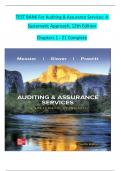
TEST BANK For Auditing & Assurance Services: A
Systematic Approach, 12th Edition
Chapters 1 - 21 Complete
,Chapter 1: An Introduction to Assurance and Financial Statement Auditing
Chapter 2: The Financial Statement Auditing Environment
Chapter 3: Audit Planning, Types of Audit Tests, and Materiality
Chapter 4: Risk Assessment
Chapter 5: Evidence and Documentation
Chapter 6: Internal Control in a Financial Statement Audit
Chapter 7: Auditing Internal Control over Financial Reporting
Chapter 8: Audit Sampling: An Overview and Application to Tests of Controls
Chapter 9: Audit Sampling: An Application to Substantive Tests of Account Balances
Chapter 10: Auditing the Revenue Process
Chapter 11: Auditing the Purchasing Process
Chapter 12: Auditing the Human Resource Management Process
Chapter 13: Auditing the Inventory Management Process
Chapter 14: Auditing the Financing/Investing Process: Prepaid Expenses, Intangible Assets, and
Property, Plant, and Equipment
Chapter 15: Auditing the Financing/Investing Process: Long-Term Liabilities, Stockholders’ Equity,
and Income Statement Accounts
Chapter 16: Auditing the Financing/Investing Process: Cash and Investments
Chapter 17: Completing the Audit Engagement
Chapter 18: Reports on Audited Financial Statements
Chapter 19: Professional Conduct, Independence, and Quality Management
Chapter 20: Legal Liability
,Chapter 21: Assurance, Attestation, and Internal Auditing Services
Auditing & Assurance Services: A Systematic Approach, 12e (Messier) Chapter
1 An Introduction to Assurance and Financial Statement Auditing
1) Auditing focuses on rules, techniques, and computations required to prepare and
analyze financial information.
ANSWER: FALSE
Difficulty: 1 Easy
Topic: The Importance for Studying Auditing
Learning Objective: 01-01 Understand why studying auditing can be valuable to you whether or
not you plan to become an auditor, and why it is different from studying accounting.
Bloom's: Remember
AACSB: Communication
AICPA: BB Legal; FN Decision Making
2) Decision makers demand reliable information that is provided by accountants.
ANSWER: TRUE
Difficulty: 1 Easy
Topic: The Demand for Auditing and Assurance
Learning Objective: 01-02 Understand the demand for auditing and be able to explain the
desired characteristics of auditors and audit services through an analogy to a house inspector
and a house inspection service.
Bloom's: Understand
AACSB: Communication
AICPA: FN Decision Making; BB Industry
3) Information asymmetry seldom occurs.
ANSWER: FALSE
Difficulty: 2 Medium
Topic: The Demand for Auditing and Assurance
Learning Objective: 01-02 Understand the demand for auditing and be able to explain the
desired characteristics of auditors and audit services through an analogy to a house inspector
and a house inspection service.
Bloom's: Apply
AACSB: Communication
AICPA: BB Industry; FN Reporting
,4) Conflicts of interest often occur between absentee owners and managers.
ANSWER: TRUE
Difficulty: 2 Medium
Topic: The Demand for Auditing and Assurance
Learning Objective: 01-02 Understand the demand for auditing and be able to explain the
desired characteristics of auditors and audit services through an analogy to a house inspector
and a house inspection service.
Bloom's: Apply
AACSB: Communication
AICPA: BB Industry; FN Reporting
5) Auditing services and attestation services are the same.
ANSWER: FALSE
Difficulty: 1 Easy
Topic: Auditing, Attest, and Assurance Services Defined
Learning Objective: 01-03 Understand the relationships among auditing, attestation, and
assurance services.
Bloom's: Understand
AACSB: Communication
AICPA: BB Industry; FN Reporting
6) Auditing is a type of attest service.
ANSWER: TRUE
Difficulty: 1 Easy
Topic: Auditing, Attest, and Assurance Services Defined
Learning Objective: 01-03 Understand the relationships among auditing, attestation, and
assurance services.; 01-04 Know the basic definition of a financial statement audit.
Bloom's: Understand
AACSB: Communication
AICPA: BB Industry; FN Reporting
7) Testing all transactions that occurred during the period is cost prohibitive.
ANSWER: TRUE
Difficulty: 2 Medium
Topic: The Audit Process
Learning Objective: 01-06 Be able to explain why on most audit engagements an auditor tests
only a sample of transactions that occurred.
Bloom's: Apply
AACSB: Communication
AICPA: FN Decision Making; BB Critical Thinking
,8) Why do auditors generally use a sampling approach to evidence gathering?
A) Auditors are experts and do not need to look at much to know whether the
financial statements are correct or not.
B) Auditors must balance the cost of the audit with the need for precision.
C) Auditors must limit their exposure to their auditee to maintain independence.
D) The auditor's relationship with the auditee is generally adversarial, so the auditor will
not have access to all of the financial information of the company.
ANSWER: B
Difficulty: 1 Easy
Topic: The Audit Process
Learning Objective: 01-06 Be able to explain why on most audit engagements an auditor tests
only a sample of transactions that occurred.
Bloom's: Understand
AACSB: Communication
AICPA: FN Decision Making; BB Industry
9) Which of the following statements best describes a relationship between sample size and
other elements of auditing?
A) If materiality increases, so will the sample size.
B) If the desired level of assurance increases, sample sizes can be smaller.
C) If materiality decreases, sample size will need to increase.
D) There is no relationship between sample size and materiality or the desired level of assurance.
ANSWER: C
Difficulty: 2 Medium
Topic: The Audit Process
Learning Objective: 01-06 Be able to explain why on most audit engagements an auditor tests
only a sample of transactions that occurred.
Bloom's: Apply
AACSB: Analytical Thinking
AICPA: BB Critical Thinking; FN Risk Analysis
, 10) Which of the following statements about the study of auditing is NOT true?
A) The study of auditing can be valuable to future accountants and business decision
makers whether or not they plan to become auditors.
B) The study of auditing focuses on learning the analytical and logical skills necessary to
evaluate the relevance and reliability of information.
C) The study of auditing focuses on learning the rules, techniques, and computations required
to analyze financial statements.
D) The study of auditing begins with the understanding of a coherent logical framework
and techniques useful for gathering and analyzing evidence about others' assertions.
ANSWER: C
Difficulty: 2 Medium
Topic: The Importance for Studying Auditing
Learning Objective: 01-01 Understand why studying auditing can be valuable to you whether or
not you plan to become an auditor, and why it is different from studying accounting.
Bloom's: Analyze AACSB:
Communication
AICPA: FN Decision Making; BB Industry
11) The basic definition of auditing states it is a process to:
A) detect fraud.
B) examine individual transactions so that the auditor may certify as to their validity.
C) objectively obtain and evaluate evidence regarding assertions.
D) assure the consistent application of correct accounting procedures.
ANSWER: C
Difficulty: 1 Easy
Topic: Auditing, Attest, and Assurance Services Defined
Learning Objective: 01-03 Understand the relationships among auditing, attestation, and
assurance services.; 01-04 Know the basic definition of a financial statement audit.
Bloom's: Remember
AACSB: Communication
AICPA: FN Reporting; BB Critical Thinking
Systematic Approach, 12th Edition
Chapters 1 - 21 Complete
,Chapter 1: An Introduction to Assurance and Financial Statement Auditing
Chapter 2: The Financial Statement Auditing Environment
Chapter 3: Audit Planning, Types of Audit Tests, and Materiality
Chapter 4: Risk Assessment
Chapter 5: Evidence and Documentation
Chapter 6: Internal Control in a Financial Statement Audit
Chapter 7: Auditing Internal Control over Financial Reporting
Chapter 8: Audit Sampling: An Overview and Application to Tests of Controls
Chapter 9: Audit Sampling: An Application to Substantive Tests of Account Balances
Chapter 10: Auditing the Revenue Process
Chapter 11: Auditing the Purchasing Process
Chapter 12: Auditing the Human Resource Management Process
Chapter 13: Auditing the Inventory Management Process
Chapter 14: Auditing the Financing/Investing Process: Prepaid Expenses, Intangible Assets, and
Property, Plant, and Equipment
Chapter 15: Auditing the Financing/Investing Process: Long-Term Liabilities, Stockholders’ Equity,
and Income Statement Accounts
Chapter 16: Auditing the Financing/Investing Process: Cash and Investments
Chapter 17: Completing the Audit Engagement
Chapter 18: Reports on Audited Financial Statements
Chapter 19: Professional Conduct, Independence, and Quality Management
Chapter 20: Legal Liability
,Chapter 21: Assurance, Attestation, and Internal Auditing Services
Auditing & Assurance Services: A Systematic Approach, 12e (Messier) Chapter
1 An Introduction to Assurance and Financial Statement Auditing
1) Auditing focuses on rules, techniques, and computations required to prepare and
analyze financial information.
ANSWER: FALSE
Difficulty: 1 Easy
Topic: The Importance for Studying Auditing
Learning Objective: 01-01 Understand why studying auditing can be valuable to you whether or
not you plan to become an auditor, and why it is different from studying accounting.
Bloom's: Remember
AACSB: Communication
AICPA: BB Legal; FN Decision Making
2) Decision makers demand reliable information that is provided by accountants.
ANSWER: TRUE
Difficulty: 1 Easy
Topic: The Demand for Auditing and Assurance
Learning Objective: 01-02 Understand the demand for auditing and be able to explain the
desired characteristics of auditors and audit services through an analogy to a house inspector
and a house inspection service.
Bloom's: Understand
AACSB: Communication
AICPA: FN Decision Making; BB Industry
3) Information asymmetry seldom occurs.
ANSWER: FALSE
Difficulty: 2 Medium
Topic: The Demand for Auditing and Assurance
Learning Objective: 01-02 Understand the demand for auditing and be able to explain the
desired characteristics of auditors and audit services through an analogy to a house inspector
and a house inspection service.
Bloom's: Apply
AACSB: Communication
AICPA: BB Industry; FN Reporting
,4) Conflicts of interest often occur between absentee owners and managers.
ANSWER: TRUE
Difficulty: 2 Medium
Topic: The Demand for Auditing and Assurance
Learning Objective: 01-02 Understand the demand for auditing and be able to explain the
desired characteristics of auditors and audit services through an analogy to a house inspector
and a house inspection service.
Bloom's: Apply
AACSB: Communication
AICPA: BB Industry; FN Reporting
5) Auditing services and attestation services are the same.
ANSWER: FALSE
Difficulty: 1 Easy
Topic: Auditing, Attest, and Assurance Services Defined
Learning Objective: 01-03 Understand the relationships among auditing, attestation, and
assurance services.
Bloom's: Understand
AACSB: Communication
AICPA: BB Industry; FN Reporting
6) Auditing is a type of attest service.
ANSWER: TRUE
Difficulty: 1 Easy
Topic: Auditing, Attest, and Assurance Services Defined
Learning Objective: 01-03 Understand the relationships among auditing, attestation, and
assurance services.; 01-04 Know the basic definition of a financial statement audit.
Bloom's: Understand
AACSB: Communication
AICPA: BB Industry; FN Reporting
7) Testing all transactions that occurred during the period is cost prohibitive.
ANSWER: TRUE
Difficulty: 2 Medium
Topic: The Audit Process
Learning Objective: 01-06 Be able to explain why on most audit engagements an auditor tests
only a sample of transactions that occurred.
Bloom's: Apply
AACSB: Communication
AICPA: FN Decision Making; BB Critical Thinking
,8) Why do auditors generally use a sampling approach to evidence gathering?
A) Auditors are experts and do not need to look at much to know whether the
financial statements are correct or not.
B) Auditors must balance the cost of the audit with the need for precision.
C) Auditors must limit their exposure to their auditee to maintain independence.
D) The auditor's relationship with the auditee is generally adversarial, so the auditor will
not have access to all of the financial information of the company.
ANSWER: B
Difficulty: 1 Easy
Topic: The Audit Process
Learning Objective: 01-06 Be able to explain why on most audit engagements an auditor tests
only a sample of transactions that occurred.
Bloom's: Understand
AACSB: Communication
AICPA: FN Decision Making; BB Industry
9) Which of the following statements best describes a relationship between sample size and
other elements of auditing?
A) If materiality increases, so will the sample size.
B) If the desired level of assurance increases, sample sizes can be smaller.
C) If materiality decreases, sample size will need to increase.
D) There is no relationship between sample size and materiality or the desired level of assurance.
ANSWER: C
Difficulty: 2 Medium
Topic: The Audit Process
Learning Objective: 01-06 Be able to explain why on most audit engagements an auditor tests
only a sample of transactions that occurred.
Bloom's: Apply
AACSB: Analytical Thinking
AICPA: BB Critical Thinking; FN Risk Analysis
, 10) Which of the following statements about the study of auditing is NOT true?
A) The study of auditing can be valuable to future accountants and business decision
makers whether or not they plan to become auditors.
B) The study of auditing focuses on learning the analytical and logical skills necessary to
evaluate the relevance and reliability of information.
C) The study of auditing focuses on learning the rules, techniques, and computations required
to analyze financial statements.
D) The study of auditing begins with the understanding of a coherent logical framework
and techniques useful for gathering and analyzing evidence about others' assertions.
ANSWER: C
Difficulty: 2 Medium
Topic: The Importance for Studying Auditing
Learning Objective: 01-01 Understand why studying auditing can be valuable to you whether or
not you plan to become an auditor, and why it is different from studying accounting.
Bloom's: Analyze AACSB:
Communication
AICPA: FN Decision Making; BB Industry
11) The basic definition of auditing states it is a process to:
A) detect fraud.
B) examine individual transactions so that the auditor may certify as to their validity.
C) objectively obtain and evaluate evidence regarding assertions.
D) assure the consistent application of correct accounting procedures.
ANSWER: C
Difficulty: 1 Easy
Topic: Auditing, Attest, and Assurance Services Defined
Learning Objective: 01-03 Understand the relationships among auditing, attestation, and
assurance services.; 01-04 Know the basic definition of a financial statement audit.
Bloom's: Remember
AACSB: Communication
AICPA: FN Reporting; BB Critical Thinking

