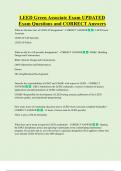
LEED Green Associate Exam UPDATED
Exam Questions and CORRECT Answers
What are the three tiers of LEED AP designation? - CORRECT ANSWER - LEED Green
Associate
LEED AP with Specialty
LEED AP Fellow
What are the five AP specialty designations? - CORRECT ANSWER - BD&C (Building
Design and Construction)
ID&C (Interior Design and Construction)
O&M (Operations and Maintenance)
Homes
ND (Neighborhood Development)
Describe the responsibilities of GBCI and USGBC with respect to LEED. - CORRECT
ANSWER - GBCI-Administers the LEED credentials, oversees evaluation of project
applications and determinations of LEED certifications
USGBC-Responsible for development of LEED rating systems, publication of the LEED
reference guides, and educational programming
How many hours of continuing education must a LEED Green Associate complete biennially? -
CORRECT ANSWER - 15 hours (3 hours must be LEED specific)
There is also a $50 fee biennially
What does opt in mean in regard to LEED credentials? - CORRECT ANSWER - Signing
the GBCI disciplinary policy and agreeing to participate in the credentialing maintenance
program. If you don't opt in, you will not have a specialty designation (This applies to those who
were already LEED AP prior to the 2009 changes)
,What are the LEED rating systems and how should they be applied to projects? - CORRECT
ANSWER - LEED for New Construction and Major Renovations (LEED NC)- applies to
entire commercial buildings such as offices, retail store, hotels, institutional facilities (such as
libraries and churches), and residential buildings with four or more habitable stories.
LEED for Core & Shell Development (LEED CS)- designed to complement the LEED for
Commercial Interiors rating system (It covers core building elements such as structure, building
envelope, and HVAC systems)
LEED for Schools (LEED S)-used for certification of K-12 educational facilities and can also be
used for prekindergarten or post-secondary buildings
LEED for Healthcare (LEED HC)- used for inpatient, outpatient, and long-term care facilities
LEED for Retail: New Construction (LEED R-NC)- adapted to the needs of the retail
environment
LEED for Commercial Interiors (LEED CI)- used for certification of tenant spaces in
commercial and institutional buildings
LEED for Retail: Commercial Interiors (LEED R-CI)- interior retail spaces
LEED for Existing Buildings: Operations & Maintenance (LEED EBO&M)- designed to
encourage sustainable maintenance, cleaning, and operation of existing commercial structures.
LEED for Homes (LEED H)- applies to single family homes and low-rise residential
construction (fewer than 4 stories)
LEED for Neighborhood Development (LEED ND)- emphasizes the elements of site selection,
design, and construction that create vibrant, walkable, mixed-use neighborhoods
, List four things that are new to the LEED 2009 rating system. - CORRECT ANSWER - 1.
Revised rating systems were released for LEED NC, LEED CI, LEED CS, LEED EBO&M, and
LEED S.
2. Upgrades were made to LEED Online to improve and streamline the application process and
help resolve technical problems.
3. Responsibilities for building certification were assigned to GBCI.
4. The LEED AP credentialing program was comprehensively revised, including the launch of
the tiered credentialing system administered by GBCI.
5. New rating systems were announced for health care, retail, existing schools, and neighborhood
development.
What are the seven credit categories of the LEED rating systems? - CORRECT
ANSWER - Sustainable Sites (SS)
Water Efficiency (WE)
Energy and Atmosphere (EA)
Materials and Resources (MR)
Indoor Environmental Quality (IEQ)
Innovation in Design/Operations (ID or IO)
Regional Priority (RP)
What does balloting mean in regard to the LEED rating systems? - CORRECT ANSWER -
When a new version of a rating system is being drafted, after the 2 comment periods are
complete, the revisions to the rating system are put to a vote and all USGBC members are
encouraged to submit a vote for or against the approval of the revisions.
Which credit category offers the most points in the LEED rating systems? - CORRECT
ANSWER - Energy and Atmosphere
Exam Questions and CORRECT Answers
What are the three tiers of LEED AP designation? - CORRECT ANSWER - LEED Green
Associate
LEED AP with Specialty
LEED AP Fellow
What are the five AP specialty designations? - CORRECT ANSWER - BD&C (Building
Design and Construction)
ID&C (Interior Design and Construction)
O&M (Operations and Maintenance)
Homes
ND (Neighborhood Development)
Describe the responsibilities of GBCI and USGBC with respect to LEED. - CORRECT
ANSWER - GBCI-Administers the LEED credentials, oversees evaluation of project
applications and determinations of LEED certifications
USGBC-Responsible for development of LEED rating systems, publication of the LEED
reference guides, and educational programming
How many hours of continuing education must a LEED Green Associate complete biennially? -
CORRECT ANSWER - 15 hours (3 hours must be LEED specific)
There is also a $50 fee biennially
What does opt in mean in regard to LEED credentials? - CORRECT ANSWER - Signing
the GBCI disciplinary policy and agreeing to participate in the credentialing maintenance
program. If you don't opt in, you will not have a specialty designation (This applies to those who
were already LEED AP prior to the 2009 changes)
,What are the LEED rating systems and how should they be applied to projects? - CORRECT
ANSWER - LEED for New Construction and Major Renovations (LEED NC)- applies to
entire commercial buildings such as offices, retail store, hotels, institutional facilities (such as
libraries and churches), and residential buildings with four or more habitable stories.
LEED for Core & Shell Development (LEED CS)- designed to complement the LEED for
Commercial Interiors rating system (It covers core building elements such as structure, building
envelope, and HVAC systems)
LEED for Schools (LEED S)-used for certification of K-12 educational facilities and can also be
used for prekindergarten or post-secondary buildings
LEED for Healthcare (LEED HC)- used for inpatient, outpatient, and long-term care facilities
LEED for Retail: New Construction (LEED R-NC)- adapted to the needs of the retail
environment
LEED for Commercial Interiors (LEED CI)- used for certification of tenant spaces in
commercial and institutional buildings
LEED for Retail: Commercial Interiors (LEED R-CI)- interior retail spaces
LEED for Existing Buildings: Operations & Maintenance (LEED EBO&M)- designed to
encourage sustainable maintenance, cleaning, and operation of existing commercial structures.
LEED for Homes (LEED H)- applies to single family homes and low-rise residential
construction (fewer than 4 stories)
LEED for Neighborhood Development (LEED ND)- emphasizes the elements of site selection,
design, and construction that create vibrant, walkable, mixed-use neighborhoods
, List four things that are new to the LEED 2009 rating system. - CORRECT ANSWER - 1.
Revised rating systems were released for LEED NC, LEED CI, LEED CS, LEED EBO&M, and
LEED S.
2. Upgrades were made to LEED Online to improve and streamline the application process and
help resolve technical problems.
3. Responsibilities for building certification were assigned to GBCI.
4. The LEED AP credentialing program was comprehensively revised, including the launch of
the tiered credentialing system administered by GBCI.
5. New rating systems were announced for health care, retail, existing schools, and neighborhood
development.
What are the seven credit categories of the LEED rating systems? - CORRECT
ANSWER - Sustainable Sites (SS)
Water Efficiency (WE)
Energy and Atmosphere (EA)
Materials and Resources (MR)
Indoor Environmental Quality (IEQ)
Innovation in Design/Operations (ID or IO)
Regional Priority (RP)
What does balloting mean in regard to the LEED rating systems? - CORRECT ANSWER -
When a new version of a rating system is being drafted, after the 2 comment periods are
complete, the revisions to the rating system are put to a vote and all USGBC members are
encouraged to submit a vote for or against the approval of the revisions.
Which credit category offers the most points in the LEED rating systems? - CORRECT
ANSWER - Energy and Atmosphere