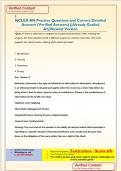
NCLEX-RN Practice Questions and Correct Detailed
Answers (Verified Answers) ||Already Graded
A+||Newest Version
Quiz: A client is referred to a surgeon by the general practitioner. After meeting the
surgeon, the client decides to find a different surgeon to continue treatment. The nurse
supports the client's action, utilizing which ethical principle?
1. Beneficence
2. Veracity
3. Autonomy
4. Privacy
Ans: Answer: 3
Rationale: Autonomy is the right of individuals to take action for themselves. Beneficence
is an ethical principle to do good and applies when the nurse has a city to help others by
doing what is best for them. Veracity refers to truthfulness. Privacy is the nondisclosure of
information by the health care team.
Cognitive Level: Applying
Client Need: Management of Care
Integrated Process: Nursing Process: Implementation
Content Area: Fundamentals
Strategy: The core issue of the question is the ability to interpret which ethical principle is
operating in a specific situation. Eliminate beneficence and veracity next because they
focus on the obligation of the nurse rather than on a right of the client.
o
o
© 2025 TestTrackers
WhatsApp or call o Resources & Updates: [Testtrackers - Stuvia US]
[+254707240657] o Your Success is Our Mission!
o For online exams and tutor expert, please whatsapp me
in the number given.
, Quiz: A nurse forgets to administer a client's diuretic and the client experiences an
episode of pulmonary edema. The charge nurse would consider the medication error to
constitute negligence because the situation contains which element?
1. Purposeful failure to perform a health care procedure
2. Unintentional failure to perform a health care procedure
3. Act of substituting a different medication for the one ordered
4. Failure to follow a direct order by a physician
Ans: Answer: 2
Rationale: Negligence is the unintentional failure of an individual to perform or not
perform an act that a reasonable person would or would not do in the same or similar
circumstances. A purposeful failure to perform a procedure would be the opposite of
negligence, which is unintentional. Substituting a different medication does not fit the
description of the situation in the question. Failure to follow a direct order does not fit the
description in the situation in the question.
Cognitive Level: Applying
Client Need: Management of Care
Integrated Process: Nursing Process: Assessment
Content Area: Fundamentals
Strategy: Two options are opposites, which is a clue that one of them may be correct.
Choose unintentional failure to carry out a procedure over purposeful failure because it
matches the definition of negligence.
Quiz: A client asks why a diagnostic test has been ordered and the nurse replies, "I'm
unsure but will find out for you." When the nurse later returns and provides an explanation,
the nurse is acting under which principle?
o
o
© 2025 TestTrackers
WhatsApp or call o Resources & Updates: [Testtrackers - Stuvia US]
[+254707240657] o Your Success is Our Mission!
o For online exams and tutor expert, please whatsapp me
in the number given.
, 1. Nonmaleficence
2. Veracity
3. Beneficence
4. Fidelity
Ans: Answer: 4
Rationale: Fidelity means being faithful to agreements and promises. This nurse is acting
on the client's behalf to obtain needed information and report it back to the client.
Nonmaleficence is the duty to do no harm. Veracity refers to telling the truth for example,
not lying to a client about a serious prognosis. Beneficence means doing good, such as by
implementing actions (e.g. keeping a salt shaker out of sight) that benefit a client (heart
condition requiring sodium-restricted diet).
Cognitive Level: Understanding
Client Need: Management of Care
Integrated Process: Nursing Process: Implementation
Content Area: Fundamentals
Strategy: Use the process of elimination. The correct answer is the one that matches the
description in the stem; that is, the nurse made a promise to a client and kept it, which
constitutes fidelity.
Quiz: An individual has a seizure while walking down the street. During the seizure, a
nurse from a physician's office is noticed driving past without stopping to assist. The
individual sues the nurse for negligence but fails to win a judgement for which reason?
1. The nurse had no duty to the individual.
o
o
© 2025 TestTrackers
WhatsApp or call o Resources & Updates: [Testtrackers - Stuvia US]
[+254707240657] o Your Success is Our Mission!
o For online exams and tutor expert, please whatsapp me
in the number given.
Answers (Verified Answers) ||Already Graded
A+||Newest Version
Quiz: A client is referred to a surgeon by the general practitioner. After meeting the
surgeon, the client decides to find a different surgeon to continue treatment. The nurse
supports the client's action, utilizing which ethical principle?
1. Beneficence
2. Veracity
3. Autonomy
4. Privacy
Ans: Answer: 3
Rationale: Autonomy is the right of individuals to take action for themselves. Beneficence
is an ethical principle to do good and applies when the nurse has a city to help others by
doing what is best for them. Veracity refers to truthfulness. Privacy is the nondisclosure of
information by the health care team.
Cognitive Level: Applying
Client Need: Management of Care
Integrated Process: Nursing Process: Implementation
Content Area: Fundamentals
Strategy: The core issue of the question is the ability to interpret which ethical principle is
operating in a specific situation. Eliminate beneficence and veracity next because they
focus on the obligation of the nurse rather than on a right of the client.
o
o
© 2025 TestTrackers
WhatsApp or call o Resources & Updates: [Testtrackers - Stuvia US]
[+254707240657] o Your Success is Our Mission!
o For online exams and tutor expert, please whatsapp me
in the number given.
, Quiz: A nurse forgets to administer a client's diuretic and the client experiences an
episode of pulmonary edema. The charge nurse would consider the medication error to
constitute negligence because the situation contains which element?
1. Purposeful failure to perform a health care procedure
2. Unintentional failure to perform a health care procedure
3. Act of substituting a different medication for the one ordered
4. Failure to follow a direct order by a physician
Ans: Answer: 2
Rationale: Negligence is the unintentional failure of an individual to perform or not
perform an act that a reasonable person would or would not do in the same or similar
circumstances. A purposeful failure to perform a procedure would be the opposite of
negligence, which is unintentional. Substituting a different medication does not fit the
description of the situation in the question. Failure to follow a direct order does not fit the
description in the situation in the question.
Cognitive Level: Applying
Client Need: Management of Care
Integrated Process: Nursing Process: Assessment
Content Area: Fundamentals
Strategy: Two options are opposites, which is a clue that one of them may be correct.
Choose unintentional failure to carry out a procedure over purposeful failure because it
matches the definition of negligence.
Quiz: A client asks why a diagnostic test has been ordered and the nurse replies, "I'm
unsure but will find out for you." When the nurse later returns and provides an explanation,
the nurse is acting under which principle?
o
o
© 2025 TestTrackers
WhatsApp or call o Resources & Updates: [Testtrackers - Stuvia US]
[+254707240657] o Your Success is Our Mission!
o For online exams and tutor expert, please whatsapp me
in the number given.
, 1. Nonmaleficence
2. Veracity
3. Beneficence
4. Fidelity
Ans: Answer: 4
Rationale: Fidelity means being faithful to agreements and promises. This nurse is acting
on the client's behalf to obtain needed information and report it back to the client.
Nonmaleficence is the duty to do no harm. Veracity refers to telling the truth for example,
not lying to a client about a serious prognosis. Beneficence means doing good, such as by
implementing actions (e.g. keeping a salt shaker out of sight) that benefit a client (heart
condition requiring sodium-restricted diet).
Cognitive Level: Understanding
Client Need: Management of Care
Integrated Process: Nursing Process: Implementation
Content Area: Fundamentals
Strategy: Use the process of elimination. The correct answer is the one that matches the
description in the stem; that is, the nurse made a promise to a client and kept it, which
constitutes fidelity.
Quiz: An individual has a seizure while walking down the street. During the seizure, a
nurse from a physician's office is noticed driving past without stopping to assist. The
individual sues the nurse for negligence but fails to win a judgement for which reason?
1. The nurse had no duty to the individual.
o
o
© 2025 TestTrackers
WhatsApp or call o Resources & Updates: [Testtrackers - Stuvia US]
[+254707240657] o Your Success is Our Mission!
o For online exams and tutor expert, please whatsapp me
in the number given.