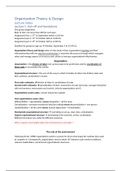
Organization Theory & Design
Lecture notes
Lecture 1: Kick-off and foundations
One group assignment.
Body of text: not more than 600 for each part.
Assignment Part 1: 27th of September before 12:00 hrs
Assignment part 2: 11th of October before 12:00 hrs
Assignment part 3: 25th of October before 12:00 hrs
Deadline for groups to sign up Monday, September 9 at 23.49 hrs.
Organization Theory and Design refers to the study of how organizations function and their
interrelationship with the external environment. It examines the process through which managers
select and manage aspects of structure and culture to increase organizational effectiveness.
Organization
Organization = the division of labor into various tasks to be performed and the coordination of
these tasks to accomplish the activity.
Organizational structure = the sum of the ways in which it divides its labor into distincy tasks and
then achieves coordination in teams.
First-order rationales division of labor & coordination of tasks
Second-order rationales specialization of labor, economies of scale and scope, manage interaction
with environment, exert power and control. (why do organizations exist?)
Organizations create value; convert inputs into outputs.
How organizations create value.
Differentiation = specialization versus integration = all the same
Centralization = everyone involved in decision making versus decentralization = one person
standardization = all the same versus mutual adjustment = formalization.
Mechanistic organizational structure everything is set up, clear roles, centralization
Organic organizational structure developing in the moment, ad hoc coordination.
Different structures are useful for different scenarios.
Why is organic-ness helpful when the environment is uncertain ?
The role of the environment
Following Porter (1980) organizations need to account for forces that shape the markets they want
to compete in. Consequently, organizations need to attain ‘fit’ between such market conditions,
relevant stakeholders, and internal organizational structures.
,Porter’s Five Forces 5 forces that make up the competitive environment.
Competitive rivalry; number and strengths of the competitors.
Supplier power; how easily can suppliers increase their prices
Buyer power; how easy is it for buyers to drive your prices down
Threat of substitution; likelihood of customers to find a different way of what your company is doing
Threat of new entry; how likely is it that people can enter your market
From concepts to theory
Contingency theory the greater the uncertainty induced by environment characteristics, the more
the organizational structure will contain organic elements.
Theory relationship + explanation
What; environmental uncertainty
How; mechanism
What; organic-ness of structure
Why; theoretical causal relationship
Organizational Design
Organizational design theory that helps us to solve real world problems and challenges & use this
theory to make difference choices in the organization.
Several concepts shape an organizational design stakeholders, environment, strategy, resources,
customers, products.
,Lecture 2: Effective Organizational Design
Why do we have organizations?
> Add value to an input to output process
> For economies of scale gather people to create value
> For economies of scope use effective resources
Challenges in collective value generation
> Division of labor
> Coordination of tasks
If we want to create value, people should act according to certain rule so therefore control is
needed, coordination (=integrate) & motivation to deliver good work. Challenges when creating an
(effective) organization. This can be done by structure (formal organization) or culture (informal
organization).
Weber’s principles of bureaucracy
6 principles a bureaucracy should have according Max Weber.
1. Authority hierarchy Positions are organized in a clear chain of command hierarchy
2. Job specialization Jobs are broken down into simple, routine and well-defined tasks
3. Formal rules and regulations SOPs, to ensure uniformity and to guide the actions of employees
4. Career orientation Managers are professional officials rather than owners
5. Formal selection members are selected on the basis of technical qualification.
6. Impersonality everyone is treated in the same way. Rules and control are applied uniformly.
If implemented, the organization should run like a well-oiled machine.
- Interactions between organizational levels will be efficiently regulated
- Each person will know his/her role in the organization
- Explicit rewards / punishments reduce the costs of enforcing and assessing employee behaviour
- Because each position is independent from the person, promotion is a motivation force.
But bureaucracy also generates costs
> no control in the development of the hierarchy, the organization will grow very large and
inefficient, rendering decision-making very slow.
> members may rely too much on rules and SOPs to make decisions which makes them unresponsive
to the needs of customers and other stakeholders.
If Hierarchy comes with all these problems, why do companies rely on it?
Benefits of hierarchy / bureaucracy
1. Control
- continually question and probe subordinates
- direct observation and evaluation / training
- prevent free-riding
2. Integrate
- continuous task-assignment
- managing relations between multiple subordinates
3. Motivate
- mentoring and professional development
- immediate feedback and performance based rewards
, Designing a hierarchy of authority
Span of control > how many people a manager supervises. The nature of the task depends the span
of control. The more complex, the smaller the span of control. The more interrelatedness, the
smaller the span of control; (your task is depending on somebody’s else task; SALES person).
Chain of command > The number of levels in a organizational structure. A tall organization has many
levels relative to the size, flat organization has a few levels relative to the size.
How tall or flat? 3,000 employees tend to have 7 levels. So > 7 level = tall, <7 level = flat.
Taller hierarchy & smaller spans of control are helpful in creating control, integration and motivation
BUT after a certain point, it can cause certain problems:
> Communication problems: communication takes longer, decision making slow, info may be manipulated
> Motivation problems: with more managers, less authority and responsibility, reduces motivation
> Bureaucratic costs; the more people in the organization, the higher the bureaucratic cost.
(bureaucratic costs = costs related to managing the organization).
Principle of minimum chain of command: An organization should choose the minimum number of
hierarchical levels consistent with its goal and the environment in which it operates (as flat as
possible to prevent the abovementioned problems)
Tall = chemical organization. They need to be reliable. Aircraft carriers; tallest organization
Flat = where you have to be very flexible in changing environments. Start-ups are flat (crucial to have
fast decision making) & in creative industries (marketing).
Leveraging multiple design variables simultaneously
If there is a LIMIT in the number of levels of the hierarchy, what other options for organizational
design do we have besides VERTICAL DIFFERENTIATION?
Level of vertical differentiation consist of 4 factors that shape the hierarchy
1. Horizontal differentiation
> creating subunits to create different departments with its own hierarchy
Disadvantage: 1) communication problems between subunits, 2) people develop subunit orientation
Lecture notes
Lecture 1: Kick-off and foundations
One group assignment.
Body of text: not more than 600 for each part.
Assignment Part 1: 27th of September before 12:00 hrs
Assignment part 2: 11th of October before 12:00 hrs
Assignment part 3: 25th of October before 12:00 hrs
Deadline for groups to sign up Monday, September 9 at 23.49 hrs.
Organization Theory and Design refers to the study of how organizations function and their
interrelationship with the external environment. It examines the process through which managers
select and manage aspects of structure and culture to increase organizational effectiveness.
Organization
Organization = the division of labor into various tasks to be performed and the coordination of
these tasks to accomplish the activity.
Organizational structure = the sum of the ways in which it divides its labor into distincy tasks and
then achieves coordination in teams.
First-order rationales division of labor & coordination of tasks
Second-order rationales specialization of labor, economies of scale and scope, manage interaction
with environment, exert power and control. (why do organizations exist?)
Organizations create value; convert inputs into outputs.
How organizations create value.
Differentiation = specialization versus integration = all the same
Centralization = everyone involved in decision making versus decentralization = one person
standardization = all the same versus mutual adjustment = formalization.
Mechanistic organizational structure everything is set up, clear roles, centralization
Organic organizational structure developing in the moment, ad hoc coordination.
Different structures are useful for different scenarios.
Why is organic-ness helpful when the environment is uncertain ?
The role of the environment
Following Porter (1980) organizations need to account for forces that shape the markets they want
to compete in. Consequently, organizations need to attain ‘fit’ between such market conditions,
relevant stakeholders, and internal organizational structures.
,Porter’s Five Forces 5 forces that make up the competitive environment.
Competitive rivalry; number and strengths of the competitors.
Supplier power; how easily can suppliers increase their prices
Buyer power; how easy is it for buyers to drive your prices down
Threat of substitution; likelihood of customers to find a different way of what your company is doing
Threat of new entry; how likely is it that people can enter your market
From concepts to theory
Contingency theory the greater the uncertainty induced by environment characteristics, the more
the organizational structure will contain organic elements.
Theory relationship + explanation
What; environmental uncertainty
How; mechanism
What; organic-ness of structure
Why; theoretical causal relationship
Organizational Design
Organizational design theory that helps us to solve real world problems and challenges & use this
theory to make difference choices in the organization.
Several concepts shape an organizational design stakeholders, environment, strategy, resources,
customers, products.
,Lecture 2: Effective Organizational Design
Why do we have organizations?
> Add value to an input to output process
> For economies of scale gather people to create value
> For economies of scope use effective resources
Challenges in collective value generation
> Division of labor
> Coordination of tasks
If we want to create value, people should act according to certain rule so therefore control is
needed, coordination (=integrate) & motivation to deliver good work. Challenges when creating an
(effective) organization. This can be done by structure (formal organization) or culture (informal
organization).
Weber’s principles of bureaucracy
6 principles a bureaucracy should have according Max Weber.
1. Authority hierarchy Positions are organized in a clear chain of command hierarchy
2. Job specialization Jobs are broken down into simple, routine and well-defined tasks
3. Formal rules and regulations SOPs, to ensure uniformity and to guide the actions of employees
4. Career orientation Managers are professional officials rather than owners
5. Formal selection members are selected on the basis of technical qualification.
6. Impersonality everyone is treated in the same way. Rules and control are applied uniformly.
If implemented, the organization should run like a well-oiled machine.
- Interactions between organizational levels will be efficiently regulated
- Each person will know his/her role in the organization
- Explicit rewards / punishments reduce the costs of enforcing and assessing employee behaviour
- Because each position is independent from the person, promotion is a motivation force.
But bureaucracy also generates costs
> no control in the development of the hierarchy, the organization will grow very large and
inefficient, rendering decision-making very slow.
> members may rely too much on rules and SOPs to make decisions which makes them unresponsive
to the needs of customers and other stakeholders.
If Hierarchy comes with all these problems, why do companies rely on it?
Benefits of hierarchy / bureaucracy
1. Control
- continually question and probe subordinates
- direct observation and evaluation / training
- prevent free-riding
2. Integrate
- continuous task-assignment
- managing relations between multiple subordinates
3. Motivate
- mentoring and professional development
- immediate feedback and performance based rewards
, Designing a hierarchy of authority
Span of control > how many people a manager supervises. The nature of the task depends the span
of control. The more complex, the smaller the span of control. The more interrelatedness, the
smaller the span of control; (your task is depending on somebody’s else task; SALES person).
Chain of command > The number of levels in a organizational structure. A tall organization has many
levels relative to the size, flat organization has a few levels relative to the size.
How tall or flat? 3,000 employees tend to have 7 levels. So > 7 level = tall, <7 level = flat.
Taller hierarchy & smaller spans of control are helpful in creating control, integration and motivation
BUT after a certain point, it can cause certain problems:
> Communication problems: communication takes longer, decision making slow, info may be manipulated
> Motivation problems: with more managers, less authority and responsibility, reduces motivation
> Bureaucratic costs; the more people in the organization, the higher the bureaucratic cost.
(bureaucratic costs = costs related to managing the organization).
Principle of minimum chain of command: An organization should choose the minimum number of
hierarchical levels consistent with its goal and the environment in which it operates (as flat as
possible to prevent the abovementioned problems)
Tall = chemical organization. They need to be reliable. Aircraft carriers; tallest organization
Flat = where you have to be very flexible in changing environments. Start-ups are flat (crucial to have
fast decision making) & in creative industries (marketing).
Leveraging multiple design variables simultaneously
If there is a LIMIT in the number of levels of the hierarchy, what other options for organizational
design do we have besides VERTICAL DIFFERENTIATION?
Level of vertical differentiation consist of 4 factors that shape the hierarchy
1. Horizontal differentiation
> creating subunits to create different departments with its own hierarchy
Disadvantage: 1) communication problems between subunits, 2) people develop subunit orientation