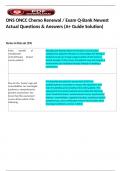
ONS ONCC Chemo Renewal / Exam Q-Bank Newest
Actual Questions & Answers (A+ Guide Solution)
Terms in this set (59)
Main benefit of Neoadjuvant therapy does not increase survival when
neoadjuvant compared to adjuvant therapy. It only changes the timing of
chemotherapy (breast treatment and can change surgical options if the tumor is
cancer patient) shrunk enough. If this occurs, the patient may only require a
lumpectomy plus radiation therapy instead of needing a
mastectomy
A comprehensive geriatric assessment (CGA) is a
Due to Mrs. Turner's age and
multidisciplinary evaluation to assess life expectancy and
comorbidities, her oncologist
risk of morbidity and mortality in the older patient. This
performs a comprehensive
assessment tool would evaluate and include the following
geriatric assessment. You
areas: functional status, socioeconomic issues, psychosocial
know that this assessment
distress, comorbidities, cognitive function, nutritional status,
covers all but which of the
polypharmacy, and a medication review (NCCN Older Adult
following:
Oncology Guidelines, version 1.2015).
,The NCCN Older Adult 65
Oncology Guidelines
(version 1.2015) provides
information on what is
included in a comprehensive
geriatric assessment.
Currently, more than 60% of
cancers in the United States
occur in people age
______and older and as the
oncology world ages, nearly
half (46%) of cancer survivors
are 70 years of age or older
Two of the agents (docetaxel and carboplatin) that
Mrs. Turner will receive are categorized as irritants. Docetaxel
can cause a significant reaction if it extravasates. It can lead to
edema, erythema, occasional pain and blister formation (ONS
What is your best Chemo/Bio guidelines, 2014). That is the most likely reason
explanation for why Mrs. that Mrs. Turner was given a port for her treatments. Some
Turner was given a port to patients will receive their treatments through a peripheral IV
receive her chemotherapy? without incident. Just because they are intravenous agents
does not mean that a port is required and needing a port has
nothing to do with her being older in age. Since none of
these agents are vesicants, they likely could have been given
safely via peripheral route but having a port placed is OK as
well.
, _____________can cause Irrirtants
inflammation, pain, and
burning but rarely cause
tissue necrosis comparable
to a vesicant (unless a large
amount or a very high
concentration of the irritant
is extravasated).
_____________can cause Vesicants
blistering and significant
pain and tissue damage
and destruction, leading to
tissue death.
A further classification of Non-DNA-binding solutions remain in the local area of the
an antineoplastic agent's extravasation, which improves the possibility of drug
potential to cause damage
deactivation.
is whether its mechanism
of action includes DNA DNA-binding agents attach to DNA nucleic acids, causing the
binding. antagonist to be ingested cellularly, leading to progressive
tissue destruction
DNA Binding Irritants Bendamustinea
Dactinomycin
Daunorubicin
Doxorubicin
Epirubicin
Idarubicin
Mechlorethamine
Mitomycin
Amsacrine
Paclitaxel
Vinblastine
DNA Nonbinding vessicants
Vincristine
Vindesine
Vinorelbine
Actual Questions & Answers (A+ Guide Solution)
Terms in this set (59)
Main benefit of Neoadjuvant therapy does not increase survival when
neoadjuvant compared to adjuvant therapy. It only changes the timing of
chemotherapy (breast treatment and can change surgical options if the tumor is
cancer patient) shrunk enough. If this occurs, the patient may only require a
lumpectomy plus radiation therapy instead of needing a
mastectomy
A comprehensive geriatric assessment (CGA) is a
Due to Mrs. Turner's age and
multidisciplinary evaluation to assess life expectancy and
comorbidities, her oncologist
risk of morbidity and mortality in the older patient. This
performs a comprehensive
assessment tool would evaluate and include the following
geriatric assessment. You
areas: functional status, socioeconomic issues, psychosocial
know that this assessment
distress, comorbidities, cognitive function, nutritional status,
covers all but which of the
polypharmacy, and a medication review (NCCN Older Adult
following:
Oncology Guidelines, version 1.2015).
,The NCCN Older Adult 65
Oncology Guidelines
(version 1.2015) provides
information on what is
included in a comprehensive
geriatric assessment.
Currently, more than 60% of
cancers in the United States
occur in people age
______and older and as the
oncology world ages, nearly
half (46%) of cancer survivors
are 70 years of age or older
Two of the agents (docetaxel and carboplatin) that
Mrs. Turner will receive are categorized as irritants. Docetaxel
can cause a significant reaction if it extravasates. It can lead to
edema, erythema, occasional pain and blister formation (ONS
What is your best Chemo/Bio guidelines, 2014). That is the most likely reason
explanation for why Mrs. that Mrs. Turner was given a port for her treatments. Some
Turner was given a port to patients will receive their treatments through a peripheral IV
receive her chemotherapy? without incident. Just because they are intravenous agents
does not mean that a port is required and needing a port has
nothing to do with her being older in age. Since none of
these agents are vesicants, they likely could have been given
safely via peripheral route but having a port placed is OK as
well.
, _____________can cause Irrirtants
inflammation, pain, and
burning but rarely cause
tissue necrosis comparable
to a vesicant (unless a large
amount or a very high
concentration of the irritant
is extravasated).
_____________can cause Vesicants
blistering and significant
pain and tissue damage
and destruction, leading to
tissue death.
A further classification of Non-DNA-binding solutions remain in the local area of the
an antineoplastic agent's extravasation, which improves the possibility of drug
potential to cause damage
deactivation.
is whether its mechanism
of action includes DNA DNA-binding agents attach to DNA nucleic acids, causing the
binding. antagonist to be ingested cellularly, leading to progressive
tissue destruction
DNA Binding Irritants Bendamustinea
Dactinomycin
Daunorubicin
Doxorubicin
Epirubicin
Idarubicin
Mechlorethamine
Mitomycin
Amsacrine
Paclitaxel
Vinblastine
DNA Nonbinding vessicants
Vincristine
Vindesine
Vinorelbine