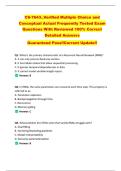
A patient begins taking nifedipine (Procardia), along with a beta blocker, to treat
hypertension. The nurse understands that the beta blocker is used to:
a.reduce flushing.
b.minimize gingival hyperplasia.
c.prevent constipation.
d.prevent reflex tachycardia.
Give this one a try later!
, d.prevent reflex tachycardia.
Beta blockers are combined with nifedipine to prevent reflex tachycardia.
Beta blockers do not reduce flushing, minimize gingival hyperplasia, or
prevent constipation. Beta blockers can reduce the adverse cardiac effects
of nifedipine.
When metronidazole (Flagyl) is a component of the H. pylori treatment regimen, the
patient must be instructed to do what?
a.Avoid any alcoholic beverages
b.Avoid foods containing tyramine
c.Take the drug on an empty stomach
d.Take the drug with food
Give this one a try later!
a.Avoid any alcoholic beverages
The patient should be instructed to avoid alcoholic beverages, because a
disulfiram-like reaction can occur if metronidazole is taken with alcohol.
Nothing indicates that the patient should avoid foods containing tyramine.
Metronidazole may be taken with or without food.
A nurse administers an ACE inhibitor to a patient who is taking the drug for the first
time. What will the nurse do?
a.Instruct the patient not to get up without assistance.
b.Make sure the patient takes a potassium supplement.
c.Report the presence of a dry cough to the prescriber.
d.Request an order for a diuretic to counter the side effects of the ACE inhibitor.
Give this one a try later!
, a.Instruct the patient not to get up without assistance.
Severe hypotension can result with the first dose of an ACE inhibitor. The
patient should be discouraged from getting up without assistance.
Potassium supplements are contraindicated. A dry cough is an expected
side effect that eventually may cause a patient to discontinue the drug;
however, it is not a contraindication to treatment. Diuretics can exacerbate
hypotension and should be discontinued temporarily when a patient starts
an ACE inhibitor.
A patient who recently started therapy with an HMG-COA reductase inhibitor asks the
nurse, "How long will it take until I see an effect on my LDL cholesterol?" The nurse
gives which correct answer?
a."At least 6 months is required to see a change."
b."A reduction usually is seen within 2 weeks."
c."Blood levels normalize immediately after the drug is started."
d."Cholesterol will not be affected, but triglycerides will fall within the first week."
Give this one a try later!
b."A reduction usually is seen within 2 weeks."
Reductions in LDL cholesterol are significant within 2 weeks and maximal
within 4 to 6 weeks. It does not take 6 months too see a change. The blood
level of LDL cholesterol is not reduced immediately upon starting the drug;
a reduction is seen within 2 weeks. Blood cholesterol is affected,
specifically LDL cholesterol, not triglycerides.
A patient who takes nonsteroidal anti-inflammatory drugs (NSAIDs) for arthritis asks a
nurse what can be done to prevent ulcers. The nurse will recommend asking the
provider about using which medication?
a.Antacids
b.Antibiotics
, c.Antisecretory agents
d.Mucosal protectants
Give this one a try later!
c.Antisecretory agents
Patients taking NSAIDs should use antisecretory agents for ulcer
prophylaxis. The other agents are not used for prophylaxis.
A patient has been taking warfarin (Coumadin) for atrial fibrillation. The provider has
ordered dabigatran etexilate (Pradaxa) to replace the warfarin. The nurse teaches the
patient about the change in drug regimen. Which statement by the patient indicates
understanding of the teaching?
a."I may need to adjust the dose of dabigatran after weaning off the warfarin."
b."I should continue to take the warfarin after beginning the dabigatran until my INR is
greater than 3."
c."I should stop taking the warfarin 3 days before starting the dabigatran."
d."I will stop taking the warfarin and will start taking the dabigatran when my INR is
less than 2."
Give this one a try later!
d."I will stop taking the warfarin and will start taking the dabigatran when
my INR is less than 2."
When switching from warfarin to dabigatran, patients should stop taking
the warfarin and begin taking the dabigatran when the INR is less than 2. It
is not correct to begin taking the dabigatran before stopping the warfarin.
While warfarin is stopped before beginning the dabigatran, the decision to
start taking the dabigatran is based on the patient's INR and not on the
amount of time that has elapsed.
hypertension. The nurse understands that the beta blocker is used to:
a.reduce flushing.
b.minimize gingival hyperplasia.
c.prevent constipation.
d.prevent reflex tachycardia.
Give this one a try later!
, d.prevent reflex tachycardia.
Beta blockers are combined with nifedipine to prevent reflex tachycardia.
Beta blockers do not reduce flushing, minimize gingival hyperplasia, or
prevent constipation. Beta blockers can reduce the adverse cardiac effects
of nifedipine.
When metronidazole (Flagyl) is a component of the H. pylori treatment regimen, the
patient must be instructed to do what?
a.Avoid any alcoholic beverages
b.Avoid foods containing tyramine
c.Take the drug on an empty stomach
d.Take the drug with food
Give this one a try later!
a.Avoid any alcoholic beverages
The patient should be instructed to avoid alcoholic beverages, because a
disulfiram-like reaction can occur if metronidazole is taken with alcohol.
Nothing indicates that the patient should avoid foods containing tyramine.
Metronidazole may be taken with or without food.
A nurse administers an ACE inhibitor to a patient who is taking the drug for the first
time. What will the nurse do?
a.Instruct the patient not to get up without assistance.
b.Make sure the patient takes a potassium supplement.
c.Report the presence of a dry cough to the prescriber.
d.Request an order for a diuretic to counter the side effects of the ACE inhibitor.
Give this one a try later!
, a.Instruct the patient not to get up without assistance.
Severe hypotension can result with the first dose of an ACE inhibitor. The
patient should be discouraged from getting up without assistance.
Potassium supplements are contraindicated. A dry cough is an expected
side effect that eventually may cause a patient to discontinue the drug;
however, it is not a contraindication to treatment. Diuretics can exacerbate
hypotension and should be discontinued temporarily when a patient starts
an ACE inhibitor.
A patient who recently started therapy with an HMG-COA reductase inhibitor asks the
nurse, "How long will it take until I see an effect on my LDL cholesterol?" The nurse
gives which correct answer?
a."At least 6 months is required to see a change."
b."A reduction usually is seen within 2 weeks."
c."Blood levels normalize immediately after the drug is started."
d."Cholesterol will not be affected, but triglycerides will fall within the first week."
Give this one a try later!
b."A reduction usually is seen within 2 weeks."
Reductions in LDL cholesterol are significant within 2 weeks and maximal
within 4 to 6 weeks. It does not take 6 months too see a change. The blood
level of LDL cholesterol is not reduced immediately upon starting the drug;
a reduction is seen within 2 weeks. Blood cholesterol is affected,
specifically LDL cholesterol, not triglycerides.
A patient who takes nonsteroidal anti-inflammatory drugs (NSAIDs) for arthritis asks a
nurse what can be done to prevent ulcers. The nurse will recommend asking the
provider about using which medication?
a.Antacids
b.Antibiotics
, c.Antisecretory agents
d.Mucosal protectants
Give this one a try later!
c.Antisecretory agents
Patients taking NSAIDs should use antisecretory agents for ulcer
prophylaxis. The other agents are not used for prophylaxis.
A patient has been taking warfarin (Coumadin) for atrial fibrillation. The provider has
ordered dabigatran etexilate (Pradaxa) to replace the warfarin. The nurse teaches the
patient about the change in drug regimen. Which statement by the patient indicates
understanding of the teaching?
a."I may need to adjust the dose of dabigatran after weaning off the warfarin."
b."I should continue to take the warfarin after beginning the dabigatran until my INR is
greater than 3."
c."I should stop taking the warfarin 3 days before starting the dabigatran."
d."I will stop taking the warfarin and will start taking the dabigatran when my INR is
less than 2."
Give this one a try later!
d."I will stop taking the warfarin and will start taking the dabigatran when
my INR is less than 2."
When switching from warfarin to dabigatran, patients should stop taking
the warfarin and begin taking the dabigatran when the INR is less than 2. It
is not correct to begin taking the dabigatran before stopping the warfarin.
While warfarin is stopped before beginning the dabigatran, the decision to
start taking the dabigatran is based on the patient's INR and not on the
amount of time that has elapsed.