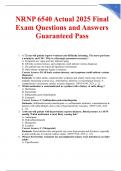
NRNP 6540 Final Exam /NRNP Week 12 Actual Final Exam 100 Questions & Correct Detailed Answers, Already Graded A+
NRNP 6540 Final Exam /NRNP Week 12 Actual Final Exam 100 Questions & Correct Detailed Answers, Already Graded A+,1. Mrs. Williams is 76 years old and comes in to have a wound checked on her right leg. She fell a month ago and the wound has not healed. She is concerned that something is wrong. The nurse practitioner examines the wound and sees that it has been cleaned properly and has no signs of infection. The edges are approximated, but the skin around the wound is red and tender to touch. The best response regarding Mrs. Williams' concern is: 1. Wound healing for older people may take up to four times longer than it does for younger people. 2. Let us talk about what you are eating. 3. Had you come in earlier, I would have ordered medicine that would have healed that right up. 4. I will order an antibiotic to prevent infection. - 1. Answer: 1 Page: 96 Feedback 1. Skin renewal turnover time increases to approximately 87 days in older adults, compared with 20 days during youth. 2. The perceived extended healing time is not related to diet. 3. This is false hope, as there is no medication that will heal this wound quickly. 4. Prophylactic antibiotics are not appropriate when there are no signs or symptoms of infection. 2. The nurse practitioner is conducting patient rounds in a long-term care facility. As she talks with Mrs. Jones, she notices that her arms and elbows are excoriated and the skin is shearing. The nurse practitioner explains to the staff that Mrs. Jones needs frequent assessment of her skin and protection provided to prevent skin breakdown because: 1. Her lack of activity causes the skin to tear. 2. Fat has redistributed to the abdomen and thighs, leaving bony surfaces in areas such as the face, hands, and sacrum. This can result in injury. 3. She has lost weight and is in jeopardy of falling. 4. She picks at herself and causes skin breakdown. - 2. Answer: 2 Page: 96 Feedback 1. Lack of activity alone does not cause skin breakdown. 2. Fat is redistributed to the abdomen and thighs, leaving bony surfaces, such as the face, hands, and sacrum, exposed to potential injury, especially skin tears from shearing, friction forces and pressure ulcer development. 3. Although losing weight may be a risk factor for falling, it is not directly related to skin breakdown. 4. There is no evidence that she is picking at herself, as there is nothing reported anywhere else on her arms. 3. Mr. James is 91 years old. His daughter notices that he has bruises and lacerations on his arms and reports this to the nurse practitioner, who tells her that older people bruise easily due to their fragile blood vessels. The skin lacerations happen because he has thin skin. Even so, the nurse practitioner assures the daughter that she will investigate further to ensure that he is getting proper care. She says this because she understands that: 1. These markings on the patient's skin are part of aging skin. 2. Bruises and lacerations can indicate inadequate care. 3. The daughter needs assurance that her father is okay. 4. The patient is being abused. - 3. Answer: 2 Page: 97 Feedback 1. Markings on the skin may be signs of aging, a disease, or maltreatment. 2. Poorly healing wounds or chronic pressure ulcers may signal a problem not only with the patient but with the caregiver's ability to provide adequate care. Welts, lacerations, burns, and distinctive markings may indicate a need for intervention. 3. This is a result of the nurse practitioner addressing it further rather than the reason for addressing it. 4. A professional cannot assume abuse without good reason. 4. The nurse practitioner assesses a patient's skin and finds an infectious lesion on the lower leg. The lesion is considered a secondary lesion. The nurse practitioner explains that a secondary lesion is one that: 1. Arises from changes to a primary lesion. 2. Is a complication of an underlying disease. 3. Is difficult to treat. 4. Is a normal sign of aging. - 4. Answer: 1 Page: 97 Feedback 1. Secondary lesions (infections) arise from changes to the primary lesion. 2. Secondary lesions are not necessarily the result of an underlying disease. 3. Secondary lesions can be treated with medications or surgery. 4. Secondary lesions arise as a condition not normal to aging. 5. Ms. Rose, 88 years old, comes to the nurse practitioner with a complaint about a growth on her hand. She wants to have a biopsy done. The nurse practitioner asks the following question: 1. Have you injured your hand recently? 2. Are you using a different detergent? 3. Has this growth changed, bled, or is it painful? 4. Has this growth made it difficult to put on your rings? - 5. Answer: 3 Page: 97 Feedback 1. An injury would not stimulate growth. 2. A reaction to a detergent would more likely be a rash. 3. Lesions that warrant biopsy are those that have changed, bleed, or are painful. 4. The ability to put on her ring is not the problem. 6. A 60-year-old male enters the burn center for triage and treatment due to a burn he received at a campfire. His left arm has an area that is erythematous and painful, and another area has a blister. What does the nurse practitioner record as the degree of burn? 1. First degree 2. Second degree 3. First and second degree 4. Second and third degree - 6. Answer: 3 Page: 98 Feedback 1. First-degree burns involving the epidermis are erythematous and painful but do not blister. 2. Second-degree burns involve the dermis and are characterized by blisters. 3. The patient presents with erythematous skin, painful with blisters, which indicates both first- and second-degree burn areas. 4. In third-degree burns there is no sensation when the wound is pinpricked. 7. The nurse practitioner is concerned with primary prevention strategies. How can the nurse practitioner implement primary prevention strategies for an 80-year-old male patient who smokes? 1. Review home fire safety protocols, including the proper use of smoke alarms, and discuss smoking cessation. 2. Inform him that if he does not stop smoking, the nurse practitioner cannot see him again. 3. Have a conference with his family about his smoking. 4. Plan a family meeting with the patient to discuss benefits of his smoking cessation. - 7. Answer: 1 Page: 115, 116 Feedback 1. Primary prevention includes educational programs designed to educate the public on safety. For example, the individual smoking in bed would hopefully benefit from smoking cessation programs in the community, as well as instruction in safety precautions. 2. Threatening refusal of care is not ethical. 3. The patient is at risk, not the family. 4. The fact that the patient smokes is not the issue; safety is the issue. 8. The nurse practitioner is conducting a safety class with community-living older adults. Which of the following should she include in her teaching of risks of burns for this population? Select all that apply. 1. Thinner skin. 2. Less vascularity. 3. Diminished nerve function. 4. A weakened immune system. 5. The burden of various comorbidities leading to enhanced wound healing and reepithelialization after burn injury. - 8. Answer: 1, 2, 3, 4 Page: 98 Feedback 1. As one ages, there are significant changes in the skin, which becomes thinner, providing a less effective barrier to external stimuli. 2. With aging, there are fewer appendages and decreased vascularity. 3. Thinner skin and diminished nerve function often result in a higher incidence of deeper burns. 4. Advanced age results in a weakened immune system. 5. Along with the burden of various comorbidities, the fragility of older skin leads to delayed wound healing and reepithelialization after burn injury.
Escuela, estudio y materia
- Institución
- NRNP 6540
- Grado
- NRNP 6540
Información del documento
- Subido en
- 11 de marzo de 2025
- Número de páginas
- 103
- Escrito en
- 2024/2025
- Tipo
- Examen
- Contiene
- Preguntas y respuestas
Temas
- nrnp 6540 final exam
- nrnp 6540
-
nrnp 6540 final exam nrnp week 12 actual final ex