
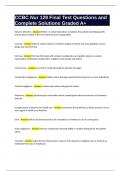
CCBC Nur 129 Final Test Questions and
Complete Solutions Graded A+
Advance Directive - Answer: Written or verbal instructions created by the patient describing specific
wishes about medical in the event they become incapacitated
Case law - Answer: body of written opinions created by judges in federal and state appellate courses
(judge law/common law)
Civil Law - Answer: Tort law that deals with conduct considered unacceptable. Based on societal
expectations. professional malpractice, negligence and assault and battery
Common law - Answer: Law that is created through the decision of judges
Comparative Negligence - Answer: liability where damages apportioned among two or more defendants
Criminal negligence - Answer: reckless and wanton disregard for safety
Disclosure - Answer: physician gives information about unanticipated adverse outcomes of treatment
and care
Durable power of attorney for health care - Answer: instrument that authorizes another person to act as
one's agent in health care decisions
Error - Answer: failure of planned action to be completed as intended or use of a wrong plan
Gross negligence - Answer: Extreme carelessness showing willful or reckless disregard for the patient
safety
Immunity - Answer: Legal doctrine that protects a person from lawsuit or negligent acts or protects an
institution from acts of employees
, Liability - Answer: Legally responsible for harm caused to another person or property as a result of one's
actions
Licensing laws - Answer: laws that establish qualifications for obtaining and maintaining a licsen
Malpractice - Answer: Failure of a professional to meet standards of conduct that a reasonable and
prudent member of the profession would do
Negligence - Answer: Failure to act in a manner that an ordinary, prudent person would act in a similar
situation
Preventable adverse event - Answer: injury caused by medical management rather than the patient's
underlying condition
Punitive damages - Answer: monetary compensation that goes beyond that which is needed to
compensate for losses, intended to punish the wrongdoer
Res ipsa loquitur - Answer: provider had exclusive control of events that resulted in injury, "the thing
speaks for itself"
Sentinel event - Answer: Joint commission, unintended adverse event that results in death, paralysis,
loss of function
Standard of care - Answer: in civil cases, the legal criteria against which the nurse conduct is compared
to
Statutory law - Answer: law enacted by a legislative body
Strict liability - Answer: sometimes referred to as absolute liability, can be imposed on a person or entity
without proof of carelessness or negligence
Complete Solutions Graded A+
Advance Directive - Answer: Written or verbal instructions created by the patient describing specific
wishes about medical in the event they become incapacitated
Case law - Answer: body of written opinions created by judges in federal and state appellate courses
(judge law/common law)
Civil Law - Answer: Tort law that deals with conduct considered unacceptable. Based on societal
expectations. professional malpractice, negligence and assault and battery
Common law - Answer: Law that is created through the decision of judges
Comparative Negligence - Answer: liability where damages apportioned among two or more defendants
Criminal negligence - Answer: reckless and wanton disregard for safety
Disclosure - Answer: physician gives information about unanticipated adverse outcomes of treatment
and care
Durable power of attorney for health care - Answer: instrument that authorizes another person to act as
one's agent in health care decisions
Error - Answer: failure of planned action to be completed as intended or use of a wrong plan
Gross negligence - Answer: Extreme carelessness showing willful or reckless disregard for the patient
safety
Immunity - Answer: Legal doctrine that protects a person from lawsuit or negligent acts or protects an
institution from acts of employees
, Liability - Answer: Legally responsible for harm caused to another person or property as a result of one's
actions
Licensing laws - Answer: laws that establish qualifications for obtaining and maintaining a licsen
Malpractice - Answer: Failure of a professional to meet standards of conduct that a reasonable and
prudent member of the profession would do
Negligence - Answer: Failure to act in a manner that an ordinary, prudent person would act in a similar
situation
Preventable adverse event - Answer: injury caused by medical management rather than the patient's
underlying condition
Punitive damages - Answer: monetary compensation that goes beyond that which is needed to
compensate for losses, intended to punish the wrongdoer
Res ipsa loquitur - Answer: provider had exclusive control of events that resulted in injury, "the thing
speaks for itself"
Sentinel event - Answer: Joint commission, unintended adverse event that results in death, paralysis,
loss of function
Standard of care - Answer: in civil cases, the legal criteria against which the nurse conduct is compared
to
Statutory law - Answer: law enacted by a legislative body
Strict liability - Answer: sometimes referred to as absolute liability, can be imposed on a person or entity
without proof of carelessness or negligence

