

Written by students who passed Immediately available after payment Read online or as PDF Wrong document? Swap it for free 4.6 TrustPilot
logo-home
Document preview thumbnail
Preview 4 out of 150 pages
Exam (elaborations)

NR546 Final Exam

Document preview thumbnail
Preview 4 out of 150 pages

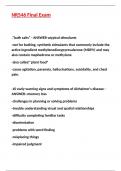
NR546 Final Exam ."bath salts" - ANSWER-atypical stimulants -not for bathing, synthetic stimulants that commonly include the active ingredient methylenedioxypyrovalerone (MDPV) and may also contain mephedrone or methylone -also called "plant food" -cause agitation, paranoia, hallucinations, suicidality, and chest pain. .10 early warning signs and symptoms of Alzheimer's disease - ANSWER--memory loss -challenges in planning or solving problems -trouble understanding visual and spatial relationships -difficulty completing familiar tasks -disorientation -problems with word finding -misplacing things -impaired judgment -social withdrawal -changes in mood .5HT, NE Dysfunction causes what mood related symptoms - ANSWER-Increased negative affect: depressed mood guilt fear/anxiety hostility irritability loneliness appetite changes .90% of serotonin receptors are in the __________ and _________ are within the brain - ANSWER-GI tract, only 10% *which causes GI side effects .A 27-year-old bartender was diagnosed with ADHD at age 10. She has been on and off medication since then, first on immediate-release methylphenidate, then on the methylphenidate patch. She experimented with illicit drugs during her late adolescence and is still a heavy drinker. After a few years of self-medication with alcohol and cigarettes, she is seeking medical attention again. You decide to put her on 80 mg/day of atomoxetine, one of the non-stimulant medications effective in ADHD. Why does atomoxetine lack abuse potential? - ANSWER-It increases dopamine levels in the prefrontal cortex but not in the nucleus accumbens. Rationale: The prefrontal cortex lacks high concentrations of dopamine transporters (DAT), so in this brain region, DA gets inactivated by norepinephrine transporters (NET). Therefore, inhibiting NET in the prefrontal cortex increases both DA and NE. As only a few NET exist in the nucleus accumbens, atomoxetine does not induce an increase in DA and NE in the nucleus accumbens, the reward center of the brain, thus atomoxetine does not have abuse potential.​ In the nucleus accumbens, there are only a few NE neurons and NE transporters. Inhibiting NET in the nucleus accumbens will not lead to an increase in NE or DA. Atomoxetine does not modulate serotonin levels. The striatum and the anterior cingulate cortex are not brain areas involved in reward. .A 40-year-old male presents to your emergency department (ED) with severe anxiety, generalized tremors, complaints of dizziness, diaphoresis, and agitation. He was incarcerated 2 days ago and is brought to the ED today by the police due to the development of acute symptoms. His social history is significant for heavy alcohol use. A Clinical Institutes Withdrawal Assessment Scale for Alcohol (CIWA) score is 39. The client tells you he has had withdrawal seizures in the past when he stops drinking. Which medication should you order? - ANSWER-lorazepam (Ativan) Rationale: Benzodiazepines are the first-line treatment for clients having psychomotor agitation associated with alcohol withdrawal. This client has an increased risk of an alcohol-related withdrawal seizure, especially since he had one in the past. carbamazepine, levetiracetam, and phenytoin are not routinely used for alcohol withdrawal due to the lack of evidence demonstrating increased efficacy. Additionally, these drugs may potentially mask hemodynamic signs of withdrawal. .A client diagnosed with Alzheimer's disease has decided to stop treatment. The nurse practitioner (NP) has educated the client that medication discontinuation will result in the return of cognitive symptoms and the medication may not work as well if restarted. The client would still like to stop the medication due to the gastrointestinal side effects. Which of the following medications requires tapering? rivastigmine donepezil galantamine - ANSWER-donepezil .A common cause of insomnia is ____________ - ANSWER-restless legs syndrome (RLS) .Acamprosate (Campral) - ANSWER-INDICATION -maintenance of alcohol abstinence PRIOR TESTS -None for healthy individuals -Patient should begin treatment ASAP after achieving abstinence derivative of the amino acid taurine and interacts with both the glutamate system to inhibit it, and with the GABA system to enhance it -"artificial alcohol" -can substitute for alcohol in patients during withdrawal *mitigate the glutamate hyperactivity and the GABA deficiency .Acute agitation in mania may be treated with: - ANSWER-rapid-acting oral, inhaled, or IM antimanic agents .Acute withdrawal symptoms after narcan - ANSWER-nausea/vomiting diarrhea runny nose sweating tremor irritability muscle spasms .AD meds: Lifespan Considerations - ANSWER-Cholinesterase inhibitors are not recommended in pregnancy and lactation .AD: Treating Psychiatric and Behavioral Symptoms - ANSWER-first-line pharmacologic treatment of aggression and agitation in dementia is SSRI/SNRI therapy. -often treated with antipsychotic medication binding at the receptor site. • not FDA approved for dementia treatment due to risks for mortality and cardiovascular side effects .Addiction - ANSWER-A change in behavior caused by biochemical changes in the brain after continued substance use characterized by preoccupation with and repeated use of a substance despite negative outcomes. .ADHD and Comorbidities tx order: - ANSWER-1. alcohol/stimulant/substance abuse 2. mood disorders 3. anxiety disorders 4. ADHD Children and adolescents 1. Nicotine dependence 2. ADHD .ADHD lifespan considerations - ANSWER--Symptoms change with age. -Not only a childhood diagnosis -Hyperactivity decreases markedly with age -Primary Symptoms: inattention, restlessness, cognitive & emotional impulsivity, executive functioning deficits, and self-regulation -Adults struggling with executive functioning difficulties and disorganization may experience occupational stress or anxiety. .ADHD Lifespan Considerations: Breastfeeding - ANSWER-Stimulants are not recommended while breastfeeding. .ADHD Lifespan Considerations: Children - ANSWER--ADHD medications are not approved for children under 6. -Consider short-acting medications for children who have significant appetite loss or are underweight; this may improve appetite for lunch and dinner. .ADHD Lifespan Considerations: Pregnancy - ANSWER-Stimulants may cause fetal harm including increases in low birth weight and pregnancy. .ADHD Patient Education - ANSWER--Common side effects include restlessness, irritability, anxiety, insomnia, stomachache, headaches, tics, and worsening of aggression symptoms.​ -Clients may note a worsening of symptoms, or "crash" when the medication wears off, especially with immediate-release (IR) medications.​ -Medications may cause appetite changes and subsequent weight loss. • Take medication with breakfast to decrease anorexia. .ADHD Prescribing Pearls - ANSWER--Before initiation of any stimulant, obtain thorough health history. -Assess for a personal or family history of cardiac disease • EKG is required if cardiac history is present in a first-degree relative -BP, height, & weight should be monitored regularly during tx -CNS stimulants may cause psychotic or manic symptoms in clients with no prior hx or may exacerbate behavior disturbance symptoms and thought disorders in clients with pre-existing psychosis -Assess all clients for bipolar disorder before tx -CNS stimulants may exacerbate comorbid anxiety & substance use disorders. -Tx efficacy will be noted within the first week of tx -Increased irritability and insomnia can be treated with a low dose of non-stimulant medication which will allow the client to fall asleep. -Abrupt withdrawal after prolonged use can result in irritability and rebound symptoms -Stimulants can cause or worsen tics; stimulants may unmask the presence of tics -When switching stimulants, D/C the current med & start the new med at a starting dose the next day -Stimulant meds available to treat ADHD are available as immediate-release or sustained-release formulations -Short-acting medications are at higher risk for diversion. Careful monitoring is required. Occasional urine drug screens should be obtained to verify the presence of amphetamines and the absence of other substances of abuse. .ADHD Symptoms: - ANSWER-Typically start before age 12, may begin to appear early as 3: -Selective Attention • lack of attention to detail • careless mistakes • not listening • losing things • diverting attention • forgetfulness -Lack of Sustained Attention • poor problem solving • difficulty completing tasks • disorganization • difficulty sustaining mental effort -Impulsivity • excessive talking • blurting things out • not waiting one's turn • interrupting -Hyperactivity • fidgeting • leaving one's seat • running, climbing • trouble playing quietly *Symptoms related to attention usually develop 2-4 years after the emergence of hyperactive symptoms in childhood .Adjunct treatment for depression - ANSWER-Antipsychotic medications are sometimes prescribed at low doses as adjunctive medications for severe depression .adverse effects associated with the acute use of opioids: - ANSWER--Itching -Constipation -Respiratory depression -Urinary retention -Sedation .After 3 months, Cora's mom reports that her irritability has decreased somewhat with the implementation of the extended-release methylphenidate, but her teacher notes that she remains argumentative and oppositional at times. Her appetite remains good, but she is having difficulty sleeping. Which of the following medication changes might you consider at this time for Cora? - ANSWER-add guanfacine 1mg daily Rationale: While methylphenidate is somewhat effective for Cora, her irritability and ADHD may be better controlled by adding a non-stimulant medication, such as guanfacine, to her daily medication regimen. Guanfacine taken at bedtime may also help with sleep. .Alcohol special considerations of lifespan and lifestyle factors that are foundational to safe prescribing: Older adult - ANSWER--Frequent monitoring is necessary when prescribing benzodiazepines for alcohol withdrawal in older adults. -Acamprosate should be used with caution in older adults. .Alcohol special considerations of lifespan and lifestyle factors that are foundational to safe prescribing: Pregnancy - ANSWER--Teratogenic effects of alcohol on the developing fetus are well known; however, there is limited data on the safety of withdrawal medications in pregnancy. -Naltrexone is commonly used to treat alcohol use disorder in pregnant women, but its effects on the fetus remain largely unknown. -Acamprosate is not recommended in pregnancy but may be necessary if the mother cannot stop drinking alcohol. -Disulfiram's safety in pregnancy is not established. .Alcohol Use Disorder - ANSWER--may affect cardiovascular health and is associated with an increased risk of several types of cancer (especially, liver and pancreatic) -Other system morbidities: diabetes, gout, renal dysfunction, hematological complications, osteoporosis, and dementia -frequently associated with trauma and accidents .Alpha-1 adrenergic effects - ANSWER-Orthostatic hypotension .Alzheimer's disease (AD) - ANSWER-progressive, irreversible, memory loss and decreasing brain function -most common type of dementia -70% of all cases -no cure • treatment may alter disease progression and reduce symptoms .amphetamine (Adzenys) (D,L) - ANSWER-INDICATION -ADHD (ages 6+) Mechanism of Action -Increases norepinephrine and especially dopamine actions by blocking their reuptake and facilitating their release Starting Dose -ER oral suspension in peds: initial 6.3 mg in AM -ER ODT in ADHD: initial 6.3 mg in AM -ER capsule in adult: initial 12.5 mg PEARLS -Avoid prescribing when an MAOI has been used within 14 days. -Substrate for CYP450 2D6 .Anticholinergic effects - ANSWER-Dry mouth Blurred vision Urinary retention Constipation .Antidepressants are used cautiously in clients with bipolar disorder and never as ________________. - ANSWER-monotherapy -Antidepressants should be combined with a mood stabilizer to prevent the onset of a hypomanic or manic episode .Antidepressants Important Prescribing Considerations: Black Box Warning - ANSWER-Suicide Risk with Antidepressant Drugs -Clients with depression may consider or attempt suicide -risk for suicide may increase at the start of treatment -Antidepressant-induced suicide is more prevalent in children, adolescents, and adults younger than 25 years. .Antidepressants Important Prescribing Considerations: Drug-Drug Interactions - ANSWER-Most antidepressant medications have serious drug-drug interactions. Carefully review the client's history and current prescriptions before selecting a medication. .Antidepressants Important Prescribing Considerations: Serotonin Syndrome - ANSWER-potentially life-threatening condition reported with the use of serotonergic antidepressants -especially when they are used concomitantly with other serotonergic drugs (such as triptans, tricyclic antidepressants, fentanyl, lithium, tramadol, tryptophan, buspirone, and St. John's Wort), and with drugs that impair serotonin metabolism (particularly MAOIs) S/S -mental status changes (e.g., agitation, hallucinations, delirium, and coma) -autonomic instability (e.g., tachycardia, labile blood pressure, dizziness, diaphoresis, flushing, hyperthermia) -neuromuscular symptoms (e.g., tremor, rigidity, myoclonus, hyperreflexia, incoordination) -seizures, and/or gastrointestinal symptoms (e.g., nausea, vomiting, diarrhea) If such symptoms occur, clients should discontinue serotonergic agents and initiate treatment of symptoms. Clients should be educated about the signs and symptoms of serotonin syndrome and monitored -particularly during treatment initiation and dose increases. .Antidepressants Lifespan Considerations: Breastfeeding - ANSWER-Infant irritability should be monitored when SNRIs are prescribed. .Antidepressants Lifespan Considerations: Children - ANSWER-Antidepressants increase the risk of death by suicide in children and adults younger than 25. .Antidepressants Lifespan Considerations: Older Adult - ANSWER--Older adults may not respond to antidepressants as robustly as younger people if the first episode of depression occurs after age 65. -Citalopram and escitalopram should be dosed at 1/2 dose due to the risk of QTc prolongation. -2019 American Geriatric Society (AGS) Beers Criteria include the following recommendations: • Avoid paroxetine in clients with a history of falls/fractures. • Avoid tricyclic antidepressants prescribed with other central nervous system (CNS) depressants. .Antidepressants Lifespan Considerations: Pregnancy - ANSWER-Paroxetine is contraindicated in pregnancy due to the risk of congenital defects, including atrial septal defects. .Antidepressants: Discontinuing Medications - ANSWER-Don't suddenly stop or omit doses due to risk of discontinuation syndrome -Paroxetine highest risk due to serotonin transporter inhibition and anticholinergic rebound -If a treatment course has lasted 8 weeks, discontinuation over 1-2 weeks is safe. Once symptoms are in remission, continue treatment for 4-9 months to reduce the risk of relapse .Antidepressants: Initiating Medication - ANSWER-Start clients on a single drug for 4-8 weeks to assess efficacy. Start with the lowest recommended dose to reduce side effects. If a medication is not achieving efficacy: -Increase the dose gradually to the efficacious dose range. -Switch to a different drug within the same class after an adequate trial which includes higher dosing and a minimum of eight weeks of trial. -Switch to a drug in a different class after an adequate trial which includes higher dosing and a minimum of eight weeks of trial. -Add a second medication as an adjunct. .Apathy - ANSWER-diminished motivation and reduced goal-directed behavior, accompanied by decreased emotional responsiveness -lack of motivation is at the core of apathy -affects approximately 90% of patients with dementia -one of the most persistent and frequent secondary behavioral symptoms of dementia -shown to predict disease-worsening -if med needed for apathy: cholinesterase inhibitors are first-line in AD, FTD patients may benefit more from SSRI's/SNRI's .appropriate medication to each client: John is a 56-year-old with a history of seizure disorder who has smoked 1 pack-per-day (PPD) for 30 years. He has tried to quit using nicotine gum without success. He is committed to quitting smoking but feels he would benefit from medication to help - ANSWER-varenicline Varenicline is an appropriate medication option for clients who want to quit using tobacco products. Bupropion is contraindicated in clients with seizure disorder. .Atomoxetine - ANSWER-INDICATION -ADHD (ages 6+) Mechanism of Action -Blocks norepinephrine reuptake pumps, may also increase dopamine in PFC Starting dose -For children 70 kg or less: initial dose 0.5 mg/kg per day -For adults and children over 70 kg: initial dose 40 mg/day Side Effects -Sedation, fatigue , decreased appetite, priapism (rare), hypotension .Bipolar disorder (BD) - ANSWER-Chronic condition characterized by extreme fluctuations in mood, energy, and ability to function -Moods may be manic, hypomanic, or depressed and may include mixed mood or psychotic features -many have only experienced only one manic episode in their lifetime -Mood fluctuations may be separated by periods of high stability or may cycle rapidly -diagnosed when a client has one or more episodes of mania or hypomania with a history of one or more major depressive episodes -high risk for suicide .Bipolar Type I: - ANSWER-requires at least one episode of mania for at least one week (or any duration if hospitalization due to symptoms is required) .Bipolar Type II: - ANSWER-diagnosis requires a current or past hypomanic episode and a current or past major depressive episode. Symptoms last for at least 4 days but fewer than seven. -Hypomanic symptoms are not of sufficient duration or severity to cause significant functional impairment, psychosis, or hospitalization. -Anger and irritability are common. -Clients often enjoy the elevation of mood and are reluctant to report these symptoms, making bipolar more difficult to diagnose if the client presents in the depression phase. .Buprenorphine (Subutex) - ANSWER-INDICATION -Maintenance tx of opioid dependence -Opioid use disorder PRIOR TESTS -Liver function tests at baseline and during treatment EDUCATION -must be in a mild withdrawal state prior to starting -Allow sublingual form to dissolve under tongue completely Side effects -respiratory depression -hepatotoxicity -hypotension -implant: insertion site pain, pruritis, erythema PEARLS -Metabolized by CYP450 3A4 -Buprenorphine alone is often used to initiate treatment .Buprenorphine/Naloxone (Suboxone, Zubsolv, Bunavail) - ANSWER-INDICATION -Maintenance tx of opioid dependence -Opioid use disorder PRIOR TESTS -Liver function tests at baseline and during treatment CONTRAINDICATION -severe hepatic impairment PEARLS -buprenorphine/ naloxone is preferred for stabilization and maintenance treatment -Buprenorphine can be prescribed in combination with naloxone (Suboxone) to decrease the potential for abuse or diversion .bupropion (Wellbutrin) ​ - ANSWER-INDICATION -MDD -Seasonal affective disorder -Nicotine addiction -off-label use for ADHD in adults -appropriate for clients with concurrent depression or tobacco abuse Mechanism of action -NDRI (norepinephrine and dopamine reuptake inhibitor); Boosts neurotransmitters norepinephrine/ noradrenaline and dopamine Side effects -dry mouth, nausea, weight loss, myalgia, insomnia, h/a, anxiety, tinnitus, sweating, rash, hypertension, seizures (rare), stevens-johnson syndrom, hypomania PEARLS -Inhibits CYP450 2D6 -Use cautiously with other drugs that increase seizure risk (TCAs, lithium, phenothiazines, thioxanthenes, some antipsychotics) -Dont use if patient is anorexic or bulimic -NDRI may improve energy, alertness, and motivation; -not first-line treatment for anxiety; -contraindicated in clients with a history of seizures .carbemazepine (Tegretol) - ANSWER-INDICATION -Seizures -Pain associated with true tigeminal neuralgia -Acute mania/mixed mania ACTION -glutamate voltage gated sodium and calcium channel blocker (Glu-CB)

Content preview

NR546 Final Exam


."bath salts" - ANSWER-atypical stimulants
-not for bathing, synthetic stimulants that commonly include the
active ingredient methylenedioxypyrovalerone (MDPV) and may
also contain mephedrone or methylone
-also called "plant food"
-cause agitation, paranoia, hallucinations, suicidality, and chest
pain.


.10 early warning signs and symptoms of Alzheimer's disease -
ANSWER--memory loss
-challenges in planning or solving problems
-trouble understanding visual and spatial relationships
-difficulty completing familiar tasks
-disorientation
-problems with word finding
-misplacing things
-impaired judgment

,-social withdrawal
-changes in mood


.5HT, NE Dysfunction causes what mood related symptoms -
ANSWER-Increased negative affect:
depressed mood
guilt
fear/anxiety
hostility
irritability
loneliness
appetite changes


.90% of serotonin receptors are in the __________ and _________
are within the brain - ANSWER-GI tract, only 10%
*which causes GI side effects


.A 27-year-old bartender was diagnosed with ADHD at age 10. She
has been on and off medication since then, first on immediate-
release methylphenidate, then on the methylphenidate patch. She
experimented with illicit drugs during her late adolescence and is

,still a heavy drinker. After a few years of self-medication with
alcohol and cigarettes, she is seeking medical attention again. You
decide to put her on 80 mg/day of atomoxetine, one of the non-
stimulant medications effective in ADHD.
Why does atomoxetine lack abuse potential? - ANSWER-It
increases dopamine levels in the prefrontal cortex but not in the
nucleus accumbens.


Rationale: The prefrontal cortex lacks high concentrations of
dopamine transporters (DAT), so in this brain region, DA gets
inactivated by norepinephrine transporters (NET). Therefore,
inhibiting NET in the prefrontal cortex increases both DA and NE.
As only a few NET exist in the nucleus accumbens, atomoxetine
does not induce an increase in DA and NE in the nucleus
accumbens, the reward center of the brain, thus atomoxetine
does not have abuse potential.
In the nucleus accumbens, there are only a few NE neurons and
NE transporters. Inhibiting NET in the nucleus accumbens will not
lead to an increase in NE or DA. Atomoxetine does not modulate
serotonin levels. The striatum and the anterior cingulate cortex
are not brain areas involved in reward.


.A 40-year-old male presents to your emergency department (ED)
with severe anxiety, generalized tremors, complaints of dizziness,

, diaphoresis, and agitation. He was incarcerated 2 days ago and is
brought to the ED today by the police due to the development of
acute symptoms. His social history is significant for heavy alcohol
use. A Clinical Institutes Withdrawal Assessment Scale for Alcohol
(CIWA) score is 39.
The client tells you he has had withdrawal seizures in the past
when he stops drinking. Which medication should you order? -
ANSWER-lorazepam (Ativan)


Rationale: Benzodiazepines are the first-line treatment for clients
having psychomotor agitation associated with alcohol withdrawal.
This client has an increased risk of an alcohol-related withdrawal
seizure, especially since he had one in the past. carbamazepine,
levetiracetam, and phenytoin are not routinely used for alcohol
withdrawal due to the lack of evidence demonstrating increased
efficacy. Additionally, these drugs may potentially mask
hemodynamic signs of withdrawal.


.A client diagnosed with Alzheimer's disease has decided to stop
treatment. The nurse practitioner (NP) has educated the client
that medication discontinuation will result in the return of
cognitive symptoms and the medication may not work as well if
restarted. The client would still like to stop the medication due to
the gastrointestinal side effects. Which of the following


Document information

Uploaded on
March 10, 2025
Number of pages
150
Written in
2024/2025
Type
Exam (elaborations)
Contains
Questions & answers
$10.99

Wrong document? Swap it for free Within 14 days of purchase and before downloading, you can choose a different document. You can simply spend the amount again.
Written by students who passed
Immediately available after payment
Read online or as PDF

Seller avatar
Reputation scores are based on the amount of documents a seller has sold for a fee and the reviews they have received for those documents. There are three levels: Bronze, Silver and Gold. The better the reputation, the more your can rely on the quality of the sellers work.
Docwyne6
3.5
(6)
Sold
33
Followers
11
Items
1701
Last sold
2 weeks ago


Why students choose Stuvia

Created by fellow students, verified by reviews

Quality you can trust: written by students who passed their tests and reviewed by others who've used these notes.

Didn't get what you expected? Choose another document

No worries! You can instantly pick a different document that better fits what you're looking for.

Pay as you like, start learning right away

No subscription, no commitments. Pay the way you're used to via credit card and download your PDF document instantly.

Student with book image

“Bought, downloaded, and aced it. It really can be that simple.”

Alisha Student

Working on your references?

Create accurate citations in APA, MLA and Harvard with our free citation generator.

Working on your references?

Frequently asked questions
