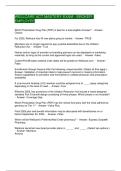
Infection prevention certification Exam Question & Answers 2024/2025
Infection prevention certification Exam Question & Answers 2024/2025 What's the primary purpose of an infection prevention and control policy - ANSWER-To instruct staff on how to protect both themselves and residents from developing a healthcare associated infection How does an infection prevention and control program benefit nursing homes - ANSWER-Helps prevent pathogen transmission and protects residents and staff from developing infections What is the primary purpose of the facility infection prevention and control risk assessment - ANSWER-To set priorities and goals for preventing infections and improving resident outcomes Which of the following are core activities of an IPC program? - ANSWER-A. performing infection surveillance. B. Identifying recording, and collecting IPC incidents. D. Conducting an annual review and update based on IPC risk assessments. What is an IPC policy? - ANSWER-An IPC policy defines and provides evidence and rationale for a required IPC practice, including guidance about practice implementation What is an IPC procedure? - ANSWER-An IPC procedure outlines the specific steps or actions for performing an IPC practice What are your first two resources? - ANSWER-CDC infection control website and CDC infection control guidelines library The language, "steps to clean and disinfect a blood glucose meter " fits best in which content section of a IPC policy and procedure? - ANSWER-Procedure The language, all staff, who insert or handle indwelling urinary catheter's fits best in which Contant section of an IPC policy and procedure? - ANSWER-Responsibility You are assessing your facilities readiness to prevent C diff, infections as part of your IPC risk assessment. Which of the following factors would influence your score in this category? - ANSWER-Availability of gowns and gloves, and the process to monitor antibiotic use Which of the following is a best practice for policy development? - ANSWER-Revise policy when standards or practices change. Review annually for clinical relevance. Allow staff review and feedback. The risk for developing an infection, or transmitting pathogens are based on which of the following - ANSWER-Adhering to IPC policies and procedures. Population served. Care and service provided. Infections that are occurring in the community. Which of the following are considerations when scoring the risk of an infection event on the IPC risk assessment - ANSWER-Probability of occurrence. Level of harm. Readiness to prevent. Which of the following are reasons for conducting an annual IPC risk assessment in nursing homes - ANSWER-Assessing potential infection risks to prevent resident harm. Prioritizing area of focus for IPC program. Allocating resources to support IPC performance improvement activities. After you have scored the risk assessment which of the following actions, would you take first to address the findings - ANSWER-Identify high scoring items for IPC program prioritization Which of the following best describes the primary role of the infection prevention is in a nursing home - ANSWER-Leading the infection, prevention and control program True or false individual or individuals designated as a nursing homes infection preventionist may work at a corporate location and handle all infection prevention and control responsibilities remotely - ANSWER-False Which of the following are considered important skills of an effective infection prevention list - ANSWER-Critical thinking. Data interpretation. Communication. All of the above. All of the above. Epidemiology - ANSWER-is the study of the distribution and determinants of health-related states or events in specified populations an application of this knowledge to the control of health problems Surveillance - ANSWER-is the ongoing systematic collection, analysis, interpretation, and dissemination of data. It is conduct into identify infections in monitor performance of ABC practices to reduce infection risk and prevent spread of pathogens in my residence staff and visitors. Common infectious diseases - ANSWER-Infections occur because a pathogen such as a bacteria, virus or fungus is able to invade a susceptible host in cause clinical disease Pathogen transmission - ANSWER-The transmission of infectious agents or pathogens within a nursing home, requires three elements, a source or reservoir of infectious agents with a portal of exit for the agent, susceptible host with a portal of entry, receptive to the agent, and a motor transmission for the infectious agent Diagnosis of infectious disease - ANSWER-Culture-based diagnostic tests. Nucleic acid amplification, diagnostic tests, (NAAT) polymerase chain reaction tests. (PCR) Antimicrobials - ANSWER-Are drugs used to treat infections Which of the following is not a consideration when interpreting diagnostic test results? - ANSWER-Cost of the diagnostic test Five skills needed to effectively perform as an IP - ANSWER-Communicator, Leader, educator, critical thinker, and data, interpreter, and collaborator Which role is an IP showing when he or she adapts information to address different backgrounds and learning needs - ANSWER-Educator Which role is an IP demonstrating when he or she advocates for IPC program - ANSWER-A liter Which of the following are true statements about the QIN-QIO program? - ANSWER-Provides consultation services to nursing homes at no cost. Works with nursing homes on variety of IPC program projects. Continues...
Escuela, estudio y materia
- Institución
- Infection prevention certification
- Grado
- Infection prevention certification
Información del documento
- Subido en
- 10 de marzo de 2025
- Número de páginas
- 17
- Escrito en
- 2024/2025
- Tipo
- Examen
- Contiene
- Preguntas y respuestas
Temas
- 2024
- 2025
- nursing homes
- epidemiology
- surveillance
- pathogen
- pathogen transmission
-
antimicrobials
-
infection prevention certification
-
infection prevention and control policy
-
common infectious diseases