ATI TEAS 7: Reading
Study online at https://quizlet.com/_fcw56l
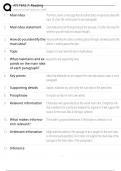
1. Main idea The thesis, claim, or message that an author states or expresses about the
topic of a text; the central point in each paragraph.
2. Main idea statement Generally placed at the beginning of the passage; it is often the very first
sentence you will read (not always though).
3. How do you identify the Ask yourself why the author is writing about the topic and what points the
main idea? author is making about the topic.
4. Topic Subject of a text; what the text is mostly about.
5. What maintains and ex- Key points and supporting ideas
pands on the main idea
of each paragraph?
6. Key points Ideas that elaborate on and support the main idea about a topic in each
paragraph.
7. Supporting details Explain, elaborate on, and clarify the main idea of the overall text.
8. Paraphrase To explain an idea in one's own words.
9. Relevant information Information will speak directly to the overall main idea. It might be info
that is evidence for a particular viewpoint or argument. It will support the
reason for the main idea in the topic sentence.
10. What makes informa- The reader's purpose determines if information is relevant or not.
tion relevant?
11. Irrelevant infomation Might add description to the passage or be a tangent to the main idea;
is not necessarily pointless, but it does not support the main idea of the
passage or the main ideas of the paragraphs.
12. Inference
1/8
, ATI TEAS 7: Reading
Study online at https://quizlet.com/_fcw56l
A logical assumption that fills in a gap in a text about the events, actions,
characters, or topics; a piece of information that is implied.
13. Facts that include Explicit information
numbers, data, dates,
historical events, or
straightforwad descrip-
tions is known as
14. Conclusion Taking all the information given - details, evidence, and assumptions - to
the next logical step based on how they all add up to create meaning or
reveal an author's purpose.
15. Explicit information Information that's directly stated in a text.
16. Implicit information Information that's not directly stated. It is implied, suggested, or hinted
at without being said outright.
17. Explanatory details Provide evidence and reasoning to support the key points and main idea
of each paragraph
18. Elaborative details Explore the key points and main idea of each paragraph in greater depth
and explain implications
19. Clarifying details Explain what the author means when they use specific terms
20. Headings Titles that are often bold and in a larger and different font than the body
text.
21. Subheadings The titles of sections of a text; are more narrowly categorized under the
main headings.
22. What is bold print used Headings and subheadings. Bold print is also used to find terms empha-
for? sized in the text; used for titles
2/8
Study online at https://quizlet.com/_fcw56l
1. Main idea The thesis, claim, or message that an author states or expresses about the
topic of a text; the central point in each paragraph.
2. Main idea statement Generally placed at the beginning of the passage; it is often the very first
sentence you will read (not always though).
3. How do you identify the Ask yourself why the author is writing about the topic and what points the
main idea? author is making about the topic.
4. Topic Subject of a text; what the text is mostly about.
5. What maintains and ex- Key points and supporting ideas
pands on the main idea
of each paragraph?
6. Key points Ideas that elaborate on and support the main idea about a topic in each
paragraph.
7. Supporting details Explain, elaborate on, and clarify the main idea of the overall text.
8. Paraphrase To explain an idea in one's own words.
9. Relevant information Information will speak directly to the overall main idea. It might be info
that is evidence for a particular viewpoint or argument. It will support the
reason for the main idea in the topic sentence.
10. What makes informa- The reader's purpose determines if information is relevant or not.
tion relevant?
11. Irrelevant infomation Might add description to the passage or be a tangent to the main idea;
is not necessarily pointless, but it does not support the main idea of the
passage or the main ideas of the paragraphs.
12. Inference
1/8
, ATI TEAS 7: Reading
Study online at https://quizlet.com/_fcw56l
A logical assumption that fills in a gap in a text about the events, actions,
characters, or topics; a piece of information that is implied.
13. Facts that include Explicit information
numbers, data, dates,
historical events, or
straightforwad descrip-
tions is known as
14. Conclusion Taking all the information given - details, evidence, and assumptions - to
the next logical step based on how they all add up to create meaning or
reveal an author's purpose.
15. Explicit information Information that's directly stated in a text.
16. Implicit information Information that's not directly stated. It is implied, suggested, or hinted
at without being said outright.
17. Explanatory details Provide evidence and reasoning to support the key points and main idea
of each paragraph
18. Elaborative details Explore the key points and main idea of each paragraph in greater depth
and explain implications
19. Clarifying details Explain what the author means when they use specific terms
20. Headings Titles that are often bold and in a larger and different font than the body
text.
21. Subheadings The titles of sections of a text; are more narrowly categorized under the
main headings.
22. What is bold print used Headings and subheadings. Bold print is also used to find terms empha-
for? sized in the text; used for titles
2/8