

Infection Prevention and Control
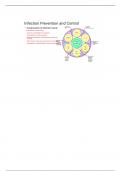
• Components of Infection Cycle
- Viral infection is harder to treat.
- reservoir: natural habitat of an organism
- The portal of exit: where it escapes
- Means of transmission: direct (touching), indirect (not
touching)
- Portal of entry: mouth, eyes, nose (mucous membrane)
- Susceptible host: elderly, children, immune compromised
, • Infectious Agents • Reservoirs for Microorganisms
• Bacteria: most significant and most prevalent • Other people (children)
in hospital settings • Animals
• Virus: smallest of all microorganisms • Soil
- viral infections are harder to treat • Food, water, milk (not pasteurized, contaminated)
• Fungi: plant-like organisms present in air, soil, • Inanimate objects (doorknobs, artificial nails, toys)
and water (athletes, common area use like a dorm)
• Common Portal of Exit
• Bacteria Classification just FYI • Respiratory sneezing
• Spherical (cocci), rod shaped (bacilli),
• Gastrointestinal diarrhea
corkscrew shaped (spirochetes)
• Genitourinary tracts UTI
• Gram positive or gram negative—based on
reaction to Gram stain • Breaks in skin dry skin
• Aerobic or anaerobic—based on need for • Blood and tissue anticoagulants, can’t see blood on
everything. Patient may bleed while brushing teeth and you
oxygen might touch a utensil after they eat.
• Organism’s Potential to Produce Best line of protection - Hand washing
Disease
• Number of organisms (how much exposure)
• Virulence
• Competence of personʼs immune system
• Length and intimacy of contact between
person and microorganism (exposure timeframe)
• Components of Infection Cycle
- Viral infection is harder to treat.
- reservoir: natural habitat of an organism
- The portal of exit: where it escapes
- Means of transmission: direct (touching), indirect (not
touching)
- Portal of entry: mouth, eyes, nose (mucous membrane)
- Susceptible host: elderly, children, immune compromised
, • Infectious Agents • Reservoirs for Microorganisms
• Bacteria: most significant and most prevalent • Other people (children)
in hospital settings • Animals
• Virus: smallest of all microorganisms • Soil
- viral infections are harder to treat • Food, water, milk (not pasteurized, contaminated)
• Fungi: plant-like organisms present in air, soil, • Inanimate objects (doorknobs, artificial nails, toys)
and water (athletes, common area use like a dorm)
• Common Portal of Exit
• Bacteria Classification just FYI • Respiratory sneezing
• Spherical (cocci), rod shaped (bacilli),
• Gastrointestinal diarrhea
corkscrew shaped (spirochetes)
• Genitourinary tracts UTI
• Gram positive or gram negative—based on
reaction to Gram stain • Breaks in skin dry skin
• Aerobic or anaerobic—based on need for • Blood and tissue anticoagulants, can’t see blood on
everything. Patient may bleed while brushing teeth and you
oxygen might touch a utensil after they eat.
• Organism’s Potential to Produce Best line of protection - Hand washing
Disease
• Number of organisms (how much exposure)
• Virulence
• Competence of personʼs immune system
• Length and intimacy of contact between
person and microorganism (exposure timeframe)


