Escrito por estudiantes que aprobaron Inmediatamente disponible después del pago Leer en línea o como PDF ¿Documento equivocado? Cámbialo gratis 4,6 TrustPilot
logo-home
Examen

Chapter 8.1- genetic code (experiments) Complete Assignment Questions Answers Already Passed.

Puntuación
-
Vendido
-
Páginas
4
Grado
A+
Subido en
05-03-2025
Escrito en
2024/2025

genetic code - correct answer sequence of nucleotides, coded in triplets (codons) along the mRNA, that determines the sequence of amino acids in proteins number of different triplet combinations - correct answer - 4ˆ3 = 64 different triplet combinations - 3 because of triplet; 2 and 1 produced not enough - 61 are coding and 3 that don't code (3 stop codons) codon - correct answer - nucleotide triplet that represents a particular amino acid to be inserted in a specific position in the growing amino acid chain during translation - reading corresponds to the 5' to 3' direction along the mRNA nonoverlapping code - correct answer -a single nucleotide is part of only one codon/ nucleotides cannot be a part of multiple codons - if there was overlapping: would limit amino acids that can be adjacent to each other and would have mutations - non overlapping has no biases -- no limit to what amino acid can sit next to each other collinearity of gene and protein - correct answer - nucleotide sequence of a gene is collinear with the amino acid sequence of a polypeptide - consecutive order of bases in the DNA instruct the consecutive order of amino acids in proteins - Yanofsky: determined the amino acid sequence of the mutants -- Saw that where mutations were, corresponded to the amino acid that was affected in the protein - mutation and substituted amino acid were in the same place mutant proteins universal genetic code - correct answer - indicates that it evolved very early and remained constant - every organism has the same genetic code - EXCEPTIONS! (mitochondria; and some of the stop codons are actually coding codons) degenerate genetic code - correct answer - several different codons can specify the same amino acid, and a single tRNA anticodon can recognize several different codons - code is ambiguous because each codon specifies only one amino acid - there are 64 possible codons, if each amino acid corresponded to only a single codon, then there would be 44 codons not encoding an amino acid (20 amino acids), but know that each codon has a meaning -- degenerate code reading frame - correct answer - sequential portioning of nucleotides into groups of three to generate the correct order of amino acids in the resulting polypeptide chain - have three different reading frames possible, only one is used (if says in middle of coding region-- know there shouldn't be a stop codon in the chosen reading frame) - selection of the first codon determines the reading frame evidence for triplet codon through frameshift mutations - correct answer - crick and brenner - frameshift mutations in T4 rIIB gene provided evidence that a codon consists of three nucleotides - rIIB+ WT exposed to proflavin -- mutant created, rIIB- and there is an insertion (FC0) and shifts reading frame -- exposed again to proflavin and get a revertant: has the original mutation and a second mutation, which suppresses FC0 by restoring the proper reading frame through a deletion (mutant FC7) - either mutations by itself causes shift but if together then RF is restored - revertant and WT yields rLLB- mutants: one with mutant FC0 and other with FC7 -- didn't get two normal ones, which proved that the revertant was because of intragenic suppression - ++ and -- shift the reading frame BUT if added or inserted in a group of three (+++ or ---) reading frame is restored - can only restore WT if portion of protein encoded between the two mutations (insertion and deletion) is not required for protein function intragenic suppression - correct answer restoration of gene function by one mutation canceling the effects of another mutation in the same gene use of synthetic mRNAs and in vitro translation to decipher the gene code - correct answer synthetic mRNA is added to a cell-free translational system (treated with DNase to delete DNA), which contains radioactive amino acids -- analyze radioactive polypeptides synthesized - if radioactive then you know that mRNA sequence coded for those amino acids - same synthetic mRNA placed in 20 different test tubes, each with a different radioactive amino acid - some ambiguities because it wasn't clear which codon represented which amino acid (UCU and CUC, and two different amino acids but didn't know which coded for which amino acid) in vitro translational systems - correct answer obtained cellular extracts that synthesized polypeptides a test tube cracking the genetic code with mini-mRNAs - correct answer added short, synthetic mRNAs (3 nucleotides in length) that was known to in vitro translational system containing tRNAs, where only one of the 20 amino acids was radioactive, and amino acids -- pour through filter -- if tRNA is bond to the ribosome (complementary base pairing with the mRNA, codon specifies that amino acid) then it won't go through the filter and filter is lit up with radioactivity polarity of DNA, mRNA, and polypeptide - correct answer - only one strand of DNA is used for RNA synthesis, can use either one, but will get different sequences/polypeptides - DNA template 3' to 5' -- mRNA 5' to 3' -- polypeptide N to C DNA template strand - correct answer - strand that is complementary to both the RNA-like DNA strand and the mRNA, used as a template for transcription - "antisense or noncoding strand" RNA-like DNA strand - correct answer - not used for transcription, but has the same polarity (5' to 3') and sequence (expect T in DNA and U in RNA) as the RNA transcribed - "sense or coding strand" N and C terminus - correct answer - N: has the first amino acid (met or fmet), which has primary aino group free - C: has the last amino acid that was added to the growing polypeptide, which has a free carboxyl group -- "carboxyl terminus" stop codons - correct answer triplets that do not correspond to an amino acid and instead signal termination of translation experiment showing that UAG is a stop signal - correct answer - Sydney Brenner - identified stop mutations using ingenious experiments involving point mutations in a T4 phage, m - amino acid in the mutant only differed from the corresponding amino acid in the WT by a single mutant --mutant had a point mutation that changed a codon for amino acid into the stop codon -- polypeptides were shorter than the WT protein experimental verification of the genetic code - correct answer - Yanofsky - further analyzing his exp: - crossed mutants that carried mutation in the trpA- gene -- when two mutant strains with different amino acids at the same position (had different nucleotide sequence-- different amino acids) were crossed-- recombination could produce a WT allele (supplied a normal nucleotide for the one with a mutant) -- missense mutations -- could use the genetic code to predict the precise amino acid alter

Mostrar más Leer menos
Institución
RLLB
Grado
RLLB

Vista previa del contenido

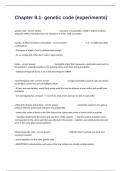
Chapter 8.1- genetic code (experiments)

genetic code - correct answer sequence of nucleotides, coded in triplets (codons)
along the mRNA, that determines the sequence of amino acids in proteins


number of different triplet combinations - correct answer - 4ˆ3 = 64 different triplet
combinations

- 3 because of triplet; 2 and 1 produced not enough

- 61 are coding and 3 that don't code (3 stop codons)


codon - correct answer - nucleotide triplet that represents a particular amino acid to
be inserted in a specific position in the growing amino acid chain during translation

- reading corresponds to the 5' to 3' direction along the mRNA


nonoverlapping code - correct answer -a single nucleotide is part of only one codon/
nucleotides cannot be a part of multiple codons

- if there was overlapping: would limit amino acids that can be adjacent to each other and would have
mutations

- non overlapping has no biases --> no limit to what amino acid can sit next to each other


collinearity of gene and protein - correct answer - nucleotide sequence of a gene is
collinear with the amino acid sequence of a polypeptide

- consecutive order of bases in the DNA instruct the consecutive order of amino acids in proteins

- Yanofsky: determined the amino acid sequence of the mutants --> Saw that where mutations were,
corresponded to the amino acid that was affected in the protein - mutation and substituted amino acid
were in the same place mutant proteins


universal genetic code - correct answer - indicates that it evolved very early and
remained constant

- every organism has the same genetic code

- EXCEPTIONS! (mitochondria; and some of the stop codons are actually coding codons)
Escuela, estudio y materia

Institución
RLLB
Grado
RLLB

Información del documento

Subido en
5 de marzo de 2025
Número de páginas
4
Escrito en
2024/2025
Tipo
Examen
Contiene
Preguntas y respuestas

Temas

$13.49
Accede al documento completo:

¿Documento equivocado? Cámbialo gratis Dentro de los 14 días posteriores a la compra y antes de descargarlo, puedes elegir otro documento. Puedes gastar el importe de nuevo.
Escrito por estudiantes que aprobaron
Inmediatamente disponible después del pago
Leer en línea o como PDF


Documento también disponible en un lote

Thumbnail
Package deal
package deal of RLLB Exam Correctly Answered.
-
9 2025
$ 125.41 Más información

Conoce al vendedor

Seller avatar
Los indicadores de reputación están sujetos a la cantidad de artículos vendidos por una tarifa y las reseñas que ha recibido por esos documentos. Hay tres niveles: Bronce, Plata y Oro. Cuanto mayor reputación, más podrás confiar en la calidad del trabajo del vendedor.
RealGrades Nursing
Ver perfil
Seguir Necesitas iniciar sesión para seguir a otros usuarios o asignaturas
Vendido
174
Miembro desde
2 año
Número de seguidores
52
Documentos
11847
Última venta
3 días hace

4.0

26 reseñas

5
12
4
5
3
7
2
1
1
1

Documentos populares

Recientemente visto por ti

Por qué los estudiantes eligen Stuvia

Creado por compañeros estudiantes, verificado por reseñas

Calidad en la que puedes confiar: escrito por estudiantes que aprobaron y evaluado por otros que han usado estos resúmenes.

¿No estás satisfecho? Elige otro documento

¡No te preocupes! Puedes elegir directamente otro documento que se ajuste mejor a lo que buscas.

Paga como quieras, empieza a estudiar al instante

Sin suscripción, sin compromisos. Paga como estés acostumbrado con tarjeta de crédito y descarga tu documento PDF inmediatamente.

Student with book image

“Comprado, descargado y aprobado. Así de fácil puede ser.”

Alisha Student

Preguntas frecuentes