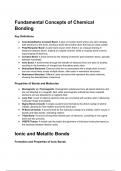
Fundamental Concepts of Chemical
Bonding
Key Definitions
● Coordinate/Dative Covalent Bond: A type of covalent bond where one atom donates
both electrons to the bond, forming a bond with another atom that has an empty orbital.
● Polar/Nonpolar Bond: A polar bond occurs when there is an unequal sharing of
electrons between atoms, leading to a dipole moment, while a nonpolar bond involves
equal sharing of electrons.
● Covalent Bond: A bond formed by the sharing of electron pairs between atoms, typically
between nonmetals.
● Ionic Bond: A bond formed through the transfer of electrons from one atom to another,
resulting in the formation of charged ions that attract each other.
● Delocalized Electrons: Electrons that are not associated with a single atom or bond
and can move freely across multiple atoms, often seen in resonance structures.
● Resonance Structure: Different Lewis structures that represent the same molecule,
showing the delocalization of electrons.
Properties of Bonds and Molecules
● Diamagnetic vs. Paramagnetic: Diamagnetic substances have all paired electrons and
are not attracted to a magnetic field, while paramagnetic substances have unpaired
electrons and are attracted to a magnetic field.
● Lone Pair: A pair of valence electrons that are not shared with another atom, influencing
molecular shape and polarity.
● Sigma Bond (σ-bond): A single covalent bond formed by the direct overlap of atomic
orbitals, allowing for free rotation around the bond axis.
● Pi Bond (π-bond): A bond formed by the sideways overlap of p-orbitals, which occurs in
double and triple bonds, restricting rotation.
● Triple Bond: A bond involving three shared pairs of electrons, consisting of one sigma
bond and two pi bonds.
● VSEPR Theory: A model used to predict the geometry of individual molecules based on
the repulsion between electron pairs.
Ionic and Metallic Bonds
Formation and Properties of Ionic Bonds
Bonding
Key Definitions
● Coordinate/Dative Covalent Bond: A type of covalent bond where one atom donates
both electrons to the bond, forming a bond with another atom that has an empty orbital.
● Polar/Nonpolar Bond: A polar bond occurs when there is an unequal sharing of
electrons between atoms, leading to a dipole moment, while a nonpolar bond involves
equal sharing of electrons.
● Covalent Bond: A bond formed by the sharing of electron pairs between atoms, typically
between nonmetals.
● Ionic Bond: A bond formed through the transfer of electrons from one atom to another,
resulting in the formation of charged ions that attract each other.
● Delocalized Electrons: Electrons that are not associated with a single atom or bond
and can move freely across multiple atoms, often seen in resonance structures.
● Resonance Structure: Different Lewis structures that represent the same molecule,
showing the delocalization of electrons.
Properties of Bonds and Molecules
● Diamagnetic vs. Paramagnetic: Diamagnetic substances have all paired electrons and
are not attracted to a magnetic field, while paramagnetic substances have unpaired
electrons and are attracted to a magnetic field.
● Lone Pair: A pair of valence electrons that are not shared with another atom, influencing
molecular shape and polarity.
● Sigma Bond (σ-bond): A single covalent bond formed by the direct overlap of atomic
orbitals, allowing for free rotation around the bond axis.
● Pi Bond (π-bond): A bond formed by the sideways overlap of p-orbitals, which occurs in
double and triple bonds, restricting rotation.
● Triple Bond: A bond involving three shared pairs of electrons, consisting of one sigma
bond and two pi bonds.
● VSEPR Theory: A model used to predict the geometry of individual molecules based on
the repulsion between electron pairs.
Ionic and Metallic Bonds
Formation and Properties of Ionic Bonds