

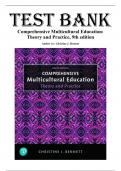
TEST BANK
Comprehensive Multicultural Education:
Theory and Practice, 9th edition
ST
Author (s): Christine I. Bennett
UV
Jane W. Ball EMSC National Resource CenterRuth C. Bindler
IA
AP
PR
OV
ED
?
,Test Bank: Comprehensive Multicultural Education:
Theory and Practice, 9th edition
Chapter 1 Test: Multicultural Schools: What, Why, and How
Instructions: For the multiple-choice questions write the one best answer in the blank.
1. Multicultural education in the United States is
A. An approach to teaching and learning based on democratic values and affirmation of a
ST
culturally pluralistic society.
B. A movement to insure that each student is treated absolutely equally.
C. Focused on the basic differences that exist between people in the United States and the
world.
UV
D. Mainly for African American and Latino children and youth.
2. Multicultural competence includes all of the following EXCEPT
A. Insight into one's own cultural assumptions.
B. The ability to interact effectively with people from another culture.
IA
C. Empathy for different "world views."
D. Acceptance of all cultural differences.
3. Multicultural education does NOT emphasize
A.
Equal educational opportunities and equity for all ethnic groups.
AP
B.
Efforts to help all students reach their fullest potential.
C.
Commitment to combat racism, as well as all forms of prejudice and discrimination.
D.
Inclusion of multiple perspectives related to race, class, culture, and gender in the
curriculum.
E. Total assimilation of ethnic minorities into mainstream culture.
PR
4. A primary assumption of multicultural education is that
A. Elimination of cultural differences will ultimately end conflicts between individuals and
nations.
B. Individuals who identify with different ethnic groups can retain and preserve some of their
OV
original culture and still function in mainstream society.
C. The socio-political interests of different ethnic groups should take priority over a
common national identity.
D. Individuals benefit in competitive environments that bring out their best.
5. The critics of multicultural education in the United States argue that it
E
A. Is a threat to national unity.
B.
D?
Ignores inaccuracies and omissions in the curriculum.
C. Neglects our nation’s role in an interdependent world.
D. Focuses on educational equity and excellence.
E. Favors Christianity and democratic values.
6. Advocates of multicultural education argue that
A. It is easy to correct inaccuracies and omissions in the curriculum.
B. Mono-cultural schools can be effective in a multicultural society.
C. It is fundamental to the democratic ideas of the United States.
, D. It emphasizes academic success for the best students.
7. The “business-as-usual” approach to school desegregation description emphasizes
A. An active one-way absorption of ethnic minorities into the school culture.
B. School policies and practices that promote positive intergroup contacts among students from
different groups.
C. Passive school responses that maintain the school’s traditions and expect all students to fit in.
D. School policies and practices that create racially identifiable student activities and
classroom tracking.
8. The “integrated pluralism” approach to school desegregation emphasizes
ST
A. An active one-way absorption of ethnic minorities into the school culture.
B. School policies and practices that promote positive intergroup contacts among students from
different groups.
UV
C. Passive school responses that maintain the school’s traditions and expect all students to fit in.
D. School policies and practices that create racially identifiable student activities and
classroom tracking.
9. Previously desegregated schools become re-segregated when
A. Ethnic minorities are totally assimilated into the school culture.
IA
B. School policies and practices create racially identifiable student activities and classroom
tracking.
C. The curriculum becomes less Eurocentric.
D. Anglo-European families return to the inner cities.
AP
10. School integration, in contrast to school desegregation, is evident in
A. The "separate, but equal" Supreme Court ruling.
B. An active process that affirms diversity and promotes positive intergroup contact.
C. Any school policy intended to raise academic standards.
PR
D. Schools that track students into classes that match their abilities.
E. Business as usual, the passive response that maintains schools practices and expects
students to change.
11. Multicultural schools require active attention to all of the following EXCEPT
OV
A. Curricular content and extracurricular activities.
B. Faculty and staffing patterns.
C. Rules and standards for discipline and academic achievement.
D. Positive teacher expectations.
E. Total equality in classroom instruction.
E
12. The core values of a multicultural curriculum do NOT include
A.
D?
Respect for universal human rights.
B. Rejection of violence in any form.
C. Acceptance and appreciation for cultural diversity.
D. A sense of responsibility to the world community.
, 13. Mark the following statements as true (T) or false (F). The “achievement gap” in American
education
A. It is caused primarily by parents who do not encourage their children to do well in
school.
B. It shows disproportionately high dropout rates of African American, American
Indian, Latino, and low-income high school students.
C. A major cause is the “opportunity gap” many low-income and ethnic minority
students experience in society and in high poverty schools.
D. Although overall scores on national tests have recently improved for all groups, the
ST
average scores for White students continue to be higher than the average scores of Black and
Latino students.
14. When and why did multicultural education originate?
UV
A. After the Civil Rights movement when public schools began to desegregate and
disproportionately high numbers of students of color were placed in special education and
lower tracks.
B. After the Civil Rights movement when educators decided to help culturally disadvantaged
students.
IA
C. After the Civil Rights movement when the rapid assimilation of minority groups into
mainstream school and society became an important goal.
D. It has always been an important educational goal in our society’s efforts to equalize
educational opportunities
15. Equity pedagogy envisions teachers that
AP
A. Emphasize equality and treat students from all ethnic groups the same.
B. Emphasize fairness and sometimes treat students differently according to relevant
differences.
C. Emphasize academic excellence and treat all student the same.
PR
D. Emphasize student success on standardized tests.
E. Respect students even though they are less capable of learning.
16. Multicultural curriculum reform does NOT require teachers to
A. Rethink the on-going curriculum.
OV
B. Detect bias in the educational materials they use.
C. Focus on both minority and non-minority students.
D. Create different lesson plans for all ethnic groups present.
17. Teachers' multicultural competence is evident all of the following EXCEPT
A. Insight into their cultural assumptions, ethnocentrism, and prejudices.
E
B. Interact comfortably with students, parents, and fellow educators who are racially and
D?
culturally and racially different from them.
C. Are informed about and affirm the cultural identity of both minority and non-minority
students present in their classroom.
D. Have absolutely no discipline problems.
Comprehensive Multicultural Education:
Theory and Practice, 9th edition
ST
Author (s): Christine I. Bennett
UV
Jane W. Ball EMSC National Resource CenterRuth C. Bindler
IA
AP
PR
OV
ED
?
,Test Bank: Comprehensive Multicultural Education:
Theory and Practice, 9th edition
Chapter 1 Test: Multicultural Schools: What, Why, and How
Instructions: For the multiple-choice questions write the one best answer in the blank.
1. Multicultural education in the United States is
A. An approach to teaching and learning based on democratic values and affirmation of a
ST
culturally pluralistic society.
B. A movement to insure that each student is treated absolutely equally.
C. Focused on the basic differences that exist between people in the United States and the
world.
UV
D. Mainly for African American and Latino children and youth.
2. Multicultural competence includes all of the following EXCEPT
A. Insight into one's own cultural assumptions.
B. The ability to interact effectively with people from another culture.
IA
C. Empathy for different "world views."
D. Acceptance of all cultural differences.
3. Multicultural education does NOT emphasize
A.
Equal educational opportunities and equity for all ethnic groups.
AP
B.
Efforts to help all students reach their fullest potential.
C.
Commitment to combat racism, as well as all forms of prejudice and discrimination.
D.
Inclusion of multiple perspectives related to race, class, culture, and gender in the
curriculum.
E. Total assimilation of ethnic minorities into mainstream culture.
PR
4. A primary assumption of multicultural education is that
A. Elimination of cultural differences will ultimately end conflicts between individuals and
nations.
B. Individuals who identify with different ethnic groups can retain and preserve some of their
OV
original culture and still function in mainstream society.
C. The socio-political interests of different ethnic groups should take priority over a
common national identity.
D. Individuals benefit in competitive environments that bring out their best.
5. The critics of multicultural education in the United States argue that it
E
A. Is a threat to national unity.
B.
D?
Ignores inaccuracies and omissions in the curriculum.
C. Neglects our nation’s role in an interdependent world.
D. Focuses on educational equity and excellence.
E. Favors Christianity and democratic values.
6. Advocates of multicultural education argue that
A. It is easy to correct inaccuracies and omissions in the curriculum.
B. Mono-cultural schools can be effective in a multicultural society.
C. It is fundamental to the democratic ideas of the United States.
, D. It emphasizes academic success for the best students.
7. The “business-as-usual” approach to school desegregation description emphasizes
A. An active one-way absorption of ethnic minorities into the school culture.
B. School policies and practices that promote positive intergroup contacts among students from
different groups.
C. Passive school responses that maintain the school’s traditions and expect all students to fit in.
D. School policies and practices that create racially identifiable student activities and
classroom tracking.
8. The “integrated pluralism” approach to school desegregation emphasizes
ST
A. An active one-way absorption of ethnic minorities into the school culture.
B. School policies and practices that promote positive intergroup contacts among students from
different groups.
UV
C. Passive school responses that maintain the school’s traditions and expect all students to fit in.
D. School policies and practices that create racially identifiable student activities and
classroom tracking.
9. Previously desegregated schools become re-segregated when
A. Ethnic minorities are totally assimilated into the school culture.
IA
B. School policies and practices create racially identifiable student activities and classroom
tracking.
C. The curriculum becomes less Eurocentric.
D. Anglo-European families return to the inner cities.
AP
10. School integration, in contrast to school desegregation, is evident in
A. The "separate, but equal" Supreme Court ruling.
B. An active process that affirms diversity and promotes positive intergroup contact.
C. Any school policy intended to raise academic standards.
PR
D. Schools that track students into classes that match their abilities.
E. Business as usual, the passive response that maintains schools practices and expects
students to change.
11. Multicultural schools require active attention to all of the following EXCEPT
OV
A. Curricular content and extracurricular activities.
B. Faculty and staffing patterns.
C. Rules and standards for discipline and academic achievement.
D. Positive teacher expectations.
E. Total equality in classroom instruction.
E
12. The core values of a multicultural curriculum do NOT include
A.
D?
Respect for universal human rights.
B. Rejection of violence in any form.
C. Acceptance and appreciation for cultural diversity.
D. A sense of responsibility to the world community.
, 13. Mark the following statements as true (T) or false (F). The “achievement gap” in American
education
A. It is caused primarily by parents who do not encourage their children to do well in
school.
B. It shows disproportionately high dropout rates of African American, American
Indian, Latino, and low-income high school students.
C. A major cause is the “opportunity gap” many low-income and ethnic minority
students experience in society and in high poverty schools.
D. Although overall scores on national tests have recently improved for all groups, the
ST
average scores for White students continue to be higher than the average scores of Black and
Latino students.
14. When and why did multicultural education originate?
UV
A. After the Civil Rights movement when public schools began to desegregate and
disproportionately high numbers of students of color were placed in special education and
lower tracks.
B. After the Civil Rights movement when educators decided to help culturally disadvantaged
students.
IA
C. After the Civil Rights movement when the rapid assimilation of minority groups into
mainstream school and society became an important goal.
D. It has always been an important educational goal in our society’s efforts to equalize
educational opportunities
15. Equity pedagogy envisions teachers that
AP
A. Emphasize equality and treat students from all ethnic groups the same.
B. Emphasize fairness and sometimes treat students differently according to relevant
differences.
C. Emphasize academic excellence and treat all student the same.
PR
D. Emphasize student success on standardized tests.
E. Respect students even though they are less capable of learning.
16. Multicultural curriculum reform does NOT require teachers to
A. Rethink the on-going curriculum.
OV
B. Detect bias in the educational materials they use.
C. Focus on both minority and non-minority students.
D. Create different lesson plans for all ethnic groups present.
17. Teachers' multicultural competence is evident all of the following EXCEPT
A. Insight into their cultural assumptions, ethnocentrism, and prejudices.
E
B. Interact comfortably with students, parents, and fellow educators who are racially and
D?
culturally and racially different from them.
C. Are informed about and affirm the cultural identity of both minority and non-minority
students present in their classroom.
D. Have absolutely no discipline problems.

