
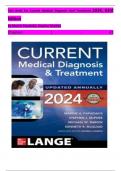
Test Bank For Current Medical Diagnosis And Treatment 2024, 63rd
Edition
By Maxine Papadakis, Stephen Mcphee
Chapters 1 - 42
,Chapter 1. Disease Prevention & Health Promotion
DQ DQ DQ DQ DQ DQ
1. Which of the following behaviors indicates the highest potential for spreading infections
DQ DQ DQ DQ DQ DQ DQ DQ DQ DQ DQ DQ DQ
among clients? The nurse:
DQ DQ DQ
1) disinfects dirty hands with antibacterial soap. DQ DQ DQ DQ DQ
2) allows alcohol-based rub to dry for 10 seconds.
DQ DQ DQ DQ DQ DQ DQ
3) washes hands only after leaving each room.
DQ DQ DQ DQ DQ DQ
4) uses cold water for medical asepsis.
DQ DQ DQ DQ DQ
2. What is the most frequent cause of the spread of infection among institutionalized
DQ DQ DQ DQ DQ DQ DQ DQ DQ DQ DQ DQ DQ
patients?
1) Airborne microbes from other patients DQ DQ DQ DQ
2) Contact with contaminated equipment DQ DQ DQ
3) Hands of healthcare workers
DQ DQ DQ
4) Exposure from family members DQ DQ DQ
3. Which of the following nursing activities is of highest priority for maintaining medic
DQ DQ DQ DQ DQ DQ DQ DQ DQ DQ DQ DQ DQ
al asepsis?
DQ
1) Washing hands DQ
2) Donning gloves DQ
3) Applying sterile drapes DQ DQ
4) Wearing a gown DQ DQ
4. A patient infected with a virus but who does not have any outward sign of the disea
DQ DQ DQ DQ DQ DQ DQ DQ DQ DQ DQ DQ DQ DQ DQ DQ DQ
se is considered a:
DQ DQ DQ
1) pathogen.
2) fomite.
3) vector.
4) carrier.
5. A patient is admitted to the hospital with tuberculosis. Which precautions must the
DQ DQ DQ DQ DQ DQ DQ DQ DQ DQ DQ DQ DQ DQ
nurse institute when caring for this patient?
DQ DQ DQ DQ DQ DQ
1) Droplet transmission DQ
2) Airborne transmission DQ
,3) Direct contact
DQ
4) Indirect contact
DQ
, 6. A patient becomes infected with oral candidiasis (thrush) while receiving intraveno
DQ DQ DQ DQ DQ DQ DQ DQ DQ DQ DQ
us antibiotics to treat a systemic infection. Which type of infection has the patient devel
DQ DQ DQ DQ DQ DQ DQ DQ DQ DQ DQ DQ DQ DQ
oped?
1) Endogenous nosocomial DQ
2) Exogenous nosocomial DQ
3) Latent
4) Primary
7.The nurse assists a surgeon with central venous catheter insertion. Which actio
DQ DQ DQ DQ DQ DQ DQ DQ DQ DQ DQ
n is necessary to help maintain sterile technique?
DQ DQ DQ DQ DQ DQ DQ
1) Closing the patients door to limit room traffic while preparing the sterile field
DQ DQ DQ DQ DQ DQ DQ DQ DQ DQ DQ DQ
2) Using clean procedure gloves to handle sterile equipment
DQ DQ DQ DQ DQ DQ DQ
Placing the nonsterile syringes containing flush solution on the sterile field
3) DQ DQ DQ DQ DQ DQ DQ DQ DQ DQ
Remaining 6 inches away from the sterile field during the procedure
4) DQ DQ DQ DQ DQ DQ DQ DQ DQ DQ
D Q8.A patient admitted to the hospital with pneumonia has been receiving antibiotics f
D Q DQ DQ DQ DQ DQ DQ DQ DQ DQ DQ DQ DQ
or 2 days. His condition has stabilized, and his temperature has returned to normal. Whic
DQ DQ DQ DQ DQ DQ DQ DQ DQ DQ DQ DQ DQ DQ
h stage of infection is the patient most likely experiencing?
DQ DQ DQ DQ DQ DQ DQ DQ DQ
1) Incubation
2) Prodromal
3) Decline
4) Convalescence
5) 8.
9. A patient develops localized heat and erythema over an area on the lower leg. T
DQ DQ DQ DQ DQ DQ DQ DQ DQ DQ DQ DQ DQ DQ DQ
hese findings are indicative of which secondary defense against infection?
DQ DQ DQ DQ DQ DQ DQ DQ DQ
1) Phagocytosis
2) Complement cascade DQ
3) Inflammation
4) Immunity
10. The patient suddenly develops hives, shortness of breath, and wheezing after recei
DQ DQ DQ DQ DQ DQ DQ DQ DQ DQ DQ DQ
ving an antibiotic. Which antibody is primarily responsible for this patients response?
DQ DQ DQ DQ DQ DQ DQ DQ DQ DQ DQ
1) IgA
2) IgE
3) IgG
4) IgM
Edition
By Maxine Papadakis, Stephen Mcphee
Chapters 1 - 42
,Chapter 1. Disease Prevention & Health Promotion
DQ DQ DQ DQ DQ DQ
1. Which of the following behaviors indicates the highest potential for spreading infections
DQ DQ DQ DQ DQ DQ DQ DQ DQ DQ DQ DQ DQ
among clients? The nurse:
DQ DQ DQ
1) disinfects dirty hands with antibacterial soap. DQ DQ DQ DQ DQ
2) allows alcohol-based rub to dry for 10 seconds.
DQ DQ DQ DQ DQ DQ DQ
3) washes hands only after leaving each room.
DQ DQ DQ DQ DQ DQ
4) uses cold water for medical asepsis.
DQ DQ DQ DQ DQ
2. What is the most frequent cause of the spread of infection among institutionalized
DQ DQ DQ DQ DQ DQ DQ DQ DQ DQ DQ DQ DQ
patients?
1) Airborne microbes from other patients DQ DQ DQ DQ
2) Contact with contaminated equipment DQ DQ DQ
3) Hands of healthcare workers
DQ DQ DQ
4) Exposure from family members DQ DQ DQ
3. Which of the following nursing activities is of highest priority for maintaining medic
DQ DQ DQ DQ DQ DQ DQ DQ DQ DQ DQ DQ DQ
al asepsis?
DQ
1) Washing hands DQ
2) Donning gloves DQ
3) Applying sterile drapes DQ DQ
4) Wearing a gown DQ DQ
4. A patient infected with a virus but who does not have any outward sign of the disea
DQ DQ DQ DQ DQ DQ DQ DQ DQ DQ DQ DQ DQ DQ DQ DQ DQ
se is considered a:
DQ DQ DQ
1) pathogen.
2) fomite.
3) vector.
4) carrier.
5. A patient is admitted to the hospital with tuberculosis. Which precautions must the
DQ DQ DQ DQ DQ DQ DQ DQ DQ DQ DQ DQ DQ DQ
nurse institute when caring for this patient?
DQ DQ DQ DQ DQ DQ
1) Droplet transmission DQ
2) Airborne transmission DQ
,3) Direct contact
DQ
4) Indirect contact
DQ
, 6. A patient becomes infected with oral candidiasis (thrush) while receiving intraveno
DQ DQ DQ DQ DQ DQ DQ DQ DQ DQ DQ
us antibiotics to treat a systemic infection. Which type of infection has the patient devel
DQ DQ DQ DQ DQ DQ DQ DQ DQ DQ DQ DQ DQ DQ
oped?
1) Endogenous nosocomial DQ
2) Exogenous nosocomial DQ
3) Latent
4) Primary
7.The nurse assists a surgeon with central venous catheter insertion. Which actio
DQ DQ DQ DQ DQ DQ DQ DQ DQ DQ DQ
n is necessary to help maintain sterile technique?
DQ DQ DQ DQ DQ DQ DQ
1) Closing the patients door to limit room traffic while preparing the sterile field
DQ DQ DQ DQ DQ DQ DQ DQ DQ DQ DQ DQ
2) Using clean procedure gloves to handle sterile equipment
DQ DQ DQ DQ DQ DQ DQ
Placing the nonsterile syringes containing flush solution on the sterile field
3) DQ DQ DQ DQ DQ DQ DQ DQ DQ DQ
Remaining 6 inches away from the sterile field during the procedure
4) DQ DQ DQ DQ DQ DQ DQ DQ DQ DQ
D Q8.A patient admitted to the hospital with pneumonia has been receiving antibiotics f
D Q DQ DQ DQ DQ DQ DQ DQ DQ DQ DQ DQ DQ
or 2 days. His condition has stabilized, and his temperature has returned to normal. Whic
DQ DQ DQ DQ DQ DQ DQ DQ DQ DQ DQ DQ DQ DQ
h stage of infection is the patient most likely experiencing?
DQ DQ DQ DQ DQ DQ DQ DQ DQ
1) Incubation
2) Prodromal
3) Decline
4) Convalescence
5) 8.
9. A patient develops localized heat and erythema over an area on the lower leg. T
DQ DQ DQ DQ DQ DQ DQ DQ DQ DQ DQ DQ DQ DQ DQ
hese findings are indicative of which secondary defense against infection?
DQ DQ DQ DQ DQ DQ DQ DQ DQ
1) Phagocytosis
2) Complement cascade DQ
3) Inflammation
4) Immunity
10. The patient suddenly develops hives, shortness of breath, and wheezing after recei
DQ DQ DQ DQ DQ DQ DQ DQ DQ DQ DQ DQ
ving an antibiotic. Which antibody is primarily responsible for this patients response?
DQ DQ DQ DQ DQ DQ DQ DQ DQ DQ DQ
1) IgA
2) IgE
3) IgG
4) IgM

