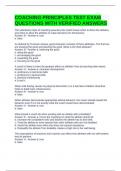
COACHING PRINCIPLES TEST EXAM
QUESTIONS WITH VERIFIED ANSWERS
The submissive style of coaching assumes the coach knows when to direct the athletes
and when to allow the athletes to make decisions for themselves.
Answer: B - Answer-a. true
b. false
As defined by Thomas Lickona, good character consists of three attributes. The first two
are knowing the good and desiring the good. What is the third attribute?
Answer: B - Answer-a. believing the good
b. doing the good
c. encouraging the good
d. rewarding the good
e. focusing on the good
A coach is likely to have the greatest effect on athletes' lives by teaching them about
Answer: A - Answer-a. character development
b. proficiency in technical skills
c. proficiency in tactical skills
d. physical conditioning
e. b and c
When mild hazing causes no physical discomfort, it is a harmless initiation ritual that
helps to build team cohesiveness.
Answer: B - Answer-a. true
b. false
When athletes demonstrate appropriate ethical behavior, the coach should reward the
behavior even if it is not exactly what the coach would have demonstrated.
Answer: A - Answer-a. true
b. false
What should a coach do when working with an athlete with a disability?
Answer: E - Answer-a. Focus the coaching on what the athlete cannot do.
b. Increase the competitive risks and failures the athlete has to deal with.
c. Treat the athlete as more special than other athletes who are not disabled.
d. Assist the athlete even when she does not request assistance.
e. Disqualify the athlete if her disability creates a high risk to her well-being.
The expectations of teachers and coaches can affect how athletes with low self-esteem
tend to perform.
Answer: A - Answer-a. true
b. false
, Typically, an athlete's peer group provides the most influence on the athlete's thinking
and life choices when the athlete is in what stage of development?
Answer: C - Answer-a. preadolescence (9 to 10 years)
b. early adolescence (11 to 14 years)
c. middle adolescence (15 to 17 years)
d. late adolescence (18 to 21 years)
e. adulthood (21+ years)
What should a coach do to more effectively coach athletes of varying cultural
backgrounds?
Answer: A - Answer-a. Understand the athletes' cultural heritages and how they might
influence his coaching.
b. Expect all athletes to display the same emotions and attitudes.
c. Ignore cultural differences among athletes.
d. Avoid discussing prejudices with athletes.
e. all of these
Athletes should be matched for competition based on their chronological age to prevent
the risk of injury to younger athletes.
Answer: B - Answer-a. true
b. false
A coach who uses active listening should interrupt athletes frequently to clarify what
they mean.
Answer: B - Answer-a. true
b. false
What is the difference between content and emotion in communication?
Answer: B - Answer-a. Content is expressed nonverbally, and emotion is expressed
verbally.
b. Content is the substance of the message, and emotion is how you feel about it.
c. Emotion mostly affects the messages you send, and content mostly affects the
messages you receive.
d. Generally, coaches are better at controlling the emotion of their messages rather than
the substance of their messages.
e. b and c
An important benefit of active listening is that it enables a coach to
Answer: d - Answer-a. focus on the athletes' thought processes rather than their
emotions
b. discourage discussion of the athletes' problems and fears unrelated to the sport
c. increase the opportunities to express sympathy
d. respond more constructively to the athletes
e. decrease the coach's influence by increasing the athletes' independence
QUESTIONS WITH VERIFIED ANSWERS
The submissive style of coaching assumes the coach knows when to direct the athletes
and when to allow the athletes to make decisions for themselves.
Answer: B - Answer-a. true
b. false
As defined by Thomas Lickona, good character consists of three attributes. The first two
are knowing the good and desiring the good. What is the third attribute?
Answer: B - Answer-a. believing the good
b. doing the good
c. encouraging the good
d. rewarding the good
e. focusing on the good
A coach is likely to have the greatest effect on athletes' lives by teaching them about
Answer: A - Answer-a. character development
b. proficiency in technical skills
c. proficiency in tactical skills
d. physical conditioning
e. b and c
When mild hazing causes no physical discomfort, it is a harmless initiation ritual that
helps to build team cohesiveness.
Answer: B - Answer-a. true
b. false
When athletes demonstrate appropriate ethical behavior, the coach should reward the
behavior even if it is not exactly what the coach would have demonstrated.
Answer: A - Answer-a. true
b. false
What should a coach do when working with an athlete with a disability?
Answer: E - Answer-a. Focus the coaching on what the athlete cannot do.
b. Increase the competitive risks and failures the athlete has to deal with.
c. Treat the athlete as more special than other athletes who are not disabled.
d. Assist the athlete even when she does not request assistance.
e. Disqualify the athlete if her disability creates a high risk to her well-being.
The expectations of teachers and coaches can affect how athletes with low self-esteem
tend to perform.
Answer: A - Answer-a. true
b. false
, Typically, an athlete's peer group provides the most influence on the athlete's thinking
and life choices when the athlete is in what stage of development?
Answer: C - Answer-a. preadolescence (9 to 10 years)
b. early adolescence (11 to 14 years)
c. middle adolescence (15 to 17 years)
d. late adolescence (18 to 21 years)
e. adulthood (21+ years)
What should a coach do to more effectively coach athletes of varying cultural
backgrounds?
Answer: A - Answer-a. Understand the athletes' cultural heritages and how they might
influence his coaching.
b. Expect all athletes to display the same emotions and attitudes.
c. Ignore cultural differences among athletes.
d. Avoid discussing prejudices with athletes.
e. all of these
Athletes should be matched for competition based on their chronological age to prevent
the risk of injury to younger athletes.
Answer: B - Answer-a. true
b. false
A coach who uses active listening should interrupt athletes frequently to clarify what
they mean.
Answer: B - Answer-a. true
b. false
What is the difference between content and emotion in communication?
Answer: B - Answer-a. Content is expressed nonverbally, and emotion is expressed
verbally.
b. Content is the substance of the message, and emotion is how you feel about it.
c. Emotion mostly affects the messages you send, and content mostly affects the
messages you receive.
d. Generally, coaches are better at controlling the emotion of their messages rather than
the substance of their messages.
e. b and c
An important benefit of active listening is that it enables a coach to
Answer: d - Answer-a. focus on the athletes' thought processes rather than their
emotions
b. discourage discussion of the athletes' problems and fears unrelated to the sport
c. increase the opportunities to express sympathy
d. respond more constructively to the athletes
e. decrease the coach's influence by increasing the athletes' independence