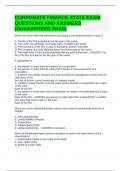
CORPORATE FINANCE STATE EXAM
QUESTIONS AND ANSWERS
(GUARANTEED PASS)
Which one of the following statements concerning a sole proprietorship is correct?
A. The life of the firm is limited to the life span of the owner.
B. The owner can generally raise large sums of capital quite easily.
C. The ownership of the firm is easy to transfer to another individual.
D. The company must pay separate taxes from those paid by the owner.
E. The legal costs to form a sole proprietorship are quite substantial. - ANSWER-The
life of the firm is limited to the life span of the owner.
A stakeholder is:
A. any person or entity that owns shares of a corporation.
B. any person or entity that has voting rights based on share ownership of a
corporation.
C. a person who initially started a firm and currently has management control over the
cash flows of the
firm due to his/her current ownership of company equity.
D. creditor to whom the firm currently owes money and who consequently has a claim
on the cash
flows of the firm.
E. any person or entity other than a shareholder or creditor who potentially has a claim
on the cash
flows of the firm. - ANSWER-any person or entity other than a shareholder or creditor
who potentially has a claim on the cash
flows of the firm.
Which one of the following business types is best suited to raising large amounts of
capital?
A. Sole proprietorship.
B. Limited liability company.
C. Corporation.
D. General partnership.
E. Limited partnership. - ANSWER-Corporation.
Which of the following help convince managers to work in the best interest of the
shareholders?
I. compensation based on the value of the equity
II. share option plans
III. threat of a proxy fight
,IV. threat of conversion to a partnership
A. I and II only.
B. II and III only.
C. I, II and III only.
D. I and III only.
E. I, II, III, and IV. - ANSWER-compensation based on the value of the equity
II. share option plans
III. threat of a proxy fight
A current asset is:
A. an item currently owned by the firm.
B. an item that the firm expects to own within the next year.
C. an item currently owned by the firm that will convert to cash within the next 12
months.
D. the amount of cash on hand the firm currently shows on its statement of financial
position.
E. the market value of all items currently owned by the firm. - ANSWER-an item
currently owned by the firm that will convert to cash within the next 12 months.
_____ is calculated by adding back non-cash expenses to net income and adjusting for
changes in current
assets and liabilities.
A. Operating cash flow
B. Capital spending
C. Net working capital
D. Cash flow from operations
E. Cash flow to creditors - ANSWER-Operating cash flow
Net working capital is defined as:
A. total liabilities minus shareholders' equity.
B. current liabilities minus shareholders' equity.
C. non-current assets minus non-current liabilities.
D. total assets minus total liabilities.
E. current assets minus current liabilities. - ANSWER-current assets minus current
liabilities.
Earnings per share is equal to:
A. net income divided by the total number of shares outstanding.
B. net income divided by the par value of the ordinary equity.
C. gross income multiplied by the par value of the ordinary equity.
D. operating income divided by the par value of the ordinary equity.
, E. net income divided by total shareholders' equity. - ANSWER-net income divided
by the total number of shares outstanding.
Which of the following are included in current assets?
I. Equipment
II. Inventory
III. Trade payables
IV. Cash
A. II and IV only.
B. I and III only.
C. I, II, and IV only.
D. III and IV only.
E. II, III, and IV only. - ANSWER-Inventory, Cash
Book value:
A. is equivalent to market value for firms with non-current assets.
B. is based on historical cost.
C. generally tends to exceed market value when non-current assets are included.
D. is more of a financial than an accounting valuation.
E. is adjusted to market value whenever the market value exceeds the stated book
value. - ANSWER-is based on historical cost.
Depreciation:
A. is a noncash expense that is recorded on the income statement.
B. increases the net non-current assets as shown on the statement of financial position.
C. reduces both the net non-current assets and the costs of a firm.
D. is a non-cash expense which increases the net operating income.
E. decreases net non-current assets, net income, and operating cash flows. -
ANSWER-is a noncash expense that is recorded on the income statement.
Which of the following is not included in the computation of operating cash flow?
A. Earnings before interest and taxes
B. Interest paid
C. Depreciation
D. Current taxes
E. All of the above are included. - ANSWER-Interest paid
Which one of the following statements concerning net present value (NPV) is correct?
A. An investment should be accepted if, and only if, the NPV is exactly equal to zero.
B. An investment should be accepted only if the NPV is equal to the initial cash flow.
C. An investment should be accepted if the NPV is positive and rejected if it is negative.
QUESTIONS AND ANSWERS
(GUARANTEED PASS)
Which one of the following statements concerning a sole proprietorship is correct?
A. The life of the firm is limited to the life span of the owner.
B. The owner can generally raise large sums of capital quite easily.
C. The ownership of the firm is easy to transfer to another individual.
D. The company must pay separate taxes from those paid by the owner.
E. The legal costs to form a sole proprietorship are quite substantial. - ANSWER-The
life of the firm is limited to the life span of the owner.
A stakeholder is:
A. any person or entity that owns shares of a corporation.
B. any person or entity that has voting rights based on share ownership of a
corporation.
C. a person who initially started a firm and currently has management control over the
cash flows of the
firm due to his/her current ownership of company equity.
D. creditor to whom the firm currently owes money and who consequently has a claim
on the cash
flows of the firm.
E. any person or entity other than a shareholder or creditor who potentially has a claim
on the cash
flows of the firm. - ANSWER-any person or entity other than a shareholder or creditor
who potentially has a claim on the cash
flows of the firm.
Which one of the following business types is best suited to raising large amounts of
capital?
A. Sole proprietorship.
B. Limited liability company.
C. Corporation.
D. General partnership.
E. Limited partnership. - ANSWER-Corporation.
Which of the following help convince managers to work in the best interest of the
shareholders?
I. compensation based on the value of the equity
II. share option plans
III. threat of a proxy fight
,IV. threat of conversion to a partnership
A. I and II only.
B. II and III only.
C. I, II and III only.
D. I and III only.
E. I, II, III, and IV. - ANSWER-compensation based on the value of the equity
II. share option plans
III. threat of a proxy fight
A current asset is:
A. an item currently owned by the firm.
B. an item that the firm expects to own within the next year.
C. an item currently owned by the firm that will convert to cash within the next 12
months.
D. the amount of cash on hand the firm currently shows on its statement of financial
position.
E. the market value of all items currently owned by the firm. - ANSWER-an item
currently owned by the firm that will convert to cash within the next 12 months.
_____ is calculated by adding back non-cash expenses to net income and adjusting for
changes in current
assets and liabilities.
A. Operating cash flow
B. Capital spending
C. Net working capital
D. Cash flow from operations
E. Cash flow to creditors - ANSWER-Operating cash flow
Net working capital is defined as:
A. total liabilities minus shareholders' equity.
B. current liabilities minus shareholders' equity.
C. non-current assets minus non-current liabilities.
D. total assets minus total liabilities.
E. current assets minus current liabilities. - ANSWER-current assets minus current
liabilities.
Earnings per share is equal to:
A. net income divided by the total number of shares outstanding.
B. net income divided by the par value of the ordinary equity.
C. gross income multiplied by the par value of the ordinary equity.
D. operating income divided by the par value of the ordinary equity.
, E. net income divided by total shareholders' equity. - ANSWER-net income divided
by the total number of shares outstanding.
Which of the following are included in current assets?
I. Equipment
II. Inventory
III. Trade payables
IV. Cash
A. II and IV only.
B. I and III only.
C. I, II, and IV only.
D. III and IV only.
E. II, III, and IV only. - ANSWER-Inventory, Cash
Book value:
A. is equivalent to market value for firms with non-current assets.
B. is based on historical cost.
C. generally tends to exceed market value when non-current assets are included.
D. is more of a financial than an accounting valuation.
E. is adjusted to market value whenever the market value exceeds the stated book
value. - ANSWER-is based on historical cost.
Depreciation:
A. is a noncash expense that is recorded on the income statement.
B. increases the net non-current assets as shown on the statement of financial position.
C. reduces both the net non-current assets and the costs of a firm.
D. is a non-cash expense which increases the net operating income.
E. decreases net non-current assets, net income, and operating cash flows. -
ANSWER-is a noncash expense that is recorded on the income statement.
Which of the following is not included in the computation of operating cash flow?
A. Earnings before interest and taxes
B. Interest paid
C. Depreciation
D. Current taxes
E. All of the above are included. - ANSWER-Interest paid
Which one of the following statements concerning net present value (NPV) is correct?
A. An investment should be accepted if, and only if, the NPV is exactly equal to zero.
B. An investment should be accepted only if the NPV is equal to the initial cash flow.
C. An investment should be accepted if the NPV is positive and rejected if it is negative.