
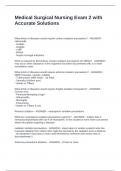
Medical Surgical Nursing Exam 2 with
Accurate Solutions
What kinds of diseases would require contact isolation precautions? - ANSWER--
salmonella
- scabies
- shigella
- c-diff
- MRSA
- herpes & fungal infections
What is required to discontinue contact isolation precautions for MRSA? - ANSWER--
may occur when clearance of the organism has been documented with 3 or more
surveillance tests
What kinds of diseases would require airborne isolation precautions? - ANSWER--
MMR (measles, mumps, rubella)
- TUberculosis (N95 mask, - air flow)
- Varicella (chicken pox)
* thanks to Tiffany
What kinds of diseases would require droplet isolation precautions? - ANSWER--
Corona virus
- Pertussis/whooping cough
- Influenza/flu
- Meningitis
- Pneumonia
* thanks to Tiffany & Jay
Reverse isolation - ANSWER-- neutropenic isolation precautions
What are neutropenic isolation precautions used for? - ANSWER-- Patient that is
immunocompromised with low # of neutrophils. In this incidence were more concerned
about the patient acquiring a disease.
radiation isolation precautions - ANSWER-- steps taken to isolate a patient who has
received radiation from others who might be harmed by the radiation from a distance
- all equipment must stay in room until removed by someone who knows how to
decontaminate it
Airborne precautions distance - ANSWER-- 10 feet or more
, Droplet precautions distance - ANSWER-- 3 to 6 feet
Clinical manifestations of TB - ANSWER-- fatigue
- weight loss & anorexia
- night sweats
- cough with rusty colored/blood streaked sputum
- dyspnea, orthopnea, and rales as disease progresses
Treatments for anaphylactic reaction - ANSWER-- removal of triggering agent - prompt
recognition & treatment
- IM epinephrine can repeat q5-15min 2or3x
- IV for patients not responding IM
- glucagon if pt on beta blocker
- 2nd line antihistamines & glucocorticoids
PACU nursing care - ANSWER-- for frequent monitoring & assessment of patient
recovery
- assessment of airway, respiratory status, v/s including cardiac rhythm, LOC, temp &
color of skin, pain level, dressing condition, hydration status, IV, cath, and drains
Informed consent - ANSWER-- surgeons responsibility to educate pt on procedure
before anesthesia or pain meds are given
- nurse acts as witness and advocate to ensure pt has all info they need, validate their
understanding
- ensure the pt signed in your presence
What is the criteria that needs to be met for home discharge? - ANSWER-- alert and
awake
- tolerating fluids
- v/s @ baseline
- wound clean & dry
- ability to void/ambulate
conscious sedation - ANSWER-- provides anesthesia without loss of consciousness
instead their is a decrease in LOC
- pt maintains their airway and responds to verbal cues
- usual meds are benzos like diazepam, midazolam & narcotics like fentanyl &
meperidine
Absolute Neutrophil Count (ANC) - ANSWER-- # of neutrophils available to fight
infection
- (%bands+%segs)xWBC
- normal range 1500-8000
Accurate Solutions
What kinds of diseases would require contact isolation precautions? - ANSWER--
salmonella
- scabies
- shigella
- c-diff
- MRSA
- herpes & fungal infections
What is required to discontinue contact isolation precautions for MRSA? - ANSWER--
may occur when clearance of the organism has been documented with 3 or more
surveillance tests
What kinds of diseases would require airborne isolation precautions? - ANSWER--
MMR (measles, mumps, rubella)
- TUberculosis (N95 mask, - air flow)
- Varicella (chicken pox)
* thanks to Tiffany
What kinds of diseases would require droplet isolation precautions? - ANSWER--
Corona virus
- Pertussis/whooping cough
- Influenza/flu
- Meningitis
- Pneumonia
* thanks to Tiffany & Jay
Reverse isolation - ANSWER-- neutropenic isolation precautions
What are neutropenic isolation precautions used for? - ANSWER-- Patient that is
immunocompromised with low # of neutrophils. In this incidence were more concerned
about the patient acquiring a disease.
radiation isolation precautions - ANSWER-- steps taken to isolate a patient who has
received radiation from others who might be harmed by the radiation from a distance
- all equipment must stay in room until removed by someone who knows how to
decontaminate it
Airborne precautions distance - ANSWER-- 10 feet or more
, Droplet precautions distance - ANSWER-- 3 to 6 feet
Clinical manifestations of TB - ANSWER-- fatigue
- weight loss & anorexia
- night sweats
- cough with rusty colored/blood streaked sputum
- dyspnea, orthopnea, and rales as disease progresses
Treatments for anaphylactic reaction - ANSWER-- removal of triggering agent - prompt
recognition & treatment
- IM epinephrine can repeat q5-15min 2or3x
- IV for patients not responding IM
- glucagon if pt on beta blocker
- 2nd line antihistamines & glucocorticoids
PACU nursing care - ANSWER-- for frequent monitoring & assessment of patient
recovery
- assessment of airway, respiratory status, v/s including cardiac rhythm, LOC, temp &
color of skin, pain level, dressing condition, hydration status, IV, cath, and drains
Informed consent - ANSWER-- surgeons responsibility to educate pt on procedure
before anesthesia or pain meds are given
- nurse acts as witness and advocate to ensure pt has all info they need, validate their
understanding
- ensure the pt signed in your presence
What is the criteria that needs to be met for home discharge? - ANSWER-- alert and
awake
- tolerating fluids
- v/s @ baseline
- wound clean & dry
- ability to void/ambulate
conscious sedation - ANSWER-- provides anesthesia without loss of consciousness
instead their is a decrease in LOC
- pt maintains their airway and responds to verbal cues
- usual meds are benzos like diazepam, midazolam & narcotics like fentanyl &
meperidine
Absolute Neutrophil Count (ANC) - ANSWER-- # of neutrophils available to fight
infection
- (%bands+%segs)xWBC
- normal range 1500-8000

