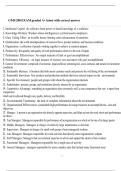
NURS 6512 LATEST EXAM WITH DIFFERENT
VERSIONS WITH COMPLETE QUESTIONS AND
CORRECT ANSWERS WIRH ALREADY A+ GRADED
Examination Findings of a child with Kawasaki
disease
ANSWER-Fever, Conjunctival Injection,
Strawberry Tongue, and Edema of the Hands
and Feet.
Lymphadenopathy and Polymorphous
ANSWER-Nonvesicular Rashes.
Peripheral Edema
ANSWER-Grading:
,1+ Slight Pitting, no visible distortion,
disappears rapidly.
2+ A Somewhat Deeper Pit than in 12+, but
again no readily detectable distortion,
disappears in 10-15 seconds.
3+ Noticeably Deep Pit that may last more than
a minute; dependent extremity looks fuller and
swollen.
4+ Very Deep Pit that lasts as long as 2-5 min;
dependent extremity is grossly distorted.
Ammonia in breath odor
ANSWER-Uremia (ammonia)
Grading of Pulses
,ANSWER-
3+ Full, Increased
2+ Expected
1+ Diminished, barely palpable
0 Absent, not palpable
Acute Limb Ischemia (ALI)
ANSWER-Stage I - Viable - No sensory
impairment - No motor impairment - Audible
Arterial Doppler Signal - Audible Venous Dopler
Signal
Stage IIa - Marginally Threatened - Minimal
Sensory Impairment - No Motor Impairment -
Often inaudible Arterial Doppler Signal -
Audible Venous Doppler Signal
Stage IIb - Immediately
, Threatened - Rest Pain Sensory Impairment -
Mild to moderate Motor Impairment -
Inaudible Arterial Doppler Signal - Audible
Venous Doppler SignalStage III - Irreversible -
Anesthetic Sensory Impairment - Paralytic/rigor
Motor Impairment - Inaudible Arterial Doppler
Signal - Inaudible Venous Doppler Signal
Assessment for Peripheral Arterial Disease
Site of Pain is Distal to the Narrowing.
Note:
ANSWER-Pulses (strong, weak or possibly
absent)
Possible systolic bruits over the arteries that
may extend through diastole.
Loss of expected body warmth.
Localized pallor and cyanosis.
VERSIONS WITH COMPLETE QUESTIONS AND
CORRECT ANSWERS WIRH ALREADY A+ GRADED
Examination Findings of a child with Kawasaki
disease
ANSWER-Fever, Conjunctival Injection,
Strawberry Tongue, and Edema of the Hands
and Feet.
Lymphadenopathy and Polymorphous
ANSWER-Nonvesicular Rashes.
Peripheral Edema
ANSWER-Grading:
,1+ Slight Pitting, no visible distortion,
disappears rapidly.
2+ A Somewhat Deeper Pit than in 12+, but
again no readily detectable distortion,
disappears in 10-15 seconds.
3+ Noticeably Deep Pit that may last more than
a minute; dependent extremity looks fuller and
swollen.
4+ Very Deep Pit that lasts as long as 2-5 min;
dependent extremity is grossly distorted.
Ammonia in breath odor
ANSWER-Uremia (ammonia)
Grading of Pulses
,ANSWER-
3+ Full, Increased
2+ Expected
1+ Diminished, barely palpable
0 Absent, not palpable
Acute Limb Ischemia (ALI)
ANSWER-Stage I - Viable - No sensory
impairment - No motor impairment - Audible
Arterial Doppler Signal - Audible Venous Dopler
Signal
Stage IIa - Marginally Threatened - Minimal
Sensory Impairment - No Motor Impairment -
Often inaudible Arterial Doppler Signal -
Audible Venous Doppler Signal
Stage IIb - Immediately
, Threatened - Rest Pain Sensory Impairment -
Mild to moderate Motor Impairment -
Inaudible Arterial Doppler Signal - Audible
Venous Doppler SignalStage III - Irreversible -
Anesthetic Sensory Impairment - Paralytic/rigor
Motor Impairment - Inaudible Arterial Doppler
Signal - Inaudible Venous Doppler Signal
Assessment for Peripheral Arterial Disease
Site of Pain is Distal to the Narrowing.
Note:
ANSWER-Pulses (strong, weak or possibly
absent)
Possible systolic bruits over the arteries that
may extend through diastole.
Loss of expected body warmth.
Localized pallor and cyanosis.