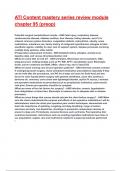
ATI Content mastery series review module
chapter 95 (preop)
Potential surgical complications include - ANS Fetal injury, respiratory disease,
cardiovascular disease, diabetes mellitus, liver disease, kidney disease, and if it is
ordered, immune system disorders, coagulation defects, malnutrition, obesity, some
medications, substance use, family history of malignant hyperthermia, allergies to latex
anesthetic agents, inability to cope, lack of support system, disease processes involving
multiple body systems, older adults
\Preoperative assessment includes - ANS Detailed history, allergies, anxiety level,
baseline data, and venous thromboembolism risk
\What are some labs to look at? - ANS Urinalysis, Blood type and crossmatch, CBC,
pregnancy test, clotting studies such as PT, INR, APTT, and platelet count, Electrolyte
levels, serum creatinine and BUN, ABGs, chest x-ray, and 12 lead ECG
\What are some nursing care for pre-operative patients? - ANS Informed consent, enemas
if undergoing bowel surgery, check scheduled medication prescriptions especially if they
can be held after the procedures, and PO for at least six hours for Solid food and two
hours for clear liquids before surgery with general anesthesia, clean skin, jewelry is
dentures etc. removed, cover client with lightweight blanket, stylish IV access, I minister
pre-operative medications as prescribed such as prophylactic antibiotics, plant should
void prior, Ensure pre-operative checklist is complete
\What are some of the risk factors for surgery? - ANS Infection, anemia, hypokalemia
from dehydration or blood loss, Electrolyte in balance due in adequate diet or disease
processes
\What are some things that nurses should educate the client before surgery? - ANS Make
sure the client understands the purpose and effects of pre-operative medications I will be
administered, teach the client post operative pain control techniques, demonstrate and
teach the importance of splinting, coughing and deep breathing; range of motion
exercises and early I am beautician, stockings in pneumatic compression devices to
prevent a deep vein Thrombosis, invasive Devices such as Drains, Post operative diet,
incentives barometer, instructions such as avoiding cigarettes medications two holes in
our preparation, explain care and restrictions related to surgical procedures performed
\
chapter 95 (preop)
Potential surgical complications include - ANS Fetal injury, respiratory disease,
cardiovascular disease, diabetes mellitus, liver disease, kidney disease, and if it is
ordered, immune system disorders, coagulation defects, malnutrition, obesity, some
medications, substance use, family history of malignant hyperthermia, allergies to latex
anesthetic agents, inability to cope, lack of support system, disease processes involving
multiple body systems, older adults
\Preoperative assessment includes - ANS Detailed history, allergies, anxiety level,
baseline data, and venous thromboembolism risk
\What are some labs to look at? - ANS Urinalysis, Blood type and crossmatch, CBC,
pregnancy test, clotting studies such as PT, INR, APTT, and platelet count, Electrolyte
levels, serum creatinine and BUN, ABGs, chest x-ray, and 12 lead ECG
\What are some nursing care for pre-operative patients? - ANS Informed consent, enemas
if undergoing bowel surgery, check scheduled medication prescriptions especially if they
can be held after the procedures, and PO for at least six hours for Solid food and two
hours for clear liquids before surgery with general anesthesia, clean skin, jewelry is
dentures etc. removed, cover client with lightweight blanket, stylish IV access, I minister
pre-operative medications as prescribed such as prophylactic antibiotics, plant should
void prior, Ensure pre-operative checklist is complete
\What are some of the risk factors for surgery? - ANS Infection, anemia, hypokalemia
from dehydration or blood loss, Electrolyte in balance due in adequate diet or disease
processes
\What are some things that nurses should educate the client before surgery? - ANS Make
sure the client understands the purpose and effects of pre-operative medications I will be
administered, teach the client post operative pain control techniques, demonstrate and
teach the importance of splinting, coughing and deep breathing; range of motion
exercises and early I am beautician, stockings in pneumatic compression devices to
prevent a deep vein Thrombosis, invasive Devices such as Drains, Post operative diet,
incentives barometer, instructions such as avoiding cigarettes medications two holes in
our preparation, explain care and restrictions related to surgical procedures performed
\