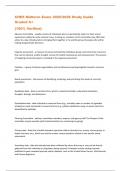
CHES Midterm Exam 2025/2026 Study Guide
Graded A+
(100% Verified)
Advisory Committee - usually consists of individuals who can periodically report on their actual
experiences related to some common issue. In doing so, members of this committee may offer their
advice to a key individual who is bringing them together or to another group of people who will be
making programmatic decisions
Capacity assessment - a measure of actual and potential individual, group, and community resources
that can be inherent, and/or brought, to bear for health maintenance and enhancement. The process
of mapping community assets is included in the capacity assessment
Coalition - a group of diverse organizations and constituencies working together toward a common
goal
Needs assessment - the process of identifying, analysing, and prioritizing the needs of a priority
population
Qualitative data - data in narrative form, which is collected to better understand motivation,
thoughts, feelings, and behaviours
Quantitative data - data collected in numerical form (e.g., mortality rates or number of cigarettes
smoked) or easily translated to numerical form (e.g., patient satisfaction using a 5-point scale from
dissatisfied to satisfied)
Planning Committee - advisory committee members, experts, and agency staff. The lifespan of this
committee may be episodic (with limited duration) or continuing (on-going)
Primary data - data that a health education specialist collects directly (via a survey, a focus group, in-
depth interview, etc.), which are used to answer unique questions related to the specific needs
assessment
Secondary data - data that already have been collected by others that may or may not be directly
gathered from the individual or population being assessed. Examples include existing research
published in peer-reviewed journals and/or datasets, such as the United States Census, Vital Records,
and Disease Registries
,Stakeholders - individuals or agencies with a vested interest in the health education program
Social determinants of health - conditions in which people are born, live, work, play, as well as age,
that affect their health risks, health, daily functioning, and quality of life (Centres for Disease Control
and Prevention [CDC], 2018a)
needs assessment - the process of identifying, analysing, and prioritizing the needs of a priority
population
capacity (asset-based) assessment - actual and potential influential resources in the community (e.g.,
stakeholders) and the support (e.g., individual protective factors, significant others, settings) at an
individual level to address needs
Area of Responsibility 1 - Assessment of Needs and Capacity
Competency 1.1 Plan Assessment - Sub-competencies:
1.1.1 Define the purpose and scope of the assessment.
1.1.2 Identify priority population(s).
1.1.3 Identify existing and available resources, policies, programs, practices, and interventions.
1.1.4 Examine the factors and determinants that influence the assessment process.
1.1.5 Recruit and/or engage priority population(s), partners, and stakeholders to participate
throughout all steps in the assessment, planning, implementation, and evaluation processes.
1.1.1 Planning committee should ask and address at this stage of the assessment process - What is
the goal of the needs assessment?
What does the planning committee hope to gain from the needs assessment?
How extensive will the needs assessment be?
What types of resources will be available to conduct the needs assessment?
What type of needs assessment is appropriate? (e.g., comprehensive, focused)
1.1.2 Priority Population - can be identified by the demographic qualities of the population such as
age, sex, ethnicity, and income that will impact the information gathered for the needs assessment.
,Community perspective - allows health education specialists to use specific criteria including
geography (i.e., state, county, zip code), sector (i.e., school, worksite, faith-based), environmental
conditions, culture and social aspects, size of population, and shared characteristics within the
community to further define the priority population
1.1.3 Existing Five factors - Resources
Policies
Programs
Practices
Interventions
Resources - human resources (e.g., staff, data collectors), supplies, incentives for participation, and
travel funds that are available to conduct assessment.
individuals, organizations and institutions, buildings, landscapes, equipment that may be a potential
asset for development of the program/intervention.
assessments that have been conducted in the targeted community to avoid duplication of efforts.
Policies - (e.g., laws, regulations, both formal/informal) at the sector/organizational, local, state
and/or federal level that may influence the actions or behaviors of the priority population
Programs area 1 - available for the priority population to assess usage, effectiveness, accessibility and
if priority population needs are being met to avoid duplication
Practices - evidence-based, or best practices, that can have the potential to impact assessment
process/findings and program planning efforts in multiple settings and populations
Interventions - designed to change environmental or behavioral factors related to health
6 types of community assets - individual
institutional
organizational
governmental
physical and land
cultural
, 1.1.4 Framing the Assessment Factors and Determinants - identify both a planning model and
implementation model in this stage, which will help to identify the types of data that need to be
collected to fully understand the complex influences on health
Priority Population Perspective - Expressed, actual, perceived, and relative needs should all be
addressed in the needs assessment, because community concerns may not always reflect empirical
evidence
Expressed needs - observed through individuals' use of services
Actual needs - inferred through the discrepancy of services provided to one community group as
compared to another
Perceived needs - what individuals in a community state that they want
Relative needs - describe a discrepancy between an individual's or group's current status and that of
others, such as smoke free environment in restaurants among different cities
1.1.5 Recruit/Engage - Involving those who will be impacted by the health promotion
program/intervention
Partners - either individuals or organizations that bring knowledge, skills, or resources to the table
and are willing to share risks, responsibilities, and rewards
8 reasons why partnering is beneficial - Meeting the needs of a priority population, which could not
be met by the capacities of an individual partner.
Sharing of financial resources.
Solving a problem or achieving a goal that is a priority to several partners.
Bringing more stakeholders to the "table."
Bringing more credibility to the program.
Seeing and solving a problem from multiple perspectives.
Creating a greater response to a need because there is strength in numbers.
Graded A+
(100% Verified)
Advisory Committee - usually consists of individuals who can periodically report on their actual
experiences related to some common issue. In doing so, members of this committee may offer their
advice to a key individual who is bringing them together or to another group of people who will be
making programmatic decisions
Capacity assessment - a measure of actual and potential individual, group, and community resources
that can be inherent, and/or brought, to bear for health maintenance and enhancement. The process
of mapping community assets is included in the capacity assessment
Coalition - a group of diverse organizations and constituencies working together toward a common
goal
Needs assessment - the process of identifying, analysing, and prioritizing the needs of a priority
population
Qualitative data - data in narrative form, which is collected to better understand motivation,
thoughts, feelings, and behaviours
Quantitative data - data collected in numerical form (e.g., mortality rates or number of cigarettes
smoked) or easily translated to numerical form (e.g., patient satisfaction using a 5-point scale from
dissatisfied to satisfied)
Planning Committee - advisory committee members, experts, and agency staff. The lifespan of this
committee may be episodic (with limited duration) or continuing (on-going)
Primary data - data that a health education specialist collects directly (via a survey, a focus group, in-
depth interview, etc.), which are used to answer unique questions related to the specific needs
assessment
Secondary data - data that already have been collected by others that may or may not be directly
gathered from the individual or population being assessed. Examples include existing research
published in peer-reviewed journals and/or datasets, such as the United States Census, Vital Records,
and Disease Registries
,Stakeholders - individuals or agencies with a vested interest in the health education program
Social determinants of health - conditions in which people are born, live, work, play, as well as age,
that affect their health risks, health, daily functioning, and quality of life (Centres for Disease Control
and Prevention [CDC], 2018a)
needs assessment - the process of identifying, analysing, and prioritizing the needs of a priority
population
capacity (asset-based) assessment - actual and potential influential resources in the community (e.g.,
stakeholders) and the support (e.g., individual protective factors, significant others, settings) at an
individual level to address needs
Area of Responsibility 1 - Assessment of Needs and Capacity
Competency 1.1 Plan Assessment - Sub-competencies:
1.1.1 Define the purpose and scope of the assessment.
1.1.2 Identify priority population(s).
1.1.3 Identify existing and available resources, policies, programs, practices, and interventions.
1.1.4 Examine the factors and determinants that influence the assessment process.
1.1.5 Recruit and/or engage priority population(s), partners, and stakeholders to participate
throughout all steps in the assessment, planning, implementation, and evaluation processes.
1.1.1 Planning committee should ask and address at this stage of the assessment process - What is
the goal of the needs assessment?
What does the planning committee hope to gain from the needs assessment?
How extensive will the needs assessment be?
What types of resources will be available to conduct the needs assessment?
What type of needs assessment is appropriate? (e.g., comprehensive, focused)
1.1.2 Priority Population - can be identified by the demographic qualities of the population such as
age, sex, ethnicity, and income that will impact the information gathered for the needs assessment.
,Community perspective - allows health education specialists to use specific criteria including
geography (i.e., state, county, zip code), sector (i.e., school, worksite, faith-based), environmental
conditions, culture and social aspects, size of population, and shared characteristics within the
community to further define the priority population
1.1.3 Existing Five factors - Resources
Policies
Programs
Practices
Interventions
Resources - human resources (e.g., staff, data collectors), supplies, incentives for participation, and
travel funds that are available to conduct assessment.
individuals, organizations and institutions, buildings, landscapes, equipment that may be a potential
asset for development of the program/intervention.
assessments that have been conducted in the targeted community to avoid duplication of efforts.
Policies - (e.g., laws, regulations, both formal/informal) at the sector/organizational, local, state
and/or federal level that may influence the actions or behaviors of the priority population
Programs area 1 - available for the priority population to assess usage, effectiveness, accessibility and
if priority population needs are being met to avoid duplication
Practices - evidence-based, or best practices, that can have the potential to impact assessment
process/findings and program planning efforts in multiple settings and populations
Interventions - designed to change environmental or behavioral factors related to health
6 types of community assets - individual
institutional
organizational
governmental
physical and land
cultural
, 1.1.4 Framing the Assessment Factors and Determinants - identify both a planning model and
implementation model in this stage, which will help to identify the types of data that need to be
collected to fully understand the complex influences on health
Priority Population Perspective - Expressed, actual, perceived, and relative needs should all be
addressed in the needs assessment, because community concerns may not always reflect empirical
evidence
Expressed needs - observed through individuals' use of services
Actual needs - inferred through the discrepancy of services provided to one community group as
compared to another
Perceived needs - what individuals in a community state that they want
Relative needs - describe a discrepancy between an individual's or group's current status and that of
others, such as smoke free environment in restaurants among different cities
1.1.5 Recruit/Engage - Involving those who will be impacted by the health promotion
program/intervention
Partners - either individuals or organizations that bring knowledge, skills, or resources to the table
and are willing to share risks, responsibilities, and rewards
8 reasons why partnering is beneficial - Meeting the needs of a priority population, which could not
be met by the capacities of an individual partner.
Sharing of financial resources.
Solving a problem or achieving a goal that is a priority to several partners.
Bringing more stakeholders to the "table."
Bringing more credibility to the program.
Seeing and solving a problem from multiple perspectives.
Creating a greater response to a need because there is strength in numbers.