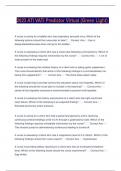
SOCI Exam 2 Practice Solution Manual Already Passed
1. Socialization does not occur through social networking sites like Facebook, Twitter, and Snapchat. -
Answers F
2. Erving Goffman developed the theory of dramaturgy, which views an individual's social life as a series
of dramatic performances. - Answers T
3. Sociologists focus on the various agents of socialization that help a child learn society's norms and
culture. - Answers T
4. As a child matures, peer socialization becomes more important and more likely to conflict with
primary socialization - Answers T
5. An example of resocialization would be learning new behavioral expectations when moving from the
city to a rural area. - Answers F
6. A high school is an excellent example of a total institution. - Answers F
7. An example of role conflict would be a man who needs to attend a business meeting at the same time
his children have a playoff baseball game. - Answers T
8. Triads are the most basic of interpersonal relationships. - Answers F
9. Mike is a Dodgers baseball fan who enjoys sitting in the stadium next to fellow fans of the team,
which would be considered Mike's out-group. - Answers F
1. Explain the concept of "the strength of weak ties." How are weak ties strong? - Answers Weak ties are
strong because we can network with a much larger group and possibly accomplish more.
1. Organizations refer to collectives, which are purposely constructed to achieve particular ends. -
Answers T
2. According to Max Weber, bureaucracies are always rational organizations. - Answers F
3. The development of bureaucracy is one of the defining characteristics of Western society. - Answers T
4. The leaders of cults often have outgoing and engaging personalities and therefore are referred to as
people who exert charismatic authority. - Answers T
5. Theories of glass ceilings for women have been based on studies of American organizations and are
unlikely to apply globally. - Answers F
6. Contemporary organizations have been forced to become more flexible and agile than the ideal type
of a bureaucracy. - Answers T
7. A network organization can be composed of several "interconnected nodes" with a horizontal
structure and fuzzy boundaries. - Answers T
, 8. Spaces of flows are likely to have clear and defensible borders and are permanent in nature. -
Answers F
9. Some of the most important and most obvious barriers to global flows are those constructed by
nation-states, but nation-states have been losing control over a number of global flows. - Answers T
1. Discuss the concepts of gemeinschaft and gesellschaft according to Ferdinand Töennies and give an
example of each. - Answers gemeinschaft society as a traditional society characterized by face-to-face
relations, a gesellschaft society is characterized by social relations that are impersonal, distant, and
limited
1. Deviance is defined as an action, belief, or human characteristic that is inherently against human
nature. - Answers F
2. Deviance may vary greatly from one geographic area to another. - Answers T
3. Deviant consumers include those who consume too much or do not consume enough conventional
goods. - Answers T
4. Explanatory theories of deviance mostly focus on upbringing as the factor responsible for deviance. -
Answers T
5. In strain theory, "innovators" reject both cultural goals and the traditional routes to their attainment.
- Answers F
6. Travis Hirschi's social control theory focuses on why people do not commit deviant acts. - Answers T
7. Conflict/critical theorists focus on how inequalities cause some of the less powerful individuals in
society to engage in deviant and criminal acts because they have few, if any, other ways of succeeding in
society. - Answers T
8. Part of the interactionist perspective, as it pertains to deviance, is the interpretation of symbols and
the interactions between people. - Answers T
9. Labeling theory is concerned with the reactions, actions, and interactions of social control agents who
label the person as deviant. - Answers T
1. Discuss the application of conflict theories to deviance, the elite, and the poor. Select one example of
how this approach can be applied to a contemporary issue of deviance - Answers conflict theories see
social inequality as very important to how deviance is defined and how deviant behaviors are punished
WHAT IS DEVIANCE? - Answers Deviance is seen as something created by the capitalist economic system
in which the interests of capitalists are served
1. The three dimensions of social stratification are social class, income, and power. - Answers F
1. Socialization does not occur through social networking sites like Facebook, Twitter, and Snapchat. -
Answers F
2. Erving Goffman developed the theory of dramaturgy, which views an individual's social life as a series
of dramatic performances. - Answers T
3. Sociologists focus on the various agents of socialization that help a child learn society's norms and
culture. - Answers T
4. As a child matures, peer socialization becomes more important and more likely to conflict with
primary socialization - Answers T
5. An example of resocialization would be learning new behavioral expectations when moving from the
city to a rural area. - Answers F
6. A high school is an excellent example of a total institution. - Answers F
7. An example of role conflict would be a man who needs to attend a business meeting at the same time
his children have a playoff baseball game. - Answers T
8. Triads are the most basic of interpersonal relationships. - Answers F
9. Mike is a Dodgers baseball fan who enjoys sitting in the stadium next to fellow fans of the team,
which would be considered Mike's out-group. - Answers F
1. Explain the concept of "the strength of weak ties." How are weak ties strong? - Answers Weak ties are
strong because we can network with a much larger group and possibly accomplish more.
1. Organizations refer to collectives, which are purposely constructed to achieve particular ends. -
Answers T
2. According to Max Weber, bureaucracies are always rational organizations. - Answers F
3. The development of bureaucracy is one of the defining characteristics of Western society. - Answers T
4. The leaders of cults often have outgoing and engaging personalities and therefore are referred to as
people who exert charismatic authority. - Answers T
5. Theories of glass ceilings for women have been based on studies of American organizations and are
unlikely to apply globally. - Answers F
6. Contemporary organizations have been forced to become more flexible and agile than the ideal type
of a bureaucracy. - Answers T
7. A network organization can be composed of several "interconnected nodes" with a horizontal
structure and fuzzy boundaries. - Answers T
, 8. Spaces of flows are likely to have clear and defensible borders and are permanent in nature. -
Answers F
9. Some of the most important and most obvious barriers to global flows are those constructed by
nation-states, but nation-states have been losing control over a number of global flows. - Answers T
1. Discuss the concepts of gemeinschaft and gesellschaft according to Ferdinand Töennies and give an
example of each. - Answers gemeinschaft society as a traditional society characterized by face-to-face
relations, a gesellschaft society is characterized by social relations that are impersonal, distant, and
limited
1. Deviance is defined as an action, belief, or human characteristic that is inherently against human
nature. - Answers F
2. Deviance may vary greatly from one geographic area to another. - Answers T
3. Deviant consumers include those who consume too much or do not consume enough conventional
goods. - Answers T
4. Explanatory theories of deviance mostly focus on upbringing as the factor responsible for deviance. -
Answers T
5. In strain theory, "innovators" reject both cultural goals and the traditional routes to their attainment.
- Answers F
6. Travis Hirschi's social control theory focuses on why people do not commit deviant acts. - Answers T
7. Conflict/critical theorists focus on how inequalities cause some of the less powerful individuals in
society to engage in deviant and criminal acts because they have few, if any, other ways of succeeding in
society. - Answers T
8. Part of the interactionist perspective, as it pertains to deviance, is the interpretation of symbols and
the interactions between people. - Answers T
9. Labeling theory is concerned with the reactions, actions, and interactions of social control agents who
label the person as deviant. - Answers T
1. Discuss the application of conflict theories to deviance, the elite, and the poor. Select one example of
how this approach can be applied to a contemporary issue of deviance - Answers conflict theories see
social inequality as very important to how deviance is defined and how deviant behaviors are punished
WHAT IS DEVIANCE? - Answers Deviance is seen as something created by the capitalist economic system
in which the interests of capitalists are served
1. The three dimensions of social stratification are social class, income, and power. - Answers F