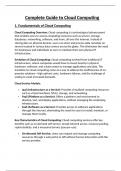
Complete Guide to Cloud Computing
1. Fundamentals of Cloud Computing
Cloud Computing Overview: Cloud computing is a technological advancement
that enables users to access computing resources such as servers, storage,
databases, networking, software, and more, all over the internet. Instead of
storing data on physical devices, users can store and process data remotely on
servers located in various data centers across the globe. This eliminates the need
for businesses and individuals to own or maintain their own physical IT
infrastructure.
Evolution of Cloud Computing: Cloud computing evolved from traditional IT
infrastructure, where companies would have to invest heavily in physical
hardware, software, and a data center to manage applications and data. The
transition to cloud computing came as a way to address the inefficiencies of on-
premise solutions—high upfront costs, hardware failures, and the challenge of
scaling to meet increased demands.
Cloud Service Models:
IaaS (Infrastructure as a Service): Provides virtualized computing resources
such as virtual machines (VMs), storage, and networking.
PaaS (Platform as a Service): Offers a platform and environment to
develop, test, and deploy applications, without managing the underlying
infrastructure.
SaaS (Software as a Service): Provides access to software applications
through the internet, eliminating the need for users to install, maintain, or
manage them locally.
Key Characteristics of Cloud Computing: Cloud computing services offer key
benefits such as on-demand self-service, broad network access, resource pooling,
rapid elasticity, and a measured service (pay-per-use).
On-demand Self-Service: Users can request and manage computing
resources through a web portal or API without human interaction with the
service provider.
, Broad Network Access: Cloud resources are accessible from various devices
with internet access, such as laptops, smartphones, and desktops.
Resource Pooling: Cloud providers pool computing resources to serve
multiple clients, utilizing multi-tenant models.
Rapid Elasticity: The ability to scale resources up or down quickly as
required by demand.
Measured Service: Resources are metered, and clients are billed according
to usage.
2. Cloud Service Models (IaaS, PaaS, SaaS)
Cloud service models offer varying degrees of control and management for users,
from managing the entire infrastructure to simply using an application over the
cloud.
IaaS (Infrastructure as a Service):
IaaS provides users with virtualized computing infrastructure over the
internet. Users have full control over their operating systems, applications,
and storage while the cloud provider manages the physical infrastructure.
Examples:
o Amazon Web Services (AWS): AWS offers scalable compute power
with services like EC2, S3, and RDS, among others.
o Microsoft Azure: Azure provides virtual machines, load balancers,
and storage services, among others.
Benefits of IaaS:
Cost-Efficiency: Users only pay for what they use, eliminating the need for
large upfront investments in hardware.
Scalability: Easily scale computing resources up or down based on demand,
ensuring businesses only pay for what they need.
Flexibility: Users can install and configure operating systems and
applications, ensuring complete flexibility over their infrastructure.
1. Fundamentals of Cloud Computing
Cloud Computing Overview: Cloud computing is a technological advancement
that enables users to access computing resources such as servers, storage,
databases, networking, software, and more, all over the internet. Instead of
storing data on physical devices, users can store and process data remotely on
servers located in various data centers across the globe. This eliminates the need
for businesses and individuals to own or maintain their own physical IT
infrastructure.
Evolution of Cloud Computing: Cloud computing evolved from traditional IT
infrastructure, where companies would have to invest heavily in physical
hardware, software, and a data center to manage applications and data. The
transition to cloud computing came as a way to address the inefficiencies of on-
premise solutions—high upfront costs, hardware failures, and the challenge of
scaling to meet increased demands.
Cloud Service Models:
IaaS (Infrastructure as a Service): Provides virtualized computing resources
such as virtual machines (VMs), storage, and networking.
PaaS (Platform as a Service): Offers a platform and environment to
develop, test, and deploy applications, without managing the underlying
infrastructure.
SaaS (Software as a Service): Provides access to software applications
through the internet, eliminating the need for users to install, maintain, or
manage them locally.
Key Characteristics of Cloud Computing: Cloud computing services offer key
benefits such as on-demand self-service, broad network access, resource pooling,
rapid elasticity, and a measured service (pay-per-use).
On-demand Self-Service: Users can request and manage computing
resources through a web portal or API without human interaction with the
service provider.
, Broad Network Access: Cloud resources are accessible from various devices
with internet access, such as laptops, smartphones, and desktops.
Resource Pooling: Cloud providers pool computing resources to serve
multiple clients, utilizing multi-tenant models.
Rapid Elasticity: The ability to scale resources up or down quickly as
required by demand.
Measured Service: Resources are metered, and clients are billed according
to usage.
2. Cloud Service Models (IaaS, PaaS, SaaS)
Cloud service models offer varying degrees of control and management for users,
from managing the entire infrastructure to simply using an application over the
cloud.
IaaS (Infrastructure as a Service):
IaaS provides users with virtualized computing infrastructure over the
internet. Users have full control over their operating systems, applications,
and storage while the cloud provider manages the physical infrastructure.
Examples:
o Amazon Web Services (AWS): AWS offers scalable compute power
with services like EC2, S3, and RDS, among others.
o Microsoft Azure: Azure provides virtual machines, load balancers,
and storage services, among others.
Benefits of IaaS:
Cost-Efficiency: Users only pay for what they use, eliminating the need for
large upfront investments in hardware.
Scalability: Easily scale computing resources up or down based on demand,
ensuring businesses only pay for what they need.
Flexibility: Users can install and configure operating systems and
applications, ensuring complete flexibility over their infrastructure.