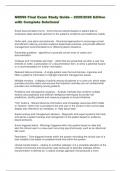
NR599 Final Exam Study Guide – 2025/2026 Edition
with Complete Solutions!
Smart documentation forms - forms that are tailored based on patient data to
emphasize data elements pertinent to the patient's conditions and healthcare needs.
Order sets, care plans and protocols - Structured approaches to encourage correct
and efficient ordering, promote evidence-based best practices, and provide different
management recommendations for different patient situations.
Parameter guideline - algorithms to promote correct entry of orders and
documentation.
Critiques and "immediate warnings" - Alerts that are presented just after a user has
entered an order, a prescription or a documentation item, to show a potential hazard
or a recommendation for further information.
Relevant data summaries - A single-patient view that summarizes, organizes and
filters a patient's information to highlight important management issues.
Multiple monitors - a display of activity among all patients on a care unit, which helps
providers prioritize tasks and ensures that important activities are not omitted while
providers are multitasking among patients.
Predictive and retrospective analytics: - Analytic methods that combine multiple
factors using statistical and artificial intelligence techniques to provide risk
predictions, stratify patients and measure progress on broad initiatives.
"Info" buttons - filtered reference information and knowledge resources within fields
or "buttons" where info is provided to the end user in the context of the current data
display also referred to as metadata, or "data about data".
Expert workup and management advisers - Diagnostic and expert systems that track
and advise a patient workup and management of the patient based on evidence-
based protocols.
Event-triggered alerts - Warnings triggered within the system based on data that
alert the clinical user to a new event occurring asynchronously, such as an abnormal
lab result.
Reminders - Time-triggered events within the system reminding the clinical user of a
task needed to be based on predetermined time within the system.
clinical transformation - relative to workflow redesign; it is a complete alteration of the
clinical environment and should be used cautiously to describe redesign efforts;
transformation is defined as "a radical change approach that produces a more
, responsive organization that is more capable of performing in unstable and changing
environments that organizations continue to be faced with";
- this would imply that the manner in which work is carried out and the outcomes
achieved are completely different from the prior state. which is not always true when
the change involves implementing technology
- technology can be used to launch or in conjunction with a clinical transformation
initiative but the implementation of technology alone is not considered
transformational.
-
Optimization - - when workflow analysis occurs post implementation, it is often
referred to as ________________
- it is the process of moving conditions past their current states and into more
efficient and effective methods of performing tasks.
-it is considered to be the act, process, or methodology of making something (as a
design, system or decision) as fully perfect, functional, and effective as possible.
Process Analysis - breaking down the work process into a sequential series of steps
that can be examined and assessed to improve effectiveness and efficiency;
explains how work takes place, gets done, or how it can be done.
Workflow analysis - observation and documentation of workflow to better understand
what is happening in the current environment and how it can be altered is referred to
as this process.
- it requires careful attention to detail and the ability to moderate group discussions,
organize concepts, and generate solutions.
- this is part of every functional area the INS engages in.
Process Map - a typical output of workflow analysis is a visual depiction of the
process called a ______ ________; this provides an excellent tool to identify specific
steps in the workflow analysis process.
- it also provides a vehicle for communication and a tool upon which to build
educational material, procedures and policies.
- an example is the swim-lane technique
workflow - - a term used to describe the action or execution of a series of tasks in a
prescribed sequence.
- a progression of steps (tasks, events, interactions) that consitute:
1) a work process
2) involves two or more persons
3) creates and adds value to the organizations activities.
- also known as a process or process flow particularly in the context of
implementation.
swim-lane technique - because workflow crosses many different care providers, it
may be useful to construct the process map using this technique, which uses
categories such as functional work groups and roles to visually depict groups of work
and to indicate who performs the work.
with Complete Solutions!
Smart documentation forms - forms that are tailored based on patient data to
emphasize data elements pertinent to the patient's conditions and healthcare needs.
Order sets, care plans and protocols - Structured approaches to encourage correct
and efficient ordering, promote evidence-based best practices, and provide different
management recommendations for different patient situations.
Parameter guideline - algorithms to promote correct entry of orders and
documentation.
Critiques and "immediate warnings" - Alerts that are presented just after a user has
entered an order, a prescription or a documentation item, to show a potential hazard
or a recommendation for further information.
Relevant data summaries - A single-patient view that summarizes, organizes and
filters a patient's information to highlight important management issues.
Multiple monitors - a display of activity among all patients on a care unit, which helps
providers prioritize tasks and ensures that important activities are not omitted while
providers are multitasking among patients.
Predictive and retrospective analytics: - Analytic methods that combine multiple
factors using statistical and artificial intelligence techniques to provide risk
predictions, stratify patients and measure progress on broad initiatives.
"Info" buttons - filtered reference information and knowledge resources within fields
or "buttons" where info is provided to the end user in the context of the current data
display also referred to as metadata, or "data about data".
Expert workup and management advisers - Diagnostic and expert systems that track
and advise a patient workup and management of the patient based on evidence-
based protocols.
Event-triggered alerts - Warnings triggered within the system based on data that
alert the clinical user to a new event occurring asynchronously, such as an abnormal
lab result.
Reminders - Time-triggered events within the system reminding the clinical user of a
task needed to be based on predetermined time within the system.
clinical transformation - relative to workflow redesign; it is a complete alteration of the
clinical environment and should be used cautiously to describe redesign efforts;
transformation is defined as "a radical change approach that produces a more
, responsive organization that is more capable of performing in unstable and changing
environments that organizations continue to be faced with";
- this would imply that the manner in which work is carried out and the outcomes
achieved are completely different from the prior state. which is not always true when
the change involves implementing technology
- technology can be used to launch or in conjunction with a clinical transformation
initiative but the implementation of technology alone is not considered
transformational.
-
Optimization - - when workflow analysis occurs post implementation, it is often
referred to as ________________
- it is the process of moving conditions past their current states and into more
efficient and effective methods of performing tasks.
-it is considered to be the act, process, or methodology of making something (as a
design, system or decision) as fully perfect, functional, and effective as possible.
Process Analysis - breaking down the work process into a sequential series of steps
that can be examined and assessed to improve effectiveness and efficiency;
explains how work takes place, gets done, or how it can be done.
Workflow analysis - observation and documentation of workflow to better understand
what is happening in the current environment and how it can be altered is referred to
as this process.
- it requires careful attention to detail and the ability to moderate group discussions,
organize concepts, and generate solutions.
- this is part of every functional area the INS engages in.
Process Map - a typical output of workflow analysis is a visual depiction of the
process called a ______ ________; this provides an excellent tool to identify specific
steps in the workflow analysis process.
- it also provides a vehicle for communication and a tool upon which to build
educational material, procedures and policies.
- an example is the swim-lane technique
workflow - - a term used to describe the action or execution of a series of tasks in a
prescribed sequence.
- a progression of steps (tasks, events, interactions) that consitute:
1) a work process
2) involves two or more persons
3) creates and adds value to the organizations activities.
- also known as a process or process flow particularly in the context of
implementation.
swim-lane technique - because workflow crosses many different care providers, it
may be useful to construct the process map using this technique, which uses
categories such as functional work groups and roles to visually depict groups of work
and to indicate who performs the work.