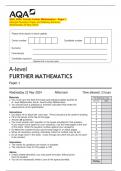
AQA_2024: A-level Further Mathematics - Paper 2
(Merged Question Paper and Marking Scheme)
(Monday 3 June 2024)
Please write clearly in block capitals.
Centre number Candidate number
Surname
Forename(s)
Candidate signature
I declare this is my own work.
A-level
FURTHER MATHEMATICS
Paper 2
Monday 3 June 2024 Afternoon Time allowed: 2 hours
Materials For Examiner’s Use
You must have the AQA Formulae and statistical tables booklet for Question Mark
A‑ level Mathematics and A‑ level Further Mathematics.
1
You should have a graphical or scientific calculator that meets the
requirements of the specification. 2
3
Instructions 4
Use black ink or black ball‑ point pen. Pencil should only be used for drawing. 5
Fill in the boxes at the top of this page.
6
Answer all questions.
7
You must answer each question in the space provided for that question.
If you require extra space for your answer(s), use the lined pages at the end 8
of this book. Write the question number against your answer(s). 9
Do not write outside the box around each page or on blank pages. 10
Show all necessary working; otherwise marks for method may be lost. 11
Do all rough work in this book. Cross through any work that you do not want 12
to be marked. 13
14
Information
The marks for questions are shown in brackets.
15
The maximum mark for this paper is 100. 16
17
Advice 18
Unless stated otherwise, you may quote formulae, without proof, 19
from the booklet.
20
You do not necessarily need to use all the space provided.
TOTAL
,A-Level Further Mathematics: Paper 2 (Monday 3 June 2024)
Exam Preview Areas
This paper focuses on Applied Mathematics, covering both Mechanics and Statistics:
Mechanics:
1. Kinematics: Describing motion in straight lines, using equations of motion for uniformly accelerated
objects and analyzing projectile motion (e.g., range, height, time of flight).
2. Forces and Newton’s Laws: Applying Newton’s second law F=maF = maF=ma to solve problems
involving forces, acceleration, and friction. Understanding equilibrium conditions for objects at rest or
moving at constant velocity.
3. Momentum: Conservation of momentum in collisions, solving problems involving elastic and inelastic
collisions.
4. Energy: Work-energy theorem, calculating kinetic and potential energy, understanding energy transfer,
and applying conservation of mechanical energy in various contexts.
5. Circular Motion: Analyzing motion in a circle, including calculating centripetal force and angular
velocity, and understanding the relationship between linear and angular quantities.
6. Statics: Solving problems using the conditions for equilibrium, working with moments (torque), and
finding the center of mass of objects.
Statistics:
1. Probability: Calculating probabilities of events, conditional probability, and applying Bayes’ Theorem
to solve real-world problems.
2. Distributions: Using Binomial, Poisson, and Normal distributions to model data and calculate
probabilities or expected values.
3. Hypothesis Testing: Testing hypotheses using z-tests and t-tests for means or proportions,
interpreting P-values, and determining the significance of results.
4. Estimation: Constructing confidence intervals to estimate population parameters and calculating
margins of error.
5. Bivariate Data: Using correlation and regression analysis to explore relationships between two
variables, fitting lines to data, and interpreting results.
This paper will test your ability to apply mathematical techniques in real-world contexts, requiring both
theoretical understanding and problem-solving skills in mechanics and statistics.
G/LM/Jun24/G4006/V7 7367/2
, 2
Do not write
outside the
box
Answer all questions in the spaces provided.
1 It is given that
2 5
1 λ =0
3 –6
where λ is a constant.
Find the value of λ
Circle your answer.
[1 mark]
–28 –8 8 28
2 The movement of a particle is described by the simple harmonic equation
..
x = –25x
..
where x metres is the displacement of the particle at time t seconds, and x m s–2 is
the acceleration of the particle.
The maximum displacement of the particle is 9 metres.
Find the maximum speed of the particle.
Circle your answer.
[1 mark]
15 m s–1 45 m s–1 75 m s–1 135 m s–1
G/Jun24/7367/2
, 3
Do not write
outside the
box
3 The function g is defined by
g(x) = sech x (x ℝ)
Which one of the following is the range of g ?
Tick () one box.
[1 mark]
– < g(x) ≤ –1
– 1 ≤ g(x) < 0
0 < g(x) ≤ 1
1 ≤ g(x) ≤
4 The function f is a quartic function with real coefficients.
The complex number 5i is a root of the equation f (x) = 0
Which one of the following must be a factor of f (x)?
Circle your answer.
[1 mark]
(x2 – 25) (x2 – 5) (x2 + 5) (x2 + 25)
Turn over U
G/Jun24/7367/2
, 4
Do not write
outside the
box
5 The first four terms of the series S can be written as
S = (1 × 2) + (2 × 3) + (3 × 4) + (4 × 5) + ...
5 (a) Write an expression, using notation, for the sum of the first n terms of S [1 mark]
5 (b) Show that the sum of the first n terms of S is equal to
1
n(n + 1)(n + 2)
3
[2 marks]
G/Jun24/7367/2
, 5
Do not write
outside the
box
6 The cubic equation
x 3 + 5 x 2 – 4x + 2 = 0
has roots α, β and γ
Find a cubic equation, with integer coefficients, whose roots are 3α, 3β and 3γ
[3 marks]
Turn over for the next question
Turn over U
G/Jun24/7367/2
, 6
Do not write
outside the
box
7 The matrices A and B are defined as follows.
p–2 p–1 1 2p – 1
A= B=
0 1 0 4–p
Find the values of p such that A and B are commutative under matrix multiplication.
Fully justify your answer.
[4 marks]
G/Jun24/7367/2
, 7
Do not write
outside the
box
2 0
8 The vectors a, b, and c are such that a × b = 1 and a × c = 0
0 3
Work out (a – 4b + 3c) × (2a)
[4 marks]
Turn over U
G/Jun24/7367/2
(Merged Question Paper and Marking Scheme)
(Monday 3 June 2024)
Please write clearly in block capitals.
Centre number Candidate number
Surname
Forename(s)
Candidate signature
I declare this is my own work.
A-level
FURTHER MATHEMATICS
Paper 2
Monday 3 June 2024 Afternoon Time allowed: 2 hours
Materials For Examiner’s Use
You must have the AQA Formulae and statistical tables booklet for Question Mark
A‑ level Mathematics and A‑ level Further Mathematics.
1
You should have a graphical or scientific calculator that meets the
requirements of the specification. 2
3
Instructions 4
Use black ink or black ball‑ point pen. Pencil should only be used for drawing. 5
Fill in the boxes at the top of this page.
6
Answer all questions.
7
You must answer each question in the space provided for that question.
If you require extra space for your answer(s), use the lined pages at the end 8
of this book. Write the question number against your answer(s). 9
Do not write outside the box around each page or on blank pages. 10
Show all necessary working; otherwise marks for method may be lost. 11
Do all rough work in this book. Cross through any work that you do not want 12
to be marked. 13
14
Information
The marks for questions are shown in brackets.
15
The maximum mark for this paper is 100. 16
17
Advice 18
Unless stated otherwise, you may quote formulae, without proof, 19
from the booklet.
20
You do not necessarily need to use all the space provided.
TOTAL
,A-Level Further Mathematics: Paper 2 (Monday 3 June 2024)
Exam Preview Areas
This paper focuses on Applied Mathematics, covering both Mechanics and Statistics:
Mechanics:
1. Kinematics: Describing motion in straight lines, using equations of motion for uniformly accelerated
objects and analyzing projectile motion (e.g., range, height, time of flight).
2. Forces and Newton’s Laws: Applying Newton’s second law F=maF = maF=ma to solve problems
involving forces, acceleration, and friction. Understanding equilibrium conditions for objects at rest or
moving at constant velocity.
3. Momentum: Conservation of momentum in collisions, solving problems involving elastic and inelastic
collisions.
4. Energy: Work-energy theorem, calculating kinetic and potential energy, understanding energy transfer,
and applying conservation of mechanical energy in various contexts.
5. Circular Motion: Analyzing motion in a circle, including calculating centripetal force and angular
velocity, and understanding the relationship between linear and angular quantities.
6. Statics: Solving problems using the conditions for equilibrium, working with moments (torque), and
finding the center of mass of objects.
Statistics:
1. Probability: Calculating probabilities of events, conditional probability, and applying Bayes’ Theorem
to solve real-world problems.
2. Distributions: Using Binomial, Poisson, and Normal distributions to model data and calculate
probabilities or expected values.
3. Hypothesis Testing: Testing hypotheses using z-tests and t-tests for means or proportions,
interpreting P-values, and determining the significance of results.
4. Estimation: Constructing confidence intervals to estimate population parameters and calculating
margins of error.
5. Bivariate Data: Using correlation and regression analysis to explore relationships between two
variables, fitting lines to data, and interpreting results.
This paper will test your ability to apply mathematical techniques in real-world contexts, requiring both
theoretical understanding and problem-solving skills in mechanics and statistics.
G/LM/Jun24/G4006/V7 7367/2
, 2
Do not write
outside the
box
Answer all questions in the spaces provided.
1 It is given that
2 5
1 λ =0
3 –6
where λ is a constant.
Find the value of λ
Circle your answer.
[1 mark]
–28 –8 8 28
2 The movement of a particle is described by the simple harmonic equation
..
x = –25x
..
where x metres is the displacement of the particle at time t seconds, and x m s–2 is
the acceleration of the particle.
The maximum displacement of the particle is 9 metres.
Find the maximum speed of the particle.
Circle your answer.
[1 mark]
15 m s–1 45 m s–1 75 m s–1 135 m s–1
G/Jun24/7367/2
, 3
Do not write
outside the
box
3 The function g is defined by
g(x) = sech x (x ℝ)
Which one of the following is the range of g ?
Tick () one box.
[1 mark]
– < g(x) ≤ –1
– 1 ≤ g(x) < 0
0 < g(x) ≤ 1
1 ≤ g(x) ≤
4 The function f is a quartic function with real coefficients.
The complex number 5i is a root of the equation f (x) = 0
Which one of the following must be a factor of f (x)?
Circle your answer.
[1 mark]
(x2 – 25) (x2 – 5) (x2 + 5) (x2 + 25)
Turn over U
G/Jun24/7367/2
, 4
Do not write
outside the
box
5 The first four terms of the series S can be written as
S = (1 × 2) + (2 × 3) + (3 × 4) + (4 × 5) + ...
5 (a) Write an expression, using notation, for the sum of the first n terms of S [1 mark]
5 (b) Show that the sum of the first n terms of S is equal to
1
n(n + 1)(n + 2)
3
[2 marks]
G/Jun24/7367/2
, 5
Do not write
outside the
box
6 The cubic equation
x 3 + 5 x 2 – 4x + 2 = 0
has roots α, β and γ
Find a cubic equation, with integer coefficients, whose roots are 3α, 3β and 3γ
[3 marks]
Turn over for the next question
Turn over U
G/Jun24/7367/2
, 6
Do not write
outside the
box
7 The matrices A and B are defined as follows.
p–2 p–1 1 2p – 1
A= B=
0 1 0 4–p
Find the values of p such that A and B are commutative under matrix multiplication.
Fully justify your answer.
[4 marks]
G/Jun24/7367/2
, 7
Do not write
outside the
box
2 0
8 The vectors a, b, and c are such that a × b = 1 and a × c = 0
0 3
Work out (a – 4b + 3c) × (2a)
[4 marks]
Turn over U
G/Jun24/7367/2