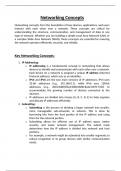
Networking Concepts
Networking concepts form the foundation of how devices, applications, and users
interact with each other over a network. These concepts are critical for
understanding the structure, communication, and management of data in any
type of network. Whether you are building a simple Local Area Network (LAN) or
a complex Wide Area Network (WAN), these concepts are essential for ensuring
the network operates efficiently, securely, and reliably.
Key Networking Concepts:
1. IP Addressing:
o IP addressing is a fundamental concept in networking that allows
devices to identify and communicate with each other over a network.
Each device on a network is assigned a unique IP address (Internet
Protocol address), which acts as an identifier.
o IPv4 and IPv6 are the two main versions of IP addresses. IPv4 uses
32-bit addresses (e.g., 192.168.0.1), while IPv6 uses 128-bit
addresses (e.g., 2001:0db8:85a3:0000:0000:8a2e:0370:7334) to
accommodate the growing number of devices connected to the
internet.
o IP addresses are divided into classes (A, B, C, D, E) to help organize
and allocate IP addresses efficiently.
2. Subnetting:
o Subnetting is the process of dividing a larger network into smaller,
more manageable sub-networks, or subnets. This is done by
borrowing bits from the host portion of the IP address and using
them for the network portion.
o Subnetting allows for efficient use of IP address space, better
security, and easier network management. The subnet mask
determines how the IP address is divided into network and host
portions.
o For example, a network might be subnetted into smaller segments to
reduce congestion or to group devices with similar communication
needs.
, 3. Routing:
o Routing is the process of determining the best path for data packets
to travel across networks from the source device to the destination.
Routers are devices that perform routing and connect multiple
networks, directing data traffic between them.
o Static routing involves manually configuring routing tables, while
dynamic routing uses protocols like RIP, OSPF, and BGP to
automatically adjust the routing path based on network conditions.
o Default gateway is the device that routes traffic from a local network
to other networks, such as the internet.
4. Switching:
o Switching refers to the process of directing data frames between
devices within the same network, often in a Local Area Network
(LAN). Switches operate at the Data Link Layer (Layer 2) of the OSI
model and use MAC addresses to forward data.
o Layer 2 switching handles traffic within the same LAN, while Layer 3
switching operates at the Network Layer (Layer 3) and involves
routing packets between different subnets or networks.
o A VLAN (Virtual Local Area Network) can be created to segment a
network into multiple logical networks, improving security and traffic
management.
5. Bandwidth:
o Bandwidth refers to the maximum amount of data that can be
transmitted over a network in a given amount of time, typically
measured in bits per second (bps). Higher bandwidth allows for
faster data transfer and better performance.
o Bandwidth is affected by various factors, including the type of
connection (e.g., fiber optics, copper wire), network congestion, and
the quality of the infrastructure.
6. Latency:
o Latency is the time it takes for data to travel from the source to the
destination. It is typically measured in milliseconds (ms). Low latency
is essential for real-time applications like VoIP (Voice over IP), online
gaming, and video conferencing.
o Latency can be influenced by factors such as network congestion, the
distance between devices, routing delays, and the type of network
infrastructure.
Networking concepts form the foundation of how devices, applications, and users
interact with each other over a network. These concepts are critical for
understanding the structure, communication, and management of data in any
type of network. Whether you are building a simple Local Area Network (LAN) or
a complex Wide Area Network (WAN), these concepts are essential for ensuring
the network operates efficiently, securely, and reliably.
Key Networking Concepts:
1. IP Addressing:
o IP addressing is a fundamental concept in networking that allows
devices to identify and communicate with each other over a network.
Each device on a network is assigned a unique IP address (Internet
Protocol address), which acts as an identifier.
o IPv4 and IPv6 are the two main versions of IP addresses. IPv4 uses
32-bit addresses (e.g., 192.168.0.1), while IPv6 uses 128-bit
addresses (e.g., 2001:0db8:85a3:0000:0000:8a2e:0370:7334) to
accommodate the growing number of devices connected to the
internet.
o IP addresses are divided into classes (A, B, C, D, E) to help organize
and allocate IP addresses efficiently.
2. Subnetting:
o Subnetting is the process of dividing a larger network into smaller,
more manageable sub-networks, or subnets. This is done by
borrowing bits from the host portion of the IP address and using
them for the network portion.
o Subnetting allows for efficient use of IP address space, better
security, and easier network management. The subnet mask
determines how the IP address is divided into network and host
portions.
o For example, a network might be subnetted into smaller segments to
reduce congestion or to group devices with similar communication
needs.
, 3. Routing:
o Routing is the process of determining the best path for data packets
to travel across networks from the source device to the destination.
Routers are devices that perform routing and connect multiple
networks, directing data traffic between them.
o Static routing involves manually configuring routing tables, while
dynamic routing uses protocols like RIP, OSPF, and BGP to
automatically adjust the routing path based on network conditions.
o Default gateway is the device that routes traffic from a local network
to other networks, such as the internet.
4. Switching:
o Switching refers to the process of directing data frames between
devices within the same network, often in a Local Area Network
(LAN). Switches operate at the Data Link Layer (Layer 2) of the OSI
model and use MAC addresses to forward data.
o Layer 2 switching handles traffic within the same LAN, while Layer 3
switching operates at the Network Layer (Layer 3) and involves
routing packets between different subnets or networks.
o A VLAN (Virtual Local Area Network) can be created to segment a
network into multiple logical networks, improving security and traffic
management.
5. Bandwidth:
o Bandwidth refers to the maximum amount of data that can be
transmitted over a network in a given amount of time, typically
measured in bits per second (bps). Higher bandwidth allows for
faster data transfer and better performance.
o Bandwidth is affected by various factors, including the type of
connection (e.g., fiber optics, copper wire), network congestion, and
the quality of the infrastructure.
6. Latency:
o Latency is the time it takes for data to travel from the source to the
destination. It is typically measured in milliseconds (ms). Low latency
is essential for real-time applications like VoIP (Voice over IP), online
gaming, and video conferencing.
o Latency can be influenced by factors such as network congestion, the
distance between devices, routing delays, and the type of network
infrastructure.