Wide Area Network (WAN)
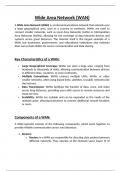
A Wide Area Network (WAN) is a telecommunications network that extends over
a large geographical area, such as a country or continent. WANs are used to
connect smaller networks, such as Local Area Networks (LANs) or Metropolitan
Area Networks (MANs), allowing for the exchange of data between devices and
systems across great distances. The internet itself is the largest example of a
WAN, but businesses, governments, and educational institutions also maintain
their own private WANs for secure communication and data sharing.
Key Characteristics of a WAN:
Large Geographical Coverage: WANs can span a large area, ranging from
hundreds to thousands of miles, allowing communication between devices
in different cities, countries, or even continents.
Multiple Connections: WANs connect multiple LANs, MANs, or other
smaller networks, often using leased lines, satellites, or public networks like
the internet.
Data Transmission: WANs facilitate the transfer of data, voice, and video
across long distances, providing users with access to remote resources and
cloud services.
Scalability: WANs are scalable and can be expanded as the needs of the
network grow, allowing businesses to connect additional remote locations
or users.
Components of a WAN:
A WAN typically consists of the following components, which work together to
provide reliable communication across vast distances:
1. Routers:
o Routers in a WAN are responsible for directing data packets between
different networks. They operate at the Network Layer (Layer 3) of
, the OSI model and determine the most efficient path for data to
travel based on IP addresses.
o In WANs, routers connect different LANs or MANs, often acting as the
gateway between a private network and the public internet.
2. Leased Lines:
o Leased lines are dedicated communication links provided by telecom
companies to connect different locations. These lines are usually
private, secure, and offer a stable connection with guaranteed
bandwidth and low latency.
o Leased lines can be costly but are ideal for businesses that need high-
speed, reliable connections over long distances.
3. Switches:
o Switches used in WANs are similar to those in LANs but are often
more powerful and capable of handling the complex routing of data
across multiple networks.
o Switches operate at Layer 2 (Data Link Layer) and are used to connect
different devices or networks within the WAN.
4. Transmission Media:
o Fiber Optic Cables: These provide high-speed, high-capacity
connections for WANs, enabling fast data transmission over long
distances. Fiber optics are immune to electromagnetic interference
and can transmit data over great distances with minimal signal loss.
o Microwave and Satellite Links: These are used to establish wireless
WAN connections when physical cables are impractical or too
expensive to deploy, especially in remote areas.
5. Internet Backbone:
o The internet backbone consists of high-capacity networks and high-
speed data transmission links owned by internet service providers
(ISPs). These backbones serve as the primary data routes for global
internet traffic and are interconnected to create the global WAN.
6. Protocols:
o WANs rely on various communication protocols to ensure data is
transmitted effectively and securely. Common protocols include IP
(Internet Protocol), TCP/IP (Transmission Control Protocol/Internet
Protocol), MPLS (Multiprotocol Label Switching), and Frame Relay.
A Wide Area Network (WAN) is a telecommunications network that extends over
a large geographical area, such as a country or continent. WANs are used to
connect smaller networks, such as Local Area Networks (LANs) or Metropolitan
Area Networks (MANs), allowing for the exchange of data between devices and
systems across great distances. The internet itself is the largest example of a
WAN, but businesses, governments, and educational institutions also maintain
their own private WANs for secure communication and data sharing.
Key Characteristics of a WAN:
Large Geographical Coverage: WANs can span a large area, ranging from
hundreds to thousands of miles, allowing communication between devices
in different cities, countries, or even continents.
Multiple Connections: WANs connect multiple LANs, MANs, or other
smaller networks, often using leased lines, satellites, or public networks like
the internet.
Data Transmission: WANs facilitate the transfer of data, voice, and video
across long distances, providing users with access to remote resources and
cloud services.
Scalability: WANs are scalable and can be expanded as the needs of the
network grow, allowing businesses to connect additional remote locations
or users.
Components of a WAN:
A WAN typically consists of the following components, which work together to
provide reliable communication across vast distances:
1. Routers:
o Routers in a WAN are responsible for directing data packets between
different networks. They operate at the Network Layer (Layer 3) of
, the OSI model and determine the most efficient path for data to
travel based on IP addresses.
o In WANs, routers connect different LANs or MANs, often acting as the
gateway between a private network and the public internet.
2. Leased Lines:
o Leased lines are dedicated communication links provided by telecom
companies to connect different locations. These lines are usually
private, secure, and offer a stable connection with guaranteed
bandwidth and low latency.
o Leased lines can be costly but are ideal for businesses that need high-
speed, reliable connections over long distances.
3. Switches:
o Switches used in WANs are similar to those in LANs but are often
more powerful and capable of handling the complex routing of data
across multiple networks.
o Switches operate at Layer 2 (Data Link Layer) and are used to connect
different devices or networks within the WAN.
4. Transmission Media:
o Fiber Optic Cables: These provide high-speed, high-capacity
connections for WANs, enabling fast data transmission over long
distances. Fiber optics are immune to electromagnetic interference
and can transmit data over great distances with minimal signal loss.
o Microwave and Satellite Links: These are used to establish wireless
WAN connections when physical cables are impractical or too
expensive to deploy, especially in remote areas.
5. Internet Backbone:
o The internet backbone consists of high-capacity networks and high-
speed data transmission links owned by internet service providers
(ISPs). These backbones serve as the primary data routes for global
internet traffic and are interconnected to create the global WAN.
6. Protocols:
o WANs rely on various communication protocols to ensure data is
transmitted effectively and securely. Common protocols include IP
(Internet Protocol), TCP/IP (Transmission Control Protocol/Internet
Protocol), MPLS (Multiprotocol Label Switching), and Frame Relay.