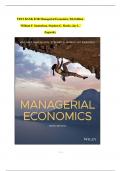
TEST BANK FOR Managerial Economics, 9th Edition
William F. Samuelson, Stephen G. Marks, Jay L.
Zagorsky
1-1
,File: qCh01; qCHAPTER q1: qIntroduction qto qEconomic qDecision qMaking
MULTIPLE qCHOICE
q
1. Managerial qeconomics qcan qbest qbe qdefined qas qthe:
a) macroeconomics qand qmicroeconomics qfor qmanagers.
b) study qof qeconomic qincentives qon qconsumer qbehavior qand qdemand.
c) analysis qof qthe qlabor qmarket qthrough qthe qbehavior qof qworkers qand qmanagers.
d) analysis qof qmajor qmanagement qdecisions qusing qeconomic qtools.
e) study qof qthe qstrategic qinteraction qbetween qfirms qin qa qmarket.
ANSWER: qd
SECTION qREFERENCE: qIntroduction
qDIFFICULTY qLEVEL: qEasy
2. Which qof qthe qfollowing qis qnot qone qof qthe qsteps qin qmanagerial qdecision qmaking?
a) Predicting qthe qconsequences qof qa qdecision.
b) Exploring qthe qalternatives qto qthe qdecision.
c) Defining qthe qproblem qand qthe qobjectives qof qthe qdecision.
d) Negotiating qa qconsensus qto qimplement qthe qdecision.
e) Performing qsensitivity qanalysis.
ANSWER: qd
SECTION qREFERENCE: qSix qSteps qto qDecision qMaking
qDIFFICULTY qLEVEL: qEasy
3. Profit qmaximization qis qan qambiguous qguide qto qdecision qmaking qin qthe qprivate qsector qbecause:
a) firms qin qthe qprivate qsector qusually qdo qnot qaim qat qprofit qmaximization.
b) the qgoal qof qprofit qmaximization qcontradicts qthe qgoal qof qsatisfying qthe qfirm‘s qshareholders.
c) of qthe qpresence qof qrisk qand quncertainty.
d) profit-maximization qignores qsocial qcosts qand qbenefits.
e) None qof qthe qabove qanswers qis qcorrect.
ANSWER: qc
SECTION qREFERENCE: qSix qSteps qto qDecision qMaking
qDIFFICULTY qLEVEL: qEasy
1-2
,4. Which qof qthe qfollowing qis qtrue qof qeconomic qmodels?
a) Models qare qtoo qtheoretical qto qbe qapplicable qin qreal qworld qdecisions.
b) Models qare qnot quseful qbecause quncertainty qprevents qaccurate qforecasts.
c) Models qare qsimplified qdescriptions qof qprocesses, qrelationships, qor qother qphenomena.
d) Models qdescribe qreal qworld qsituations qin qcomplete qdetail.
e) Models qare qnot quseful qbecause qthey qdo qnot qtake qinto qaccount qcomplicating qand
qless qimportant qfeatures qof qa qproblem.
ANSWER: qc
SECTION qREFERENCE: qSix qSteps qto qDecision qMaking
qDIFFICULTY qLEVEL: qMedium
5. Which qof qthe qfollowing qcorrectly qdescribes qa qdeterministic qeconomic qmodel?
a) A qdeterministic qmodel qis qa qmodel qfor qwhich qthe qoutcome qis qpredicted qwith qcertainty.
b) A qdeterministic qmodel qcan qonly qbe qused qto qexplain qshort-run qeconomic qphenomena.
c) A qdeterministic qmodel qis qmost quseful qin qidentifying qlong-term qtrends.
d) A qdeterministic qmodel qis qused qin qthe qstudy qof qnormative qeconomics.
e) The qoutcome qof qa qdeterministic qmodel qis qrandom qand qhas qprobabilities qattached.
ANSWER: qa
SECTION qREFERENCE: qSix qSteps qto qDecision qMaking
qDIFFICULTY qLEVEL: qEasy
6. Which qof qthe qfollowing qcorrectly qexplains qa qprobabilistic qmodel?
a) A qprobabilistic qmodel qgives qa qdescription qof qreal qworld qeconomic qphenomena.
b) A qprobabilistic qmodel qshows qthe qpossibility qof qa qrange qof qoutcomes.
c) A qprobabilistic qmodel qexamines qthe qchanges qin qeconomic qvariables qover qa qperiod qof qtime.
d) A qprobabilistic qmodel qis qbased qon qvalue qjudgments.
e) A qprobabilistic qmodel qis qused qto qexplain qlong-run qeconomic qphenomena
ANSWER: qb
SECTION qREFERENCE: qSix qSteps qto qDecision qMaking
qDIFFICULTY qLEVEL: qEasy
7. Maximizing qprofit qby qenumerating qthe qprofit qoutcomes qof qdifferent qcourses qof qaction
a) Is qonly qapplicable qto qproblems qwith qa qsmall qnumber qof qalternatives.
b) Becomes qincreasingly qcostly qas qthe qnumber qof qchoices qincrease.
c) Always qdiscovers qthe qbest qpossible qchoice.
1-3
, d) Provides qa quseful qshortcut qto qfinding qthe qoptimal qchoice.
e) Answers qb qand qc qare qboth qcorrect.
ANSWER: qb
SECTION qREFERENCE: qSix qSteps qto qDecision qMaking
qDIFFICULTY qLEVEL: qMedium
8. A qbeverages qcompany qwants qto qlaunch qa qnew qdiet qsoda qaimed qat qdiabetics qand qhealth-
qconscious qcustomers. qIt qwill quse qa q economic qmodel qto qidentify qits qtarget qcustomers.
a) deterministic
b) dynamic
c) qualitative
d) stochastic
e) probabilistic
ANSWER: qa
SECTION qREFERENCE: qSix qSteps qto qDecision qMaking
qDIFFICULTY qLEVEL: qMedium
9. Given qthat qthe qmarket qshare qof qa qfirm qdepends qon qmany qunpredictable qfactors, qa qfirm qwill
quse qa q economic qmodel qto qestimate qthe qmarket qshare qfor qone qof qits qproducts.
a) deterministic
b) dynamic
c) qualitative
d) probabilistic
e) comparative qstatics
ANSWER: qd
SECTION qREFERENCE: qSix qSteps qto qDecision qMaking
qDIFFICULTY qLEVEL: qMedium
10. Sensitivity qanalysis qis qused qby qa qfirm qto:
a) analyze qthe qimpact qof qa qchange qin qthe qprice qof qthe qgood qon qthe qdemand qfor qthe qgood.
b) examine qthe qstatic qeffects qof qan qeconomic qdecision qon qthe qfirm‘s qprofitability.
c) analyze qthe qsocial qcosts qand qbenefits qof qan qeconomic qdecision.
d) examine qthe qopportunity qcosts qof qan qeconomic qdecision.
e) examine qhow qan qoptimal qdecision qis qaffected qif qkey qeconomic qfacts qvary.
ANSWER: qe
SECTION qREFERENCE: qSix qSteps qto qDecision qMaking
1-4
William F. Samuelson, Stephen G. Marks, Jay L.
Zagorsky
1-1
,File: qCh01; qCHAPTER q1: qIntroduction qto qEconomic qDecision qMaking
MULTIPLE qCHOICE
q
1. Managerial qeconomics qcan qbest qbe qdefined qas qthe:
a) macroeconomics qand qmicroeconomics qfor qmanagers.
b) study qof qeconomic qincentives qon qconsumer qbehavior qand qdemand.
c) analysis qof qthe qlabor qmarket qthrough qthe qbehavior qof qworkers qand qmanagers.
d) analysis qof qmajor qmanagement qdecisions qusing qeconomic qtools.
e) study qof qthe qstrategic qinteraction qbetween qfirms qin qa qmarket.
ANSWER: qd
SECTION qREFERENCE: qIntroduction
qDIFFICULTY qLEVEL: qEasy
2. Which qof qthe qfollowing qis qnot qone qof qthe qsteps qin qmanagerial qdecision qmaking?
a) Predicting qthe qconsequences qof qa qdecision.
b) Exploring qthe qalternatives qto qthe qdecision.
c) Defining qthe qproblem qand qthe qobjectives qof qthe qdecision.
d) Negotiating qa qconsensus qto qimplement qthe qdecision.
e) Performing qsensitivity qanalysis.
ANSWER: qd
SECTION qREFERENCE: qSix qSteps qto qDecision qMaking
qDIFFICULTY qLEVEL: qEasy
3. Profit qmaximization qis qan qambiguous qguide qto qdecision qmaking qin qthe qprivate qsector qbecause:
a) firms qin qthe qprivate qsector qusually qdo qnot qaim qat qprofit qmaximization.
b) the qgoal qof qprofit qmaximization qcontradicts qthe qgoal qof qsatisfying qthe qfirm‘s qshareholders.
c) of qthe qpresence qof qrisk qand quncertainty.
d) profit-maximization qignores qsocial qcosts qand qbenefits.
e) None qof qthe qabove qanswers qis qcorrect.
ANSWER: qc
SECTION qREFERENCE: qSix qSteps qto qDecision qMaking
qDIFFICULTY qLEVEL: qEasy
1-2
,4. Which qof qthe qfollowing qis qtrue qof qeconomic qmodels?
a) Models qare qtoo qtheoretical qto qbe qapplicable qin qreal qworld qdecisions.
b) Models qare qnot quseful qbecause quncertainty qprevents qaccurate qforecasts.
c) Models qare qsimplified qdescriptions qof qprocesses, qrelationships, qor qother qphenomena.
d) Models qdescribe qreal qworld qsituations qin qcomplete qdetail.
e) Models qare qnot quseful qbecause qthey qdo qnot qtake qinto qaccount qcomplicating qand
qless qimportant qfeatures qof qa qproblem.
ANSWER: qc
SECTION qREFERENCE: qSix qSteps qto qDecision qMaking
qDIFFICULTY qLEVEL: qMedium
5. Which qof qthe qfollowing qcorrectly qdescribes qa qdeterministic qeconomic qmodel?
a) A qdeterministic qmodel qis qa qmodel qfor qwhich qthe qoutcome qis qpredicted qwith qcertainty.
b) A qdeterministic qmodel qcan qonly qbe qused qto qexplain qshort-run qeconomic qphenomena.
c) A qdeterministic qmodel qis qmost quseful qin qidentifying qlong-term qtrends.
d) A qdeterministic qmodel qis qused qin qthe qstudy qof qnormative qeconomics.
e) The qoutcome qof qa qdeterministic qmodel qis qrandom qand qhas qprobabilities qattached.
ANSWER: qa
SECTION qREFERENCE: qSix qSteps qto qDecision qMaking
qDIFFICULTY qLEVEL: qEasy
6. Which qof qthe qfollowing qcorrectly qexplains qa qprobabilistic qmodel?
a) A qprobabilistic qmodel qgives qa qdescription qof qreal qworld qeconomic qphenomena.
b) A qprobabilistic qmodel qshows qthe qpossibility qof qa qrange qof qoutcomes.
c) A qprobabilistic qmodel qexamines qthe qchanges qin qeconomic qvariables qover qa qperiod qof qtime.
d) A qprobabilistic qmodel qis qbased qon qvalue qjudgments.
e) A qprobabilistic qmodel qis qused qto qexplain qlong-run qeconomic qphenomena
ANSWER: qb
SECTION qREFERENCE: qSix qSteps qto qDecision qMaking
qDIFFICULTY qLEVEL: qEasy
7. Maximizing qprofit qby qenumerating qthe qprofit qoutcomes qof qdifferent qcourses qof qaction
a) Is qonly qapplicable qto qproblems qwith qa qsmall qnumber qof qalternatives.
b) Becomes qincreasingly qcostly qas qthe qnumber qof qchoices qincrease.
c) Always qdiscovers qthe qbest qpossible qchoice.
1-3
, d) Provides qa quseful qshortcut qto qfinding qthe qoptimal qchoice.
e) Answers qb qand qc qare qboth qcorrect.
ANSWER: qb
SECTION qREFERENCE: qSix qSteps qto qDecision qMaking
qDIFFICULTY qLEVEL: qMedium
8. A qbeverages qcompany qwants qto qlaunch qa qnew qdiet qsoda qaimed qat qdiabetics qand qhealth-
qconscious qcustomers. qIt qwill quse qa q economic qmodel qto qidentify qits qtarget qcustomers.
a) deterministic
b) dynamic
c) qualitative
d) stochastic
e) probabilistic
ANSWER: qa
SECTION qREFERENCE: qSix qSteps qto qDecision qMaking
qDIFFICULTY qLEVEL: qMedium
9. Given qthat qthe qmarket qshare qof qa qfirm qdepends qon qmany qunpredictable qfactors, qa qfirm qwill
quse qa q economic qmodel qto qestimate qthe qmarket qshare qfor qone qof qits qproducts.
a) deterministic
b) dynamic
c) qualitative
d) probabilistic
e) comparative qstatics
ANSWER: qd
SECTION qREFERENCE: qSix qSteps qto qDecision qMaking
qDIFFICULTY qLEVEL: qMedium
10. Sensitivity qanalysis qis qused qby qa qfirm qto:
a) analyze qthe qimpact qof qa qchange qin qthe qprice qof qthe qgood qon qthe qdemand qfor qthe qgood.
b) examine qthe qstatic qeffects qof qan qeconomic qdecision qon qthe qfirm‘s qprofitability.
c) analyze qthe qsocial qcosts qand qbenefits qof qan qeconomic qdecision.
d) examine qthe qopportunity qcosts qof qan qeconomic qdecision.
e) examine qhow qan qoptimal qdecision qis qaffected qif qkey qeconomic qfacts qvary.
ANSWER: qe
SECTION qREFERENCE: qSix qSteps qto qDecision qMaking
1-4