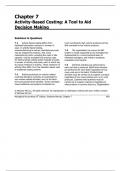
Chapter 7
Activity-Based Costing: A Tool to Aid
Decision Making
Solutions to Questions
7-1 Activity-based costing differs from much overhead to high-volume products and too
traditional absorption costing in a number of little overhead to low volume products.
ways. In activity-based costing,
nonmanufacturing as well as manufacturing costs 7-3 The organization can ensure its ABC
may be assigned to products. And, some system is vocally supported by top management,
manufacturing costs—including the costs of idle implemented by a cross-functional team of
capacity—may be excluded from product costs. influential managers, and linked to employee
An activity-based costing system typically includes evaluations and rewards.
a number of activity cost pools, each of which has
its unique measure of activity. These measures of 7-4 Unit-level activities are performed for
activity often differ from the allocation bases used each unit that is produced. Batch-level activities
in traditional costing systems. are performed for each batch regardless of how
many units are in the batch. Product-level
7-2 Relying exclusively on volume-related activities must be carried out to support a product
overhead allocation overlooks an organization’s regardless of how many batches are run or units
non-volume-related activities, such as its batch- produced. Customer-level activities must be
level and product-level activities. These oversights carried out to support customers regardless of
cause traditional cost systems to allocate too what products or services they buy. Organization-
© McGraw Hill LLC. All rights reserved. No reproduction or distribution without the prior written consent
of McGraw Hill LLC.
Managerial Accounting 18th Edition, Solutions Manual, Chapter 7 469
,sustaining activities are carried out regardless of based costing system, batch-level and product-
the company’s precise product mix or mix of level costs are assigned more appropriately. This
customers. results in shifting product-level costs back to the
products that cause them and away from the
7-5 Organization-sustaining costs, customer- high-volume products. (A similar effect will be
level costs, and the costs of idle capacity should observed with batch-level costs if high-volume
not be assigned to products. These costs products are produced in larger batches than low-
represent resources that are not consumed by the volume products.)
products.
7-9 Activity rates tell managers the average
7-6 In activity-based costing, costs must first cost of resources consumed to carry out a
be allocated to activity cost pools and then they particular activity such as processing purchase
are allocated from the activity cost pools to orders. An activity whose average cost is high
products, customers, and other cost objects. may be a good candidate for process
improvements. Benchmarking can be used to
7-7 Activity rates do not measure avoidable identify which activities have unusually large
costs. They measure the cost of resources costs. If some other organization is able to carry
consumed by cost objects, but do not out the activity at a significantly lower cost, it is
differentiate between relevant and irrelevant reasonable to suppose that improvement may be
costs. possible.
7-8 In traditional cost systems, product-level 7-10 The differences between traditional and
costs are indiscriminately spread across all activity-based product margins are primarily
products using direct labor-hours or some other caused by a company’s non-volume-related
allocation base related to volume. As a activities, such as its batch-level and product-level
consequence, high-volume products are assigned activities. Unit-level activity costs are allocated to
the bulk of such costs. If a product is responsible products using volume-related cost drivers, so
for 40% of the direct labor in a factory, it will be these types of activities typically do not expose
assigned 40% of the manufacturing overhead cost distortion to the extent it is exposed through
cost in the factory—including 40% of the product- non-volume-related activity cost allocation.
level costs of low-volume products. In an activity-
Copyright © 2024 McGraw Hill LLC. All rights reserved. No reproduction or distribution without the prior
written consent of McGraw Hill LLC.
Managerial Accounting 18th Edition, Solutions Manual, Chapter 7
,Chapter 7: Applying Excel
The completed worksheet is shown below.
© McGraw Hill LLC. All rights reserved. No reproduction or distribution without the prior written consent
of McGraw Hill LLC.
Managerial Accounting 18th Edition, Solutions Manual, Chapter 7 471
, Chapter 7: Applying Excel (continued)
The formulas needed to complete the worksheet are shown below.
Copyright © 2024 McGraw Hill LLC. All rights reserved. No reproduction or distribution without the prior
written consent of McGraw Hill LLC.
Managerial Accounting 18th Edition, Solutions Manual, Chapter 7
Activity-Based Costing: A Tool to Aid
Decision Making
Solutions to Questions
7-1 Activity-based costing differs from much overhead to high-volume products and too
traditional absorption costing in a number of little overhead to low volume products.
ways. In activity-based costing,
nonmanufacturing as well as manufacturing costs 7-3 The organization can ensure its ABC
may be assigned to products. And, some system is vocally supported by top management,
manufacturing costs—including the costs of idle implemented by a cross-functional team of
capacity—may be excluded from product costs. influential managers, and linked to employee
An activity-based costing system typically includes evaluations and rewards.
a number of activity cost pools, each of which has
its unique measure of activity. These measures of 7-4 Unit-level activities are performed for
activity often differ from the allocation bases used each unit that is produced. Batch-level activities
in traditional costing systems. are performed for each batch regardless of how
many units are in the batch. Product-level
7-2 Relying exclusively on volume-related activities must be carried out to support a product
overhead allocation overlooks an organization’s regardless of how many batches are run or units
non-volume-related activities, such as its batch- produced. Customer-level activities must be
level and product-level activities. These oversights carried out to support customers regardless of
cause traditional cost systems to allocate too what products or services they buy. Organization-
© McGraw Hill LLC. All rights reserved. No reproduction or distribution without the prior written consent
of McGraw Hill LLC.
Managerial Accounting 18th Edition, Solutions Manual, Chapter 7 469
,sustaining activities are carried out regardless of based costing system, batch-level and product-
the company’s precise product mix or mix of level costs are assigned more appropriately. This
customers. results in shifting product-level costs back to the
products that cause them and away from the
7-5 Organization-sustaining costs, customer- high-volume products. (A similar effect will be
level costs, and the costs of idle capacity should observed with batch-level costs if high-volume
not be assigned to products. These costs products are produced in larger batches than low-
represent resources that are not consumed by the volume products.)
products.
7-9 Activity rates tell managers the average
7-6 In activity-based costing, costs must first cost of resources consumed to carry out a
be allocated to activity cost pools and then they particular activity such as processing purchase
are allocated from the activity cost pools to orders. An activity whose average cost is high
products, customers, and other cost objects. may be a good candidate for process
improvements. Benchmarking can be used to
7-7 Activity rates do not measure avoidable identify which activities have unusually large
costs. They measure the cost of resources costs. If some other organization is able to carry
consumed by cost objects, but do not out the activity at a significantly lower cost, it is
differentiate between relevant and irrelevant reasonable to suppose that improvement may be
costs. possible.
7-8 In traditional cost systems, product-level 7-10 The differences between traditional and
costs are indiscriminately spread across all activity-based product margins are primarily
products using direct labor-hours or some other caused by a company’s non-volume-related
allocation base related to volume. As a activities, such as its batch-level and product-level
consequence, high-volume products are assigned activities. Unit-level activity costs are allocated to
the bulk of such costs. If a product is responsible products using volume-related cost drivers, so
for 40% of the direct labor in a factory, it will be these types of activities typically do not expose
assigned 40% of the manufacturing overhead cost distortion to the extent it is exposed through
cost in the factory—including 40% of the product- non-volume-related activity cost allocation.
level costs of low-volume products. In an activity-
Copyright © 2024 McGraw Hill LLC. All rights reserved. No reproduction or distribution without the prior
written consent of McGraw Hill LLC.
Managerial Accounting 18th Edition, Solutions Manual, Chapter 7
,Chapter 7: Applying Excel
The completed worksheet is shown below.
© McGraw Hill LLC. All rights reserved. No reproduction or distribution without the prior written consent
of McGraw Hill LLC.
Managerial Accounting 18th Edition, Solutions Manual, Chapter 7 471
, Chapter 7: Applying Excel (continued)
The formulas needed to complete the worksheet are shown below.
Copyright © 2024 McGraw Hill LLC. All rights reserved. No reproduction or distribution without the prior
written consent of McGraw Hill LLC.
Managerial Accounting 18th Edition, Solutions Manual, Chapter 7