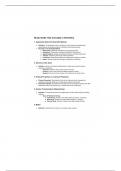
Study Guide: Key Concepts in Chemistry
1. Systematic Study (The Scientific Method)
● Definition: The systematic study in chemistry involves observing, hypothesizing,
experimenting, and analyzing data to understand chemical phenomena.
● Key Steps in the Scientific Method:
1. Observation: Gathering information and noting phenomena.
2. Hypothesis: Proposing an untested idea based on observations.
3. Experimentation: Testing the hypothesis through controlled experiments.
4. Analysis: Interpreting the results of the experiments.
5. Conclusion: Determining whether the hypothesis is supported or refuted.
6. Report: Sharing results and revising the hypothesis if necessary.
2. Structure of the Atom
● Definition: Atoms are the basic building blocks of matter and consist of protons,
neutrons, and electrons.
○ Electrons: Determine the size and extent of the atom.
○ Protons: Found in the nucleus and define the atomic number.
○ Neutrons: Also found in the nucleus and contribute to the atomic mass.
3. Physical Properties vs. Chemical Properties
● Physical Properties: Characteristics that can be observed without changing the
substance's chemical identity (e.g., melting point, boiling point, density).
● Chemical Properties: Characteristics that describe how a substance interacts with other
substances to form new products (e.g., reactivity with acids, combustion).
4. Nuclear Transformation (Radioactivity)
● Definition: The process by which an unstable atomic nucleus loses energy by emitting
radiation.
○ Types of Radioactive Decay:
■ Alpha Decay: Emission of an alpha particle (2 protons, 2 neutrons).
■ Beta Decay: Emission of a beta particle (electron or positron).
■ Gamma Decay: Emission of gamma rays (high-energy photons).
5. Matter
● Definition: Anything that has mass and occupies space (volume).
1. Systematic Study (The Scientific Method)
● Definition: The systematic study in chemistry involves observing, hypothesizing,
experimenting, and analyzing data to understand chemical phenomena.
● Key Steps in the Scientific Method:
1. Observation: Gathering information and noting phenomena.
2. Hypothesis: Proposing an untested idea based on observations.
3. Experimentation: Testing the hypothesis through controlled experiments.
4. Analysis: Interpreting the results of the experiments.
5. Conclusion: Determining whether the hypothesis is supported or refuted.
6. Report: Sharing results and revising the hypothesis if necessary.
2. Structure of the Atom
● Definition: Atoms are the basic building blocks of matter and consist of protons,
neutrons, and electrons.
○ Electrons: Determine the size and extent of the atom.
○ Protons: Found in the nucleus and define the atomic number.
○ Neutrons: Also found in the nucleus and contribute to the atomic mass.
3. Physical Properties vs. Chemical Properties
● Physical Properties: Characteristics that can be observed without changing the
substance's chemical identity (e.g., melting point, boiling point, density).
● Chemical Properties: Characteristics that describe how a substance interacts with other
substances to form new products (e.g., reactivity with acids, combustion).
4. Nuclear Transformation (Radioactivity)
● Definition: The process by which an unstable atomic nucleus loses energy by emitting
radiation.
○ Types of Radioactive Decay:
■ Alpha Decay: Emission of an alpha particle (2 protons, 2 neutrons).
■ Beta Decay: Emission of a beta particle (electron or positron).
■ Gamma Decay: Emission of gamma rays (high-energy photons).
5. Matter
● Definition: Anything that has mass and occupies space (volume).