SOCIOLOGY OF WORK AND EMPLOYMENT: TOPIC 2
TOPIC 2: Changes in Variety and Pattern of Employment Relationships: (Hours of Work,
Patterns of Reward and Remuneration).
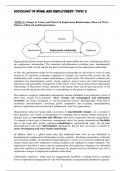
Society
Organization Employment relationship Employee
Organizational trends towards greater flexibility and employability has seen a fundamental shift in
the employment relationships. The industrial and information revolution have fundamentally
changed the world of work and this has had a profound impact on the employment relationship.
At first, the predominant model for the employment relationship was the world of work of small
businesses of craftsmen (sometimes organized in strongly tied network-like systems like the
Guilds/clubs),with a master–student relationship as a basic model. The industrial revolution later
introduced the manufacturing model, strong employer power,―carrot and stick‖motivational
approaches and paternalistic management of the factory owner which characterized employment
relationships of that period. Greater attention to the human factor and the growing power of the
unions were driving factors that acted as a counterbalance to the power of employers.
The employer–employee relationship subsequently became embedded in an elaborated system of
labor laws created by governments. More recently, the technological and information
revolution are being recognized as crucial competitive factors. Breakthroughs in the field of
technology and information, increasing global competition and escalating interdependence
between organizations have created new fundamental ―rules‖for organizations.
Organizations today are facing rapid successions of unpredictable changes. As a reaction to
these pressures, new trends in management are emerging such as greater market orientation, a
stronger focus on cost reduction and efficiency and closer cooperation between organizations.
To respond to these types of pressures, management strives for greater organizational flexibility
and at the same time greater employee commitment to organizational goals. On the other
hand,employees want more individualized opportunities that fit their own goals in relation to
career development and work–family relationships.
In addition, there is a global trend today that traditional labor laws are less influential in
determining the employment relationships in many countries. Declining unionization worldwide
and increasing numbers of individuals being employed in sectors not covered by traditional labor
statutes means that fewer employees working conditions are regulated by (legal) standards. The
implication is that there is more scope for organizations and employees to bargain over individual
terms and conditions of employment.The pressures for greater firm-level flexibility have led to
significance changes in employment relations within firms.
Additionally, employers’ rising need for organizational flexibility is leading firms to establish
diverse employment arrangements to cope with fluctuations in organizational production capacity.
1
TOPIC 2: Changes in Variety and Pattern of Employment Relationships: (Hours of Work,
Patterns of Reward and Remuneration).
Society
Organization Employment relationship Employee
Organizational trends towards greater flexibility and employability has seen a fundamental shift in
the employment relationships. The industrial and information revolution have fundamentally
changed the world of work and this has had a profound impact on the employment relationship.
At first, the predominant model for the employment relationship was the world of work of small
businesses of craftsmen (sometimes organized in strongly tied network-like systems like the
Guilds/clubs),with a master–student relationship as a basic model. The industrial revolution later
introduced the manufacturing model, strong employer power,―carrot and stick‖motivational
approaches and paternalistic management of the factory owner which characterized employment
relationships of that period. Greater attention to the human factor and the growing power of the
unions were driving factors that acted as a counterbalance to the power of employers.
The employer–employee relationship subsequently became embedded in an elaborated system of
labor laws created by governments. More recently, the technological and information
revolution are being recognized as crucial competitive factors. Breakthroughs in the field of
technology and information, increasing global competition and escalating interdependence
between organizations have created new fundamental ―rules‖for organizations.
Organizations today are facing rapid successions of unpredictable changes. As a reaction to
these pressures, new trends in management are emerging such as greater market orientation, a
stronger focus on cost reduction and efficiency and closer cooperation between organizations.
To respond to these types of pressures, management strives for greater organizational flexibility
and at the same time greater employee commitment to organizational goals. On the other
hand,employees want more individualized opportunities that fit their own goals in relation to
career development and work–family relationships.
In addition, there is a global trend today that traditional labor laws are less influential in
determining the employment relationships in many countries. Declining unionization worldwide
and increasing numbers of individuals being employed in sectors not covered by traditional labor
statutes means that fewer employees working conditions are regulated by (legal) standards. The
implication is that there is more scope for organizations and employees to bargain over individual
terms and conditions of employment.The pressures for greater firm-level flexibility have led to
significance changes in employment relations within firms.
Additionally, employers’ rising need for organizational flexibility is leading firms to establish
diverse employment arrangements to cope with fluctuations in organizational production capacity.
1