Lectures Advanced Clinical Neuropsychology
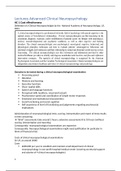
HC 1 Cost effectiveness
Definition of a Clinical Neuropsycholgist by the National Academy of Neuropsychology, US,
2001
Domains to be tested during a clinical neuropsychological examination
Processing speed
Attention
Memory and learning
Executive functions
Visuo- spatial skills
Speech and language functions
Perceptual skills (auditory, visual and tactual)
Psychomotor speed and coordination of simple motor responses
Emotional and motivational characteristics
Social functioning and social cognition
Self-awareness of level of functioning and judgements regarding psychosocial
implications
Administration of neuropsychological tests, scoring, interpretation and report of tests results
is time consuming
.Brief” assessments take around 2 hours, extensive assessments 8 to 10 hours (without
scoring, interpretation and reporting
Consequently: neuropsychological examinations are expensive
Consequently: Neuropsychological examinations might need justification (in particular in
times of financial crisis)
Costs of clinical neuropsychological examinations
(in US, at around 2000)
Costs
$600,000 per year to establish and maintain small department of clinical
neuropsychology in non-profit hospital/medical center (covering secretarial support
and salaries of 4 clinical neuropsychologists)
1
, Additional 20% of indirect costs (e.g. medical insurance, pension schemes)
In total: $720,000 (rooms, technical support, electricity etc. not included)
Charges
Costs charged for the services
Clinical neuropsychologists provide neuro-psychological services around 25 to 30
hours per week
Fees range from $140 to $200 per hour
Assuming 25 hours per week for 48 weeks (4 weeks vacation): 1,200 hours x $140 =
$168,000
In total: $672,000 per year (4 clinical neuropsychologists)
Hospital would nearly break even.
However, Charges never reflect actual fees received
Fees
Amount actually paid
Amount paid is considerably lower than the charges (applies to all aspects of
medicine and health care in the US)
Reimbursement of psychotherapy $100 per hour, neuropsychological assessment
$71 to $80 per hours
Assuming 1,000 hours neuropsychological assessment per year (1000x $80 =
$80,000) and 250 hours psychotherapy per year (250 x $100 = $25,000)
Revenue produced in reality is $105,000 (or $420,000 with 4 neuropsychologists)
HOWEVER $720,000 costs
Additional sources of revenue
Boost of revenue by medicolegal cases: About $3,000 per case (with 30 cases per
year (1 every 10 days) = 30 x $3,000 = $90,000)
Involvement of clinical neuropsychologists in research (support by grants)
Requires however additional extra effort and time (!) by/of clinical
neuropsychologist (obtaining funds, publishing, conference participation)
Why doing it then?
Markers of value
Refers to money equivalent (e.g. cost saving) of the service received
Comparison between costs of assessment and treatment with money saved by avoiding
other health care costs and by returning an individual to work and social responsibility
Objective markers
Reduce costs and liability
- Young man suffers TBI in an accident
- Assessment shows that extent and nature of impairments reduce man’s
capacity to maintain line of work for which he was preparing
- Consequently: Hundreds of thousands of lost dollars as a result of brain injury
- Because of neuropsychological assessment consequences of accident
documented
Capturing most of the man’s lost income via litigation
2
, Reduction of costs for society by neuropsychological medicolegal assessment of
around $3,000
Another example
- Savings associated with identification of malingerers
(malingering = intentional production of false or grossly exaggerated physical or
psychological symptoms, motivated by external incentives)
Final example
- Savings associated with differential diagnosis on basis of neuropsychological
assessments, e.g. between dementia and depression
- Psychiatric treatment available for depression
Which might result in productive lifestyle of patients
- If neuropsychological findings are indicative of early dementia
Patients and families can plan for the patients’ early significant decline in cognitive and
behavioural functioning
Improve quality of life
Assess the effectiveness of treatment
Pharmacological treatment, neurosurgery, neuro-feedback, cognitive trainings,
etc.
Guide treatment procedures
- Neuropsychological findings contribute significantly to decision whether
patients undergo epilepsy surgery
Provide a continuum of care for patients
- Clinical neuropsychologists consult with patients and their families about the
patients’ deficits
Prepares them to deal with intermediate and long-term consequences of patients’
brain dysfunctions
Improve physician education and decision making
- Patients and their families may suffer from pain, stress and economic burden when
patients return prematurely to work
Subjective markers
Reduce patients’ sense of psychological aloneness with daily problems
- Relief of a patient with brain tumour (“I am not mad”) when describing an
association between deficits and tumour location to her
Reduce patients’ expectations, confusion and frustration about the nature of their
disturbances
- Patients and families often have unrealistic expectations or wrong
understandings about deficits and their development
Help family members feel less guilty in making decisions regarding brain-
dysfunctional adults and children
- Many families struggle with the issue of placing a loved-one in a
residential/nursing home
- In children: Often considerable relief when parents learn that problems (e.g.
ADHD) are not the consequence of .poor” parenting or psychodynamic processes
Example:
3
, - Feelings of guilt and self-reproach of father who slapped daughter in the face and
who got a brain tumour diagnosed 10 days later
HC2 Fatigue
Fatigue
Significant proportion of general population affected by excessive fatigue
One of the most common complaints reported to primary care physicians
Frequent and prolonged tiredness interfering with everyday life in about 27% of patients
in primary care settings
Differentiation between ‘pathological fatigue’ and ‘non-pathological fatigue’
greater intensity
longer duration
more disabling effects on functional activities
remains after rest as a severe condition
There is a combination of features
Fatigue is viewed as both symptom and disease
Fatigue as a symptom
Fatigue = Often reported as the most disabling symptom in many diseases by
affecting the patient’s physical, psychological and social well-being
Fatigue = Nonspecific symptom, because it can be indicative of many causes or
conditions
Neurological conditions (e.g. traumatic brain injury, multiple sclerosis, stroke,
Parkinson's disease)
Psychiatric disorders (e.g. depression, somatoform disorders)
Medical conditions (e.g. infections, cancer, coronary heart disease, thyroid
abnormalities)
Medications (e.g. antihistamines, chemotherapy)
Unhealthy lifestyles (e.g. sleep deprivation)
Fatigue as a disease
Fatigue = Often part of a group of .unexplained” illnesses (e.g. chronic fatigue
syndrome, neurasthenia) with little understanding of its causes
Chronic fatigue syndrome (CFS) = Persistent debilitating fatigue lasting for at least 6
months not due to ongoing exertion, not substantially relieved by rest, and not
caused by other medical conditions
Chronic fatigue = Estimated to occur in about 4% to 5% of general population (Jason
et al., 1999)
Defining fatigue
Broad use of the term ‘fatigue’ in casual conversation and scientific discourse. However, no
general consensus on a universal definition of the term ‘fatigue’. As a consequence, lack of a
consensual definition remains a major obstacle to understanding the clinical manifestations
of fatigue.
4
HC 1 Cost effectiveness
Definition of a Clinical Neuropsycholgist by the National Academy of Neuropsychology, US,
2001
Domains to be tested during a clinical neuropsychological examination
Processing speed
Attention
Memory and learning
Executive functions
Visuo- spatial skills
Speech and language functions
Perceptual skills (auditory, visual and tactual)
Psychomotor speed and coordination of simple motor responses
Emotional and motivational characteristics
Social functioning and social cognition
Self-awareness of level of functioning and judgements regarding psychosocial
implications
Administration of neuropsychological tests, scoring, interpretation and report of tests results
is time consuming
.Brief” assessments take around 2 hours, extensive assessments 8 to 10 hours (without
scoring, interpretation and reporting
Consequently: neuropsychological examinations are expensive
Consequently: Neuropsychological examinations might need justification (in particular in
times of financial crisis)
Costs of clinical neuropsychological examinations
(in US, at around 2000)
Costs
$600,000 per year to establish and maintain small department of clinical
neuropsychology in non-profit hospital/medical center (covering secretarial support
and salaries of 4 clinical neuropsychologists)
1
, Additional 20% of indirect costs (e.g. medical insurance, pension schemes)
In total: $720,000 (rooms, technical support, electricity etc. not included)
Charges
Costs charged for the services
Clinical neuropsychologists provide neuro-psychological services around 25 to 30
hours per week
Fees range from $140 to $200 per hour
Assuming 25 hours per week for 48 weeks (4 weeks vacation): 1,200 hours x $140 =
$168,000
In total: $672,000 per year (4 clinical neuropsychologists)
Hospital would nearly break even.
However, Charges never reflect actual fees received
Fees
Amount actually paid
Amount paid is considerably lower than the charges (applies to all aspects of
medicine and health care in the US)
Reimbursement of psychotherapy $100 per hour, neuropsychological assessment
$71 to $80 per hours
Assuming 1,000 hours neuropsychological assessment per year (1000x $80 =
$80,000) and 250 hours psychotherapy per year (250 x $100 = $25,000)
Revenue produced in reality is $105,000 (or $420,000 with 4 neuropsychologists)
HOWEVER $720,000 costs
Additional sources of revenue
Boost of revenue by medicolegal cases: About $3,000 per case (with 30 cases per
year (1 every 10 days) = 30 x $3,000 = $90,000)
Involvement of clinical neuropsychologists in research (support by grants)
Requires however additional extra effort and time (!) by/of clinical
neuropsychologist (obtaining funds, publishing, conference participation)
Why doing it then?
Markers of value
Refers to money equivalent (e.g. cost saving) of the service received
Comparison between costs of assessment and treatment with money saved by avoiding
other health care costs and by returning an individual to work and social responsibility
Objective markers
Reduce costs and liability
- Young man suffers TBI in an accident
- Assessment shows that extent and nature of impairments reduce man’s
capacity to maintain line of work for which he was preparing
- Consequently: Hundreds of thousands of lost dollars as a result of brain injury
- Because of neuropsychological assessment consequences of accident
documented
Capturing most of the man’s lost income via litigation
2
, Reduction of costs for society by neuropsychological medicolegal assessment of
around $3,000
Another example
- Savings associated with identification of malingerers
(malingering = intentional production of false or grossly exaggerated physical or
psychological symptoms, motivated by external incentives)
Final example
- Savings associated with differential diagnosis on basis of neuropsychological
assessments, e.g. between dementia and depression
- Psychiatric treatment available for depression
Which might result in productive lifestyle of patients
- If neuropsychological findings are indicative of early dementia
Patients and families can plan for the patients’ early significant decline in cognitive and
behavioural functioning
Improve quality of life
Assess the effectiveness of treatment
Pharmacological treatment, neurosurgery, neuro-feedback, cognitive trainings,
etc.
Guide treatment procedures
- Neuropsychological findings contribute significantly to decision whether
patients undergo epilepsy surgery
Provide a continuum of care for patients
- Clinical neuropsychologists consult with patients and their families about the
patients’ deficits
Prepares them to deal with intermediate and long-term consequences of patients’
brain dysfunctions
Improve physician education and decision making
- Patients and their families may suffer from pain, stress and economic burden when
patients return prematurely to work
Subjective markers
Reduce patients’ sense of psychological aloneness with daily problems
- Relief of a patient with brain tumour (“I am not mad”) when describing an
association between deficits and tumour location to her
Reduce patients’ expectations, confusion and frustration about the nature of their
disturbances
- Patients and families often have unrealistic expectations or wrong
understandings about deficits and their development
Help family members feel less guilty in making decisions regarding brain-
dysfunctional adults and children
- Many families struggle with the issue of placing a loved-one in a
residential/nursing home
- In children: Often considerable relief when parents learn that problems (e.g.
ADHD) are not the consequence of .poor” parenting or psychodynamic processes
Example:
3
, - Feelings of guilt and self-reproach of father who slapped daughter in the face and
who got a brain tumour diagnosed 10 days later
HC2 Fatigue
Fatigue
Significant proportion of general population affected by excessive fatigue
One of the most common complaints reported to primary care physicians
Frequent and prolonged tiredness interfering with everyday life in about 27% of patients
in primary care settings
Differentiation between ‘pathological fatigue’ and ‘non-pathological fatigue’
greater intensity
longer duration
more disabling effects on functional activities
remains after rest as a severe condition
There is a combination of features
Fatigue is viewed as both symptom and disease
Fatigue as a symptom
Fatigue = Often reported as the most disabling symptom in many diseases by
affecting the patient’s physical, psychological and social well-being
Fatigue = Nonspecific symptom, because it can be indicative of many causes or
conditions
Neurological conditions (e.g. traumatic brain injury, multiple sclerosis, stroke,
Parkinson's disease)
Psychiatric disorders (e.g. depression, somatoform disorders)
Medical conditions (e.g. infections, cancer, coronary heart disease, thyroid
abnormalities)
Medications (e.g. antihistamines, chemotherapy)
Unhealthy lifestyles (e.g. sleep deprivation)
Fatigue as a disease
Fatigue = Often part of a group of .unexplained” illnesses (e.g. chronic fatigue
syndrome, neurasthenia) with little understanding of its causes
Chronic fatigue syndrome (CFS) = Persistent debilitating fatigue lasting for at least 6
months not due to ongoing exertion, not substantially relieved by rest, and not
caused by other medical conditions
Chronic fatigue = Estimated to occur in about 4% to 5% of general population (Jason
et al., 1999)
Defining fatigue
Broad use of the term ‘fatigue’ in casual conversation and scientific discourse. However, no
general consensus on a universal definition of the term ‘fatigue’. As a consequence, lack of a
consensual definition remains a major obstacle to understanding the clinical manifestations
of fatigue.
4