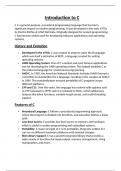
Introduction to C
C is a general-purpose, procedural programming language that has had a
significant impact on modern programming. It was developed in the early 1970s
by Dennis Ritchie at AT&T Bell Labs. Originally designed for system programming,
C has become widely used for developing software applications and operating
systems.
History and Evolution
Developed in the 1970s: C was created to improve upon the B language,
which was itself a derivative of BCPL, a language created for writing
operating systems.
UNIX Operating System: One of C's earliest and most famous applications
was for developing the UNIX operating system. This helped establish C as
the preferred language for system-level programming.
ANSI C: In 1983, the American National Standards Institute (ANSI) formed a
committee to standardize the C language, resulting in the creation of ANSI C
in 1989. This standardization ensured portability of C programs across
different platforms.
C99 and C11: Over the years, the language has evolved with updates such
as C99 (released in 1999) and C11 (released in 2011), which added new
features like inline functions, variable-length arrays, and multi-threading
support.
Features of C
Procedural Language: C follows a procedural programming approach,
where the program is divided into functions, and execution follows a linear
path.
Low-level Access: C provides low-level access to memory and hardware,
which is useful in system programming and embedded systems.
Portability: A major strength of C is its portability. Programs written in C
can run on different hardware platforms with minimal changes.
Rich Library Support: C has a powerful standard library that provides a
wide variety of functions for input/output, memory management, string
manipulation, and more.
C is a general-purpose, procedural programming language that has had a
significant impact on modern programming. It was developed in the early 1970s
by Dennis Ritchie at AT&T Bell Labs. Originally designed for system programming,
C has become widely used for developing software applications and operating
systems.
History and Evolution
Developed in the 1970s: C was created to improve upon the B language,
which was itself a derivative of BCPL, a language created for writing
operating systems.
UNIX Operating System: One of C's earliest and most famous applications
was for developing the UNIX operating system. This helped establish C as
the preferred language for system-level programming.
ANSI C: In 1983, the American National Standards Institute (ANSI) formed a
committee to standardize the C language, resulting in the creation of ANSI C
in 1989. This standardization ensured portability of C programs across
different platforms.
C99 and C11: Over the years, the language has evolved with updates such
as C99 (released in 1999) and C11 (released in 2011), which added new
features like inline functions, variable-length arrays, and multi-threading
support.
Features of C
Procedural Language: C follows a procedural programming approach,
where the program is divided into functions, and execution follows a linear
path.
Low-level Access: C provides low-level access to memory and hardware,
which is useful in system programming and embedded systems.
Portability: A major strength of C is its portability. Programs written in C
can run on different hardware platforms with minimal changes.
Rich Library Support: C has a powerful standard library that provides a
wide variety of functions for input/output, memory management, string
manipulation, and more.