JBL Module 4A Practice Exam questions and answers correct and verified A+ Tips NEW!!!
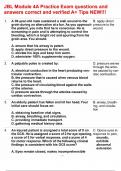
JBL Module 4A Practice Exam questions and answers correct and verified A+ Tips NEW!!!1. A 39-year-old male sustained a stab wound to the groin during an altercation at a bar. As you approach the patient, you note that he is conscious. He is screaming in pain and is attempting to control the bleeding, which is bright red and spurting from his groin area. You should: A. ensure that his airway is patent. B. apply direct pressure to the wound. C. elevate his legs and keep him warm. D. administer 100% supplemental oxygen. 2. A palpable pulse is created by: A. electrical conduction in the heart producing ven- tricular contraction. B. the pressure that is caused when venous blood returns to the heart. C. the pressure of circulating blood against the walls of the arteries. D. pressure waves through the arteries caused by cardiac contraction. 3. An elderly patient has fallen and hit her head. Your initial care should focus on: A. obtaining baseline vital signs. B. airway, breathing, and circulation. C. providing immediate transport. D. gathering medical history data. 4. An injured patient is assigned a total score of 9 on B. apply direct pressure to the wound. D. pressure waves through the arter- ies caused by car- diac contraction. B. airway, breath- ing, and circula- tion C. Opens eyes in the GCS. He is assigned a score of 2 for eye opening, response to pain, a score of 3 for verbal response, and a score of 4 for motor response. Which of the following clinical findings is consistent with his GCS score? A. Eyes remain closed, makes incomprehensible sounds, exhibits abnormal extension uses inappropri- ate words, with- draws from pain B. Opens eyes spontaneously, is confused when spo- ken to, exhibits abnormal flexion C. Opens eyes in response to pain, uses inappropri- ate words, withdraws from pain D. Opens eyes in response to voice, makes incompre- hensible sounds, localizes pain 5. During an EMS call, you should take standard precau- tions: A. immediately after completion of your primary as- sessment. B. after it has been determined that the patient is bleeding. C. before you load the patient into the ambulance. D. before exiting the ambulance and before actual patient contact. 6. In patients with deeply pigmented skin, changes in color may be apparent only in certain areas, such as the: A. forehead and face. B. lips or oral mucosa. C. dorsum of the hand. D. back of the neck. 7. Reassessment is performed to determine all of the following, EXCEPT: A. the patient's response to your treatment. B. the nature of any newly identified problems. C. whether or not the patient is deteriorating. D. the reason why the patient called EMS. 8. The chief complaint is MOST accurately defined as the: A. most serious thing the patient is concerned about. B. condition that exacerbates an underlying problem. D. before exit- ing the ambulance and before actual patient contact. B. lips or oral mu- cosa. D. the reason why the patient called EMS. A. most serious thing the patient is concerned about C. most life-threatening condition that you discover. D. gross physical signs that you detect on assess- ment. 9. The rapid exam of a patient that occurs following the primary assessment should take no longer than: A. 90 to 120 seconds. B. 30 seconds. C. 120 to 180 seconds. D. 60 to 90 seconds. 10. Treatment and transport priorities at the scene of a mass-casualty incident should be determined after: A. all the patients have been triaged. B. a physician arrives at the scene. C. area hospitals have been notified. D. the number of patients is known. 11. What maneuver should be used to open the airway of an unresponsive patient with suspected trauma? A. Head tilt-chin lift B. Tongue-jaw lift C. Jaw-thrust maneuver D. Head tilt-neck lift 12. When approaching a 32-year-old male who is com- plaining of traumatic neck pain, you should: A. stand behind him and immediately stabilize his head. B. assess his mental status by having him move his head. C. ensure that the patient can see you approaching him. D. approach him from behind and ask him not to move. D. 60 to 90 sec- onds. A. all the patients have been triaged. C. Jaw-thrust ma- neuver C. ensure that the patient can see you approaching him. 13. When you shine a light into one pupil, the normal reaction of the other pupil should be to: A. dilate. B. become larger. C. not react. D. become smaller. 14. Which of the following actions would NOT be per- f
Escuela, estudio y materia
- Institución
- JBL
- Grado
- JBL
Información del documento
- Subido en
- 17 de enero de 2025
- Número de páginas
- 57
- Escrito en
- 2024/2025
- Tipo
- Examen
- Contiene
- Preguntas y respuestas
Temas
-
jbl module 4a practice exam questions and answers

Documento también disponible en un lote