

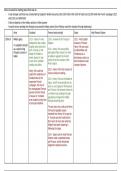
More successful at making peace than war as…
- It was cheaper and thus less constrained by England’s limited resources (the 1520 Field of the Cloth of Gold cost £15,000 while the French campaign 1522
and 1523 cost $430,000)
- It did not depend on the military actions of other powers
- It would recover prestige lost through unsuccessful military actions (how Wolsey saved the situation through diplomacy)
Aims Scotland France (main priority) Spain Holy Roman Empire
1509-14 Military glory. 1513 - James IV was 1510 - renewal of the Treaty of 1512 - First English
defeated by the smaller Etaples. invasion of France:
To establish himself English army led by the Henry VIII was used
as a warrior king Earl of Surrey in the 1511 - Henry VIII successfully by Maximillian and
through success in Battle of Flodden in persuaded Pope Julius II to enter Ferdinand as a
battle. which James IV and an alliance against the French diversionary tactic so
much of the Scottish which led to the creation of the that Ferdinand could
nobility was killed. Holy League. conquer Navarre.
Henry VIII could not 1512 - Henry VIII’s first invasion of
exploit the weakness of France achieved nothing.
Scotland due to the 1513 - Henry VIII won the Battle of
expensive French Spurs, which he personally led an
campaign, the loss of army to, and captured Therouanne
the renegotiated French and Tournai. He became known as
pension and the threat a chivalric king, helping him gain
of issues in Yorkshire popularity amongst the nobility
over taxation turning into through acquiring glory.
a full-scale rebellion.
The war was very costly and Henry
VIII had to liquidate assets
inherited from Henry VII to pay for
it. Tournai was then sold back to
the French for less than what the
English had spent repairing it
following the siege.
1514 - Spain and the Holy Roman
Empire made a separate peace
with France, which threatened
England’s national security.
- It was cheaper and thus less constrained by England’s limited resources (the 1520 Field of the Cloth of Gold cost £15,000 while the French campaign 1522
and 1523 cost $430,000)
- It did not depend on the military actions of other powers
- It would recover prestige lost through unsuccessful military actions (how Wolsey saved the situation through diplomacy)
Aims Scotland France (main priority) Spain Holy Roman Empire
1509-14 Military glory. 1513 - James IV was 1510 - renewal of the Treaty of 1512 - First English
defeated by the smaller Etaples. invasion of France:
To establish himself English army led by the Henry VIII was used
as a warrior king Earl of Surrey in the 1511 - Henry VIII successfully by Maximillian and
through success in Battle of Flodden in persuaded Pope Julius II to enter Ferdinand as a
battle. which James IV and an alliance against the French diversionary tactic so
much of the Scottish which led to the creation of the that Ferdinand could
nobility was killed. Holy League. conquer Navarre.
Henry VIII could not 1512 - Henry VIII’s first invasion of
exploit the weakness of France achieved nothing.
Scotland due to the 1513 - Henry VIII won the Battle of
expensive French Spurs, which he personally led an
campaign, the loss of army to, and captured Therouanne
the renegotiated French and Tournai. He became known as
pension and the threat a chivalric king, helping him gain
of issues in Yorkshire popularity amongst the nobility
over taxation turning into through acquiring glory.
a full-scale rebellion.
The war was very costly and Henry
VIII had to liquidate assets
inherited from Henry VII to pay for
it. Tournai was then sold back to
the French for less than what the
English had spent repairing it
following the siege.
1514 - Spain and the Holy Roman
Empire made a separate peace
with France, which threatened
England’s national security.


