
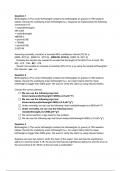
Question 1
Birthweights a) The vector birthweight contains the birthweights (in grams) of 188 newborn
babies. Denote the underlying mean birthweight by μ. Suppose we implemented the following
commands in R:
> mean(birthweight)
2913.293
> var(birthweight)
486506.6
> qnorm(0.96)
1.750686
> qnorm(0.98)
2.053749
Assuming normality, construct a bounded 96% confidence interval (CI) for μ:
[2805, 3010.4] - [2806.19, 3015.5] - [2808.08, 3018.5] - [2800.19, 3011.5]
. Evaluate the sample size needed to provide that the length of the 96%-CI is at most 100:
830 - 813 - 798 - 821 - 578
. Would it be possible to compute a bootstrap 92%-CI for μ by using the sample birthweights?
Not relevant - yes - no
Question 2
Birthweights b) The vector birthweight contains the birthweights (in grams) of 188 newborn
babies. Denote the underlying mean birthweight by μ. An expert claims that the mean
birthweight is bigger than 2800 gram. We want to verify this claim by using relevant test(s).
Choose the correct claim(s).
We can use the following sign test
binom.test(sum(birthweight<=2800),n,0.5,alt="l").
We can use the following sign test
binom.test(sum(birthweight>2800),n,0.5,alt="g").
Under normality, we can use the following t-test t.test(birthweight,mu=2800,alt="l")
Under normality, we can use the following t-test
t.test(birthweight,mu=2800,alt="g")
We cannot perform a sign tests for this problem.
We can use the following sign test binom.test(sum(birthweight<2800),n,0.5,alt="g").
Question 3
Birthweights c) The vector birthweight contains the birthweights (in grams) of 188 newborn
babies. Denote the underlying mean birthweight by μ. An expert claims that the mean
birthweight is bigger than 2800 gram. We want to verify this claim by using relevant test(s).
Suppose we have two tests to verify the claim of the expert. One test has the significance
alpha=0.3 and the power 0.78, the second test has the significance alpha=0.4 and the error of
the second kind 0.25. Which of the two tests is preferable?
, 1st - 2nd - cannot say
.
Suppose we use a t-test to verify the claim of the expert, then
We can estimate - we cannot estimate - we can compute
its power for
All parameter values from the null hypothesis - All parameter values - All parameter values
from the alternative hypothesis
.
Question 4
Birthweights d) The vector birthweight contains the birthweights (in grams) of 188 newborn
babies. Let p be the probability that birthweight of a newborn baby is less than 2600 gram.
Suppose we implemented the following command in R:
> p=sum(t<2600)/n; p
0.3522727
Suppose further that, using asymptotic normality, the expert computed the left end pl=0.25 of
the confidence interval [pl,pr] for p. We recover the whole confidence interval as
[0.15, 0.39] - [0.25, 0.41] - [0.23, 0.45] - [0.19, 0.44]
(rounded to two decimal digits) and its confidence level we recover as
q=(p+0.25)/sqrt(p*(1-p)/n); 1-2*(1-pnorm(q))
q=(p+0.25)/sqrt(p*(1-p)/n); 1-2*(1-qnorm(q))
q=(p-0.25)/sqrt(p*(1-p)/n); 1-(1-pnorm(q))
q=(p-0.25)/sqrt(p*(1-p)/n); 1-2*(1-pnorm(q))
Question 5
Birthweights e) The vector birthweight contains the birthweights (in grams) of 188 newborn
babies. An expert reports that there were 34 male and 28 female babies among 62 who
weighted less than 2600 gram, and 61 male and 65 female babies among the remaining 126
babies. The expert claims that the mean weight is different for male and female babies. We
want to verify this claim by an appropriate test. To test the claim, represent the data in the form
of contingency table.
male female
weight<2600g V1 V2
weight>2600g V3 V4
Determine the values of the above contingency table.
V1= 28 - 61 - 65 - 68 - 34
V2= 28 - 61 - 65 - 68 - 34
V3= 28 - 61 - 65 - 68 - 34
V4= 28 - 61 - 65 - 68 - 34
Birthweights a) The vector birthweight contains the birthweights (in grams) of 188 newborn
babies. Denote the underlying mean birthweight by μ. Suppose we implemented the following
commands in R:
> mean(birthweight)
2913.293
> var(birthweight)
486506.6
> qnorm(0.96)
1.750686
> qnorm(0.98)
2.053749
Assuming normality, construct a bounded 96% confidence interval (CI) for μ:
[2805, 3010.4] - [2806.19, 3015.5] - [2808.08, 3018.5] - [2800.19, 3011.5]
. Evaluate the sample size needed to provide that the length of the 96%-CI is at most 100:
830 - 813 - 798 - 821 - 578
. Would it be possible to compute a bootstrap 92%-CI for μ by using the sample birthweights?
Not relevant - yes - no
Question 2
Birthweights b) The vector birthweight contains the birthweights (in grams) of 188 newborn
babies. Denote the underlying mean birthweight by μ. An expert claims that the mean
birthweight is bigger than 2800 gram. We want to verify this claim by using relevant test(s).
Choose the correct claim(s).
We can use the following sign test
binom.test(sum(birthweight<=2800),n,0.5,alt="l").
We can use the following sign test
binom.test(sum(birthweight>2800),n,0.5,alt="g").
Under normality, we can use the following t-test t.test(birthweight,mu=2800,alt="l")
Under normality, we can use the following t-test
t.test(birthweight,mu=2800,alt="g")
We cannot perform a sign tests for this problem.
We can use the following sign test binom.test(sum(birthweight<2800),n,0.5,alt="g").
Question 3
Birthweights c) The vector birthweight contains the birthweights (in grams) of 188 newborn
babies. Denote the underlying mean birthweight by μ. An expert claims that the mean
birthweight is bigger than 2800 gram. We want to verify this claim by using relevant test(s).
Suppose we have two tests to verify the claim of the expert. One test has the significance
alpha=0.3 and the power 0.78, the second test has the significance alpha=0.4 and the error of
the second kind 0.25. Which of the two tests is preferable?
, 1st - 2nd - cannot say
.
Suppose we use a t-test to verify the claim of the expert, then
We can estimate - we cannot estimate - we can compute
its power for
All parameter values from the null hypothesis - All parameter values - All parameter values
from the alternative hypothesis
.
Question 4
Birthweights d) The vector birthweight contains the birthweights (in grams) of 188 newborn
babies. Let p be the probability that birthweight of a newborn baby is less than 2600 gram.
Suppose we implemented the following command in R:
> p=sum(t<2600)/n; p
0.3522727
Suppose further that, using asymptotic normality, the expert computed the left end pl=0.25 of
the confidence interval [pl,pr] for p. We recover the whole confidence interval as
[0.15, 0.39] - [0.25, 0.41] - [0.23, 0.45] - [0.19, 0.44]
(rounded to two decimal digits) and its confidence level we recover as
q=(p+0.25)/sqrt(p*(1-p)/n); 1-2*(1-pnorm(q))
q=(p+0.25)/sqrt(p*(1-p)/n); 1-2*(1-qnorm(q))
q=(p-0.25)/sqrt(p*(1-p)/n); 1-(1-pnorm(q))
q=(p-0.25)/sqrt(p*(1-p)/n); 1-2*(1-pnorm(q))
Question 5
Birthweights e) The vector birthweight contains the birthweights (in grams) of 188 newborn
babies. An expert reports that there were 34 male and 28 female babies among 62 who
weighted less than 2600 gram, and 61 male and 65 female babies among the remaining 126
babies. The expert claims that the mean weight is different for male and female babies. We
want to verify this claim by an appropriate test. To test the claim, represent the data in the form
of contingency table.
male female
weight<2600g V1 V2
weight>2600g V3 V4
Determine the values of the above contingency table.
V1= 28 - 61 - 65 - 68 - 34
V2= 28 - 61 - 65 - 68 - 34
V3= 28 - 61 - 65 - 68 - 34
V4= 28 - 61 - 65 - 68 - 34


