1
Higher Order Linear Differential Equations
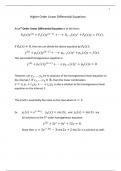
An 𝒏th Order Linear Differential Equation is of the form:
𝑃0 (𝑥 )𝑦 (𝑛) + 𝑃1 (𝑥 )𝑦 (𝑛−1) + ⋯ + 𝑃𝑛−1 (𝑥 )𝑦 ′ + 𝑃𝑛 (𝑥 )𝑦 = 𝐹 (𝑥 ).
If 𝑃0 (𝑥) ≠ 0, then we can divide the above equation by 𝑃0 (𝑥 ):
𝑦 (𝑛) + 𝑝1 (𝑥 )𝑦 (𝑛−1) + ⋯ + 𝑝𝑛−1 (𝑥 )𝑦 ′ + 𝑝𝑛 (𝑥 )𝑦 = 𝑓(𝑥 ).
The associated homogeneous equation is:
𝑦 (𝑛) + 𝑝1 (𝑥 )𝑦 (𝑛−1) + ⋯ + 𝑝𝑛−1 (𝑥 )𝑦 ′ + 𝑝𝑛 (𝑥 )𝑦 = 0.
Theorem: Let 𝑦1 , … , 𝑦𝑛 be 𝑛 solutions of the homogeneous linear equation on
the interval 𝐼. If 𝑐1 , … , 𝑐𝑛 ∈ ℝ, then the linear combination
𝑦 = 𝑐1 𝑦1 + 𝑐2 𝑦2 + ⋯ + 𝑐𝑛 𝑦𝑛 is also a solution to the homogeneous linear
equation on the interval, 𝐼.
The proof is essentially the same as the case where 𝑛 = 2.
Ex. 𝑦1 (𝑥 ) = 𝑒 (−3𝑥) , 𝑦2 (𝑥 ) = cos 2𝑥, and 𝑦3 (𝑥 ) = sin 2𝑥 are
all solutions to the 3rd order homogeneous equation:
𝑦 (3) + 3𝑦" + 4𝑦′ + 12𝑦 = 0.
Show that 𝑦 = 2𝑒 (−3𝑥) − 3 cos 2𝑥 + 2 sin 2𝑥 is a solution as well.
, 2
𝑦 = 2𝑒 (−3𝑥) − 3 cos 2𝑥 + 2 sin 2𝑥
𝑦 ′ = −6𝑒 (−3𝑥) + 6 sin 2𝑥 + 4 cos 2𝑥
𝑦 ′′ = +18𝑒 (−3𝑥) + 12 cos 2𝑥 − 8 sin 2𝑥
𝑦 ′′′ = −54𝑒 (−3𝑥) − 24 sin 2𝑥 − 16 cos 2𝑥
⟹ 𝑦 ′′′ + 3𝑦 ′′ + 4𝑦 ′ + 12𝑦 = 0.
We will see later that since 𝑦1 , 𝑦2 , and 𝑦3 are linearly independent the
general solution is: 𝑦 = 𝑐1 𝑒 (−3𝑥) + 𝑐2 cos 2𝑥 + 𝑐3 sin 2𝑥.
Theorem: Suppose 𝑝1 , … , 𝑝𝑛 and 𝑓 are continuous on the open interval, 𝐼,
containing the point 𝑎. Then given 𝑛 numbers, 𝑏0 , 𝑏1 , … , 𝑏𝑛−1 , the 𝑛th order
linear differential equation
𝑦 (𝑛) + 𝑝1 (𝑥 )𝑦 (𝑛−1) + ⋯ + 𝑝𝑛−1 (𝑥 )𝑦 ′ + 𝑝𝑛 (𝑥 )𝑦 = 𝑓(𝑥)
has a unique solution on 𝐼 with:
𝑦(𝑎) = 𝑏0 , 𝑦 ′ (𝑎) = 𝑏1 , … , 𝑦 (𝑛−1) (𝑎) = 𝑏𝑛−1 .
Ex. 𝑦 = 𝑐1 𝑒 (−3𝑥) + 𝑐2 cos 2𝑥 + 𝑐3 sin 2𝑥 is the general solution to the
equation 𝑦 ′′′ + 3𝑦 ′′ + 4𝑦 ′ + 12𝑦 = 0. Find the unique solution
where 𝑦(0) = 4, 𝑦 ′ (0) = −7, 𝑦 ′′ (0) = −3.
𝑦 = 𝑐1 𝑒 (−3𝑥) + 𝑐2 cos 2𝑥 + 𝑐3 sin 2𝑥 ; 𝑦(0) = 𝑐1 + 𝑐2 = 4
𝑦 ′ = −3𝑐1 𝑒 −3𝑥 − 2𝑐2 sin 2𝑥 + 2𝑐3 cos 2𝑥 ; 𝑦 ′ (0) = −3𝑐1 + 2𝑐3 = −7
𝑦 ′′ = 9𝑐1 𝑒 (−3𝑥) − 4𝑐2 cos 2𝑥 − 4𝑐3 sin 2𝑥 ; 𝑦 ′′ (0) = 9𝑐1 − 4𝑐2 = −3
Higher Order Linear Differential Equations
An 𝒏th Order Linear Differential Equation is of the form:
𝑃0 (𝑥 )𝑦 (𝑛) + 𝑃1 (𝑥 )𝑦 (𝑛−1) + ⋯ + 𝑃𝑛−1 (𝑥 )𝑦 ′ + 𝑃𝑛 (𝑥 )𝑦 = 𝐹 (𝑥 ).
If 𝑃0 (𝑥) ≠ 0, then we can divide the above equation by 𝑃0 (𝑥 ):
𝑦 (𝑛) + 𝑝1 (𝑥 )𝑦 (𝑛−1) + ⋯ + 𝑝𝑛−1 (𝑥 )𝑦 ′ + 𝑝𝑛 (𝑥 )𝑦 = 𝑓(𝑥 ).
The associated homogeneous equation is:
𝑦 (𝑛) + 𝑝1 (𝑥 )𝑦 (𝑛−1) + ⋯ + 𝑝𝑛−1 (𝑥 )𝑦 ′ + 𝑝𝑛 (𝑥 )𝑦 = 0.
Theorem: Let 𝑦1 , … , 𝑦𝑛 be 𝑛 solutions of the homogeneous linear equation on
the interval 𝐼. If 𝑐1 , … , 𝑐𝑛 ∈ ℝ, then the linear combination
𝑦 = 𝑐1 𝑦1 + 𝑐2 𝑦2 + ⋯ + 𝑐𝑛 𝑦𝑛 is also a solution to the homogeneous linear
equation on the interval, 𝐼.
The proof is essentially the same as the case where 𝑛 = 2.
Ex. 𝑦1 (𝑥 ) = 𝑒 (−3𝑥) , 𝑦2 (𝑥 ) = cos 2𝑥, and 𝑦3 (𝑥 ) = sin 2𝑥 are
all solutions to the 3rd order homogeneous equation:
𝑦 (3) + 3𝑦" + 4𝑦′ + 12𝑦 = 0.
Show that 𝑦 = 2𝑒 (−3𝑥) − 3 cos 2𝑥 + 2 sin 2𝑥 is a solution as well.
, 2
𝑦 = 2𝑒 (−3𝑥) − 3 cos 2𝑥 + 2 sin 2𝑥
𝑦 ′ = −6𝑒 (−3𝑥) + 6 sin 2𝑥 + 4 cos 2𝑥
𝑦 ′′ = +18𝑒 (−3𝑥) + 12 cos 2𝑥 − 8 sin 2𝑥
𝑦 ′′′ = −54𝑒 (−3𝑥) − 24 sin 2𝑥 − 16 cos 2𝑥
⟹ 𝑦 ′′′ + 3𝑦 ′′ + 4𝑦 ′ + 12𝑦 = 0.
We will see later that since 𝑦1 , 𝑦2 , and 𝑦3 are linearly independent the
general solution is: 𝑦 = 𝑐1 𝑒 (−3𝑥) + 𝑐2 cos 2𝑥 + 𝑐3 sin 2𝑥.
Theorem: Suppose 𝑝1 , … , 𝑝𝑛 and 𝑓 are continuous on the open interval, 𝐼,
containing the point 𝑎. Then given 𝑛 numbers, 𝑏0 , 𝑏1 , … , 𝑏𝑛−1 , the 𝑛th order
linear differential equation
𝑦 (𝑛) + 𝑝1 (𝑥 )𝑦 (𝑛−1) + ⋯ + 𝑝𝑛−1 (𝑥 )𝑦 ′ + 𝑝𝑛 (𝑥 )𝑦 = 𝑓(𝑥)
has a unique solution on 𝐼 with:
𝑦(𝑎) = 𝑏0 , 𝑦 ′ (𝑎) = 𝑏1 , … , 𝑦 (𝑛−1) (𝑎) = 𝑏𝑛−1 .
Ex. 𝑦 = 𝑐1 𝑒 (−3𝑥) + 𝑐2 cos 2𝑥 + 𝑐3 sin 2𝑥 is the general solution to the
equation 𝑦 ′′′ + 3𝑦 ′′ + 4𝑦 ′ + 12𝑦 = 0. Find the unique solution
where 𝑦(0) = 4, 𝑦 ′ (0) = −7, 𝑦 ′′ (0) = −3.
𝑦 = 𝑐1 𝑒 (−3𝑥) + 𝑐2 cos 2𝑥 + 𝑐3 sin 2𝑥 ; 𝑦(0) = 𝑐1 + 𝑐2 = 4
𝑦 ′ = −3𝑐1 𝑒 −3𝑥 − 2𝑐2 sin 2𝑥 + 2𝑐3 cos 2𝑥 ; 𝑦 ′ (0) = −3𝑐1 + 2𝑐3 = −7
𝑦 ′′ = 9𝑐1 𝑒 (−3𝑥) − 4𝑐2 cos 2𝑥 − 4𝑐3 sin 2𝑥 ; 𝑦 ′′ (0) = 9𝑐1 − 4𝑐2 = −3