2024_AQA-GCSE Religious Studies A – Paper 1:
Islam
(Merged Question Paper and Marking Scheme)
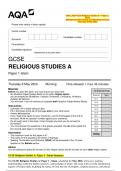
Thursday 9 May 2024
Please write clearly in block capitals.
Centre number
Candidate number
Surname
Forename(s)
Candidate signature
I declare this is my own work.
GCSE
RELIGIOUS STUDIES A
Paper 1 Islam
Thursday 9 May 2024 Morning Time allowed: 1 hour 45 minutes
Materials
For Examiner’s Use
Before you open this book, you must ensure you also have:
• the Question Paper/Answer Book for the other religion option Question Mark
you are entered for (Buddhism, Catholic Christianity, Christianity, Hinduism,
Judaism or Sikhism). 01.1
You will have 1 hour 45 minutes to complete both Question Paper/Answer Books. 01.2
Instructions 01.3
• Use black ink or black ball-point pen. 01.4
• Fill in the boxes at the top of this page and on your other book.
• Answer all questions. 01.5
• If you need extra space for your answer(s), use the lined pages at the end of 02.1
this book. Write the question number against your answer(s). 02.2
• Do all rough work in this book. Cross through any work you do not want to
be marked. 02.3
• You must answer the questions in the spaces provided. Do not write outside the 02.4
box around each page or on blank pages. 02.5
Information
TOTAL
• The maximum mark for this paper is 51.
• The marks for the questions are shown in brackets.
• Spelling, Punctuation and Grammar (SPaG) will be assessed in the 12-mark
question in the Beliefs section.
Advice
You are advised to spend 50 minutes on this religion option and 50 minutes on your other religion option.
GCSE Religious Studies A: Paper 1 - Islam Summary
The GCSE Religious Studies A: Paper 1 - Islam, scheduled for May 2025, will assess students'
understanding of the key beliefs, practices, and teachings of Islam. The exam will cover the fundamental
aspects of Islamic faith, including the nature of God, the role of prophets, religious practices, and ethical
,teachings. It will also explore how Islam influences the lives of its followers and its relevance in the
modern world.
Key Areas Covered:
1. Beliefs in Islam
Tawhid (The Oneness of God): The belief in the absolute oneness of Allah (God). Students will
need to understand how Allah is perceived as all-powerful, merciful, and beyond human
comprehension. The significance of Tawhid in Islamic theology.
Prophethood: The role of prophets (nabi) in Islam, with a focus on the final prophet, Muhammad.
Understanding the significance of the Qur'an as the revelation from Allah through Muhammad,
and the role of other prophets such as Adam, Noah, Ibrahim (Abraham), Musa (Moses), and Isa
(Jesus).
Angels: The belief in angels as messengers of Allah who carry out His commands. Key angels
include Jibril (Gabriel), who delivered Allah’s revelations to the prophets, and Mika'il (Michael),
who provides sustenance to humanity.
The Books of Allah: The Qur'an as the final revealed scripture, and the importance of the
previous scriptures such as the Torah (Tawrat), Psalms (Zabur), and the Gospel (Injil). Students
should understand the role of the Qur'an in guiding Muslim life.
The Day of Judgement: The belief in life after death, the resurrection, and the final judgement
where individuals are rewarded with eternal paradise (Jannah) or punished in hell (Jahannam)
based on their deeds.
Predestination (Qadar): The belief that Allah has knowledge of all that will happen in the
universe, but humans still have free will to make choices.
2. Islamic Practices
The Five Pillars of Islam: The five central acts of worship and practice that every Muslim is
expected to follow:
1. Shahada (Faith): The declaration of belief in the oneness of Allah and the prophethood of
Muhammad.
2. Salah (Prayer): The five daily prayers, their significance, and the rules governing them.
Students will learn about the timing of prayers, purification rituals (wudu), and the
positions and movements during prayer.
3. Zakat (Charity): The giving of a portion of one’s wealth to the poor and needy, typically
2.5% of savings. Zakat is considered a duty for Muslims to promote social justice and
reduce poverty.
4. Sawm (Fasting during Ramadan): The practice of fasting during the holy month of
Ramadan from dawn to sunset, abstaining from food, drink, and other physical needs.
Fasting is seen as a means of developing self-discipline and empathy for the less fortunate.
5. Hajj (Pilgrimage): The pilgrimage to the holy city of Mecca that every Muslim must
undertake at least once in their lifetime, if financially and physically able. Students will
learn about the key rituals of Hajj, including the Tawaf (circumambulating the Ka'bah), the
ritual of throwing stones at the pillars, and the significance of Hajj in bringing Muslims
together.
Jihad: The concept of "struggle" in Islam, which can refer to both personal spiritual struggle and
the defense of the Muslim community. Students will need to understand the different
interpretations and the ethical implications of Jihad.
3. Islamic Ethics and Morality
Halal and Haram: The concepts of permissible (halal) and forbidden (haram) actions in Islam.
Understanding what is considered morally right and wrong, including the rules regarding food,
, drink, and behavior. For example, the prohibition of alcohol and pork, and the significance of
dietary laws.
Sharia Law: An introduction to the concept of Sharia as a legal system derived from the Qur'an
and Hadith (sayings of the Prophet). The role of Sharia in guiding personal, social, and legal
matters within the Muslim community.
Social Justice and Human Rights: The Islamic perspective on equality, justice, and rights. How
Islam promotes the fair treatment of women, the poor, and other marginalized groups. The
importance of justice, mercy, and forgiveness in Islam.
The Role of Women in Islam: An exploration of the role and status of women in Islam, including
the rights granted to women in marriage, inheritance, and education. The significance of modesty
and hijab (headscarf) as a part of personal identity and faith.
4. Islam in the Modern World
Islamic Responses to Contemporary Issues: How Islamic teachings are applied to modern-day
issues such as global conflict, the environment, social media, and economic systems. The
relevance of Islamic ethics in a modern, globalized world.
Muslim Communities Worldwide: The diversity of the Muslim community, including the
differences between Sunni and Shia Islam, and how Muslims live and practice their faith in
different parts of the world.
Interfaith Dialogue and Tolerance: The importance of interfaith dialogue in promoting mutual
respect and understanding between Muslims and followers of other faiths. Islamic teachings on
peace and coexistence with others.
*JUN2480621501*
IB/M/Jun24/G4005/E6 8062/15
, 2
Do not write
outside the
0 1 Islam: Beliefs box
0 1 .1 Which one of the following is not one of the six articles of faith in Sunni Islam?
[1 mark]
Put a tick () in the box next to the correct answer.
A Belief in angels
B Belief in justice
C Belief in predestination
D Belief in prophets 1
0 1 .2 Give two Muslim beliefs about the Qur’an.
[2 marks]
1
2
2
*02*
IB/M/Jun24/8062/15
Islam
(Merged Question Paper and Marking Scheme)
Thursday 9 May 2024
Please write clearly in block capitals.
Centre number
Candidate number
Surname
Forename(s)
Candidate signature
I declare this is my own work.
GCSE
RELIGIOUS STUDIES A
Paper 1 Islam
Thursday 9 May 2024 Morning Time allowed: 1 hour 45 minutes
Materials
For Examiner’s Use
Before you open this book, you must ensure you also have:
• the Question Paper/Answer Book for the other religion option Question Mark
you are entered for (Buddhism, Catholic Christianity, Christianity, Hinduism,
Judaism or Sikhism). 01.1
You will have 1 hour 45 minutes to complete both Question Paper/Answer Books. 01.2
Instructions 01.3
• Use black ink or black ball-point pen. 01.4
• Fill in the boxes at the top of this page and on your other book.
• Answer all questions. 01.5
• If you need extra space for your answer(s), use the lined pages at the end of 02.1
this book. Write the question number against your answer(s). 02.2
• Do all rough work in this book. Cross through any work you do not want to
be marked. 02.3
• You must answer the questions in the spaces provided. Do not write outside the 02.4
box around each page or on blank pages. 02.5
Information
TOTAL
• The maximum mark for this paper is 51.
• The marks for the questions are shown in brackets.
• Spelling, Punctuation and Grammar (SPaG) will be assessed in the 12-mark
question in the Beliefs section.
Advice
You are advised to spend 50 minutes on this religion option and 50 minutes on your other religion option.
GCSE Religious Studies A: Paper 1 - Islam Summary
The GCSE Religious Studies A: Paper 1 - Islam, scheduled for May 2025, will assess students'
understanding of the key beliefs, practices, and teachings of Islam. The exam will cover the fundamental
aspects of Islamic faith, including the nature of God, the role of prophets, religious practices, and ethical
,teachings. It will also explore how Islam influences the lives of its followers and its relevance in the
modern world.
Key Areas Covered:
1. Beliefs in Islam
Tawhid (The Oneness of God): The belief in the absolute oneness of Allah (God). Students will
need to understand how Allah is perceived as all-powerful, merciful, and beyond human
comprehension. The significance of Tawhid in Islamic theology.
Prophethood: The role of prophets (nabi) in Islam, with a focus on the final prophet, Muhammad.
Understanding the significance of the Qur'an as the revelation from Allah through Muhammad,
and the role of other prophets such as Adam, Noah, Ibrahim (Abraham), Musa (Moses), and Isa
(Jesus).
Angels: The belief in angels as messengers of Allah who carry out His commands. Key angels
include Jibril (Gabriel), who delivered Allah’s revelations to the prophets, and Mika'il (Michael),
who provides sustenance to humanity.
The Books of Allah: The Qur'an as the final revealed scripture, and the importance of the
previous scriptures such as the Torah (Tawrat), Psalms (Zabur), and the Gospel (Injil). Students
should understand the role of the Qur'an in guiding Muslim life.
The Day of Judgement: The belief in life after death, the resurrection, and the final judgement
where individuals are rewarded with eternal paradise (Jannah) or punished in hell (Jahannam)
based on their deeds.
Predestination (Qadar): The belief that Allah has knowledge of all that will happen in the
universe, but humans still have free will to make choices.
2. Islamic Practices
The Five Pillars of Islam: The five central acts of worship and practice that every Muslim is
expected to follow:
1. Shahada (Faith): The declaration of belief in the oneness of Allah and the prophethood of
Muhammad.
2. Salah (Prayer): The five daily prayers, their significance, and the rules governing them.
Students will learn about the timing of prayers, purification rituals (wudu), and the
positions and movements during prayer.
3. Zakat (Charity): The giving of a portion of one’s wealth to the poor and needy, typically
2.5% of savings. Zakat is considered a duty for Muslims to promote social justice and
reduce poverty.
4. Sawm (Fasting during Ramadan): The practice of fasting during the holy month of
Ramadan from dawn to sunset, abstaining from food, drink, and other physical needs.
Fasting is seen as a means of developing self-discipline and empathy for the less fortunate.
5. Hajj (Pilgrimage): The pilgrimage to the holy city of Mecca that every Muslim must
undertake at least once in their lifetime, if financially and physically able. Students will
learn about the key rituals of Hajj, including the Tawaf (circumambulating the Ka'bah), the
ritual of throwing stones at the pillars, and the significance of Hajj in bringing Muslims
together.
Jihad: The concept of "struggle" in Islam, which can refer to both personal spiritual struggle and
the defense of the Muslim community. Students will need to understand the different
interpretations and the ethical implications of Jihad.
3. Islamic Ethics and Morality
Halal and Haram: The concepts of permissible (halal) and forbidden (haram) actions in Islam.
Understanding what is considered morally right and wrong, including the rules regarding food,
, drink, and behavior. For example, the prohibition of alcohol and pork, and the significance of
dietary laws.
Sharia Law: An introduction to the concept of Sharia as a legal system derived from the Qur'an
and Hadith (sayings of the Prophet). The role of Sharia in guiding personal, social, and legal
matters within the Muslim community.
Social Justice and Human Rights: The Islamic perspective on equality, justice, and rights. How
Islam promotes the fair treatment of women, the poor, and other marginalized groups. The
importance of justice, mercy, and forgiveness in Islam.
The Role of Women in Islam: An exploration of the role and status of women in Islam, including
the rights granted to women in marriage, inheritance, and education. The significance of modesty
and hijab (headscarf) as a part of personal identity and faith.
4. Islam in the Modern World
Islamic Responses to Contemporary Issues: How Islamic teachings are applied to modern-day
issues such as global conflict, the environment, social media, and economic systems. The
relevance of Islamic ethics in a modern, globalized world.
Muslim Communities Worldwide: The diversity of the Muslim community, including the
differences between Sunni and Shia Islam, and how Muslims live and practice their faith in
different parts of the world.
Interfaith Dialogue and Tolerance: The importance of interfaith dialogue in promoting mutual
respect and understanding between Muslims and followers of other faiths. Islamic teachings on
peace and coexistence with others.
*JUN2480621501*
IB/M/Jun24/G4005/E6 8062/15
, 2
Do not write
outside the
0 1 Islam: Beliefs box
0 1 .1 Which one of the following is not one of the six articles of faith in Sunni Islam?
[1 mark]
Put a tick () in the box next to the correct answer.
A Belief in angels
B Belief in justice
C Belief in predestination
D Belief in prophets 1
0 1 .2 Give two Muslim beliefs about the Qur’an.
[2 marks]
1
2
2
*02*
IB/M/Jun24/8062/15