

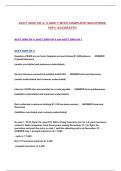
ACCT 2000 CH 4, 6 AND 7 WITH COMPLETE SOLUTIONS
100% ACCURATE!!
ACCT 2000 CH 4, ACCT 2000 CH 6 and ACCT 2000 CH 7
ACCT 2000 CH 4
Supplies of $400 are on hand. Supplies account shows $1,600 balance. - ANSWER
Prepaid Expenses
(assets overstated and expenses understated)
Service Revenue earned but unbilled total $700. - ANSWER Accrued Revenues
(assets understated and revenues understated)
Interest of $300 has accumulated on a note payable. - ANSWER Accrued Expenses
(liabilities understated and expenses understated)
Rent collected in advance totaling $1,100 has been earned. - ANSWER Unearned
Revenues
(liabilities overstated and revenues understated)
On July 1, 2012, Ryhn Co. pays $17,600 to Craig Insurance Co. for a 2-year insurance
contract. Both companies have fiscal years ending December 31. For Ryhn Co.
journalize and post the entry on July 1 and the adjusting entry on December 31. -
ANSWER July 1 prepaid insurance dr 17,600
cash cr 17,600
Dec 31 Insurance expense dr 4,400
prepaid insurance cr 4,400
,(a) Interest on notes payable of $278 is accrued.
(b) Service revenue earned but unbilled totals $1,813.
(c) Salaries of $872 earned by employees have not been recorded. - ANSWER a)
Interest Expense dr 278
Interest Payable cr 278
b) Accounts Receivable dr 1,813
Service Revenue cr 1,813
c) Salaries and Wages Expense dr 872
Salaries and Wages Payable cr 872
Identify the financial statement on which each account would be reported:
Accumulated Depreciation - ANSWER Balance Sheet
Identify the financial statement on which each account would be reported: Depreciation
Expense - ANSWER Income Statement
Identify the financial statement on which each account would be reported:
Retained Earnings (beginning) - ANSWER Retained Earnings Statement
Identify the financial statement on which each account would be reported:
Dividends - ANSWER Retained Earnings Statement
Identify the financial statement on which each account would be reported:
Service Revenue - ANSWER Income Statement
Identify the financial statement on which each account would be reported:
Supplies - ANSWER Balance Sheet
, Identify the financial statement on which each account would be reported:
Accounts Payable - ANSWER Balance Sheet
Is the reason plant assets are not reported at liquidation value. - ANSWER Going
Concern Assumption
Indicates that personal and business record-keeping should be separately maintained. -
ANSWER Economic Entity Assumption
Ensures that all relevant financial information is reported. - ANSWER Full Disclosure
Principle
Assumes that the dollar is the "measuring stick" used to report on financial
performance. - ANSWER Monetary Unit Assumption
Requires that accounting standards be followed for all significant items. - ANSWER
Materiality Constraint
Separates financial information into time periods for reporting purposes. - ANSWER
Periodicity Assumption
Requires recognition of expenses in the same period as related revenues. - ANSWER
Expense Recognition Principle
Indicates that fair value changes subsequent to purchase are not recorded in the
accounts. - ANSWER Cost Principle
1. The equipment depreciates $350 per month.
2. Half of the unearned rent revenue was earned during the quarter.
100% ACCURATE!!
ACCT 2000 CH 4, ACCT 2000 CH 6 and ACCT 2000 CH 7
ACCT 2000 CH 4
Supplies of $400 are on hand. Supplies account shows $1,600 balance. - ANSWER
Prepaid Expenses
(assets overstated and expenses understated)
Service Revenue earned but unbilled total $700. - ANSWER Accrued Revenues
(assets understated and revenues understated)
Interest of $300 has accumulated on a note payable. - ANSWER Accrued Expenses
(liabilities understated and expenses understated)
Rent collected in advance totaling $1,100 has been earned. - ANSWER Unearned
Revenues
(liabilities overstated and revenues understated)
On July 1, 2012, Ryhn Co. pays $17,600 to Craig Insurance Co. for a 2-year insurance
contract. Both companies have fiscal years ending December 31. For Ryhn Co.
journalize and post the entry on July 1 and the adjusting entry on December 31. -
ANSWER July 1 prepaid insurance dr 17,600
cash cr 17,600
Dec 31 Insurance expense dr 4,400
prepaid insurance cr 4,400
,(a) Interest on notes payable of $278 is accrued.
(b) Service revenue earned but unbilled totals $1,813.
(c) Salaries of $872 earned by employees have not been recorded. - ANSWER a)
Interest Expense dr 278
Interest Payable cr 278
b) Accounts Receivable dr 1,813
Service Revenue cr 1,813
c) Salaries and Wages Expense dr 872
Salaries and Wages Payable cr 872
Identify the financial statement on which each account would be reported:
Accumulated Depreciation - ANSWER Balance Sheet
Identify the financial statement on which each account would be reported: Depreciation
Expense - ANSWER Income Statement
Identify the financial statement on which each account would be reported:
Retained Earnings (beginning) - ANSWER Retained Earnings Statement
Identify the financial statement on which each account would be reported:
Dividends - ANSWER Retained Earnings Statement
Identify the financial statement on which each account would be reported:
Service Revenue - ANSWER Income Statement
Identify the financial statement on which each account would be reported:
Supplies - ANSWER Balance Sheet
, Identify the financial statement on which each account would be reported:
Accounts Payable - ANSWER Balance Sheet
Is the reason plant assets are not reported at liquidation value. - ANSWER Going
Concern Assumption
Indicates that personal and business record-keeping should be separately maintained. -
ANSWER Economic Entity Assumption
Ensures that all relevant financial information is reported. - ANSWER Full Disclosure
Principle
Assumes that the dollar is the "measuring stick" used to report on financial
performance. - ANSWER Monetary Unit Assumption
Requires that accounting standards be followed for all significant items. - ANSWER
Materiality Constraint
Separates financial information into time periods for reporting purposes. - ANSWER
Periodicity Assumption
Requires recognition of expenses in the same period as related revenues. - ANSWER
Expense Recognition Principle
Indicates that fair value changes subsequent to purchase are not recorded in the
accounts. - ANSWER Cost Principle
1. The equipment depreciates $350 per month.
2. Half of the unearned rent revenue was earned during the quarter.

