

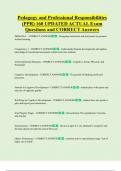
Pedagogy and Professional Responsibilities
(PPR) 160 UPDATED ACTUAL Exam
Questions and CORRECT Answers
DOMAIN I: - CORRECT ANSWER - Designing instruction and assessment to promote
student learning.
Competency 1 - CORRECT ANSWER - Understands (human development) and applies
knowledge to instruction/assessment which motivates students.
4 Developmental Domains - CORRECT ANSWER - Cognitive, Social, Physical, and
Emotional
Cognitive Development - CORRECT ANSWER - The growth of thinking skills and
processes.
Normal in Cognitive Development - CORRECT ANSWER - student plays with peers and
use toys of opposite gender.
Red Flags in Cognitive Development - CORRECT ANSWER - student does not speak or
play and rejects peer interaction.
Jean Piaget's Stages - CORRECT ANSWER - Sensorimotor, Pre-operational, Concrete,
and Formal
Sensorimotor - CORRECT ANSWER - Occurs at ages 0-2: are attached to caregiver and
develop speech towards the end of first year.
Object Permanence - CORRECT ANSWER - common trait in sensorimotor stage "out of
sight, out of mind".
,Pre-Operational - CORRECT ANSWER - Occurs at ages 2-7: engages in imaginative play
and does not grasp that others have different ideas (egocentric).
Conservation - CORRECT ANSWER - quantity remains the same no matter the size or
shape of an object. When a child has grasped this concept it means they have moved from pre-op
to concrete.
Concrete - CORRECT ANSWER - Occurs at ages 7-11: demonstrates logical thought and
how knowledge is gained through cooperative learning such as group discussions.
Reversibility - CORRECT ANSWER - things can be done, then undone.
Formal - CORRECT ANSWER - Occurs at ages 11 and up: able to research, debate,
justify and extend own learning, and student-centered.
Social Development - CORRECT ANSWER - Children learn through culture and develop
thoughts based on interactions with others.
Zone of Proximal Development - CORRECT ANSWER - difference between what a
learner can do without help and what he/she can do with help.
Kohlberg's Stages of Moral Reasoning - CORRECT ANSWER - Obedience and
Punishment, Self-Interest, Conformity, Social Order, Social Contract, and Ethical Principles.
Pre-Conventional Level - CORRECT ANSWER - Moral decisions are made based on own
interests to avoid punishments or gain rewards.
Conventional Level - CORRECT ANSWER - Focus is on pleasing others and following
rules.
, Post-Convetional Level - CORRECT ANSWER - Doing what's allowed vs. what's right
and rules can be bent for the good of the group without being rewarded.
Physical Development - CORRECT ANSWER - Environmental factors and prenatal
development such as malnutrition, illness, and prenatal health care.
Emotional Development - CORRECT ANSWER - Childs ability to control feelings and
form secure relationships.
Attachment - CORRECT ANSWER - bond between child and caregiver.
Separation Anxiety - CORRECT ANSWER - distress occurs when child is separated from
caregiver.
Parenting Styles - CORRECT ANSWER - Authoritarian, Permissive, Authoritative, and
Uninvolved
Authoritarian - CORRECT ANSWER - strict without reasoning.
Permissive - CORRECT ANSWER - minimal control.
Authoritative - CORRECT ANSWER - has rules but reasons with child.
Uninvolved - CORRECT ANSWER - little interest and neglectful.
Schemata - CORRECT ANSWER - thoughts and experiences from the past that one can
use to relate to new information.
(PPR) 160 UPDATED ACTUAL Exam
Questions and CORRECT Answers
DOMAIN I: - CORRECT ANSWER - Designing instruction and assessment to promote
student learning.
Competency 1 - CORRECT ANSWER - Understands (human development) and applies
knowledge to instruction/assessment which motivates students.
4 Developmental Domains - CORRECT ANSWER - Cognitive, Social, Physical, and
Emotional
Cognitive Development - CORRECT ANSWER - The growth of thinking skills and
processes.
Normal in Cognitive Development - CORRECT ANSWER - student plays with peers and
use toys of opposite gender.
Red Flags in Cognitive Development - CORRECT ANSWER - student does not speak or
play and rejects peer interaction.
Jean Piaget's Stages - CORRECT ANSWER - Sensorimotor, Pre-operational, Concrete,
and Formal
Sensorimotor - CORRECT ANSWER - Occurs at ages 0-2: are attached to caregiver and
develop speech towards the end of first year.
Object Permanence - CORRECT ANSWER - common trait in sensorimotor stage "out of
sight, out of mind".
,Pre-Operational - CORRECT ANSWER - Occurs at ages 2-7: engages in imaginative play
and does not grasp that others have different ideas (egocentric).
Conservation - CORRECT ANSWER - quantity remains the same no matter the size or
shape of an object. When a child has grasped this concept it means they have moved from pre-op
to concrete.
Concrete - CORRECT ANSWER - Occurs at ages 7-11: demonstrates logical thought and
how knowledge is gained through cooperative learning such as group discussions.
Reversibility - CORRECT ANSWER - things can be done, then undone.
Formal - CORRECT ANSWER - Occurs at ages 11 and up: able to research, debate,
justify and extend own learning, and student-centered.
Social Development - CORRECT ANSWER - Children learn through culture and develop
thoughts based on interactions with others.
Zone of Proximal Development - CORRECT ANSWER - difference between what a
learner can do without help and what he/she can do with help.
Kohlberg's Stages of Moral Reasoning - CORRECT ANSWER - Obedience and
Punishment, Self-Interest, Conformity, Social Order, Social Contract, and Ethical Principles.
Pre-Conventional Level - CORRECT ANSWER - Moral decisions are made based on own
interests to avoid punishments or gain rewards.
Conventional Level - CORRECT ANSWER - Focus is on pleasing others and following
rules.
, Post-Convetional Level - CORRECT ANSWER - Doing what's allowed vs. what's right
and rules can be bent for the good of the group without being rewarded.
Physical Development - CORRECT ANSWER - Environmental factors and prenatal
development such as malnutrition, illness, and prenatal health care.
Emotional Development - CORRECT ANSWER - Childs ability to control feelings and
form secure relationships.
Attachment - CORRECT ANSWER - bond between child and caregiver.
Separation Anxiety - CORRECT ANSWER - distress occurs when child is separated from
caregiver.
Parenting Styles - CORRECT ANSWER - Authoritarian, Permissive, Authoritative, and
Uninvolved
Authoritarian - CORRECT ANSWER - strict without reasoning.
Permissive - CORRECT ANSWER - minimal control.
Authoritative - CORRECT ANSWER - has rules but reasons with child.
Uninvolved - CORRECT ANSWER - little interest and neglectful.
Schemata - CORRECT ANSWER - thoughts and experiences from the past that one can
use to relate to new information.

