
Spoken acquisition
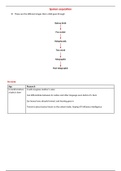
These are the different stages that a child goes through
Before birth
Pre-verbal
Holophrastic
Two word
Telegraphic
Post-telegraphic
Pre-birth
Age Research
6 months before It will recognise mother’s voice
a baby is born
Can differentiate between its native and other language even before it’s born
Ear bones have already formed, and hearing goes in
Trends to play classical music to the unborn baby, hoping it’ll influence intelligence
, Pre-verbal
Age Research
Born First noise – crying due to physical reasons
(crying)
Parents may suggest that they’re attuned to the different types of cry
It has been suggested that the parents actually just recognise when crying changes in intensity
Through crying, a baby is beginning to exercise its vocal chords and understands its noise gains
attention
A baby experiments with the noises that can be made when the tongue and back of the
2 months mouth come into contact
(cooing)
Noises such as ‘coo’ ‘goo’ ‘ga-ga’
They’re developing increased control over their vocal chords
At the onset of babbling, the child begins to make sounds that more closely resemble those of
6-9 months adult language
(babbling)
Reduplicated babbling
Simpler, appears first and involves a child repeatedly creating the same sounds
(e.g. mama, dada)
Such sounds still have no meaning, but parents say it’s their first word
Phonemic expansion
- During the babbling phase, no. of different phonemes produced by a child increases
initially
Phonemic contraction
9-10 months - A reduction in the no. of phonemes used begins to occur
- The range of sounds made by a child shrink
These are the different stages that a child goes through
Before birth
Pre-verbal
Holophrastic
Two word
Telegraphic
Post-telegraphic
Pre-birth
Age Research
6 months before It will recognise mother’s voice
a baby is born
Can differentiate between its native and other language even before it’s born
Ear bones have already formed, and hearing goes in
Trends to play classical music to the unborn baby, hoping it’ll influence intelligence
, Pre-verbal
Age Research
Born First noise – crying due to physical reasons
(crying)
Parents may suggest that they’re attuned to the different types of cry
It has been suggested that the parents actually just recognise when crying changes in intensity
Through crying, a baby is beginning to exercise its vocal chords and understands its noise gains
attention
A baby experiments with the noises that can be made when the tongue and back of the
2 months mouth come into contact
(cooing)
Noises such as ‘coo’ ‘goo’ ‘ga-ga’
They’re developing increased control over their vocal chords
At the onset of babbling, the child begins to make sounds that more closely resemble those of
6-9 months adult language
(babbling)
Reduplicated babbling
Simpler, appears first and involves a child repeatedly creating the same sounds
(e.g. mama, dada)
Such sounds still have no meaning, but parents say it’s their first word
Phonemic expansion
- During the babbling phase, no. of different phonemes produced by a child increases
initially
Phonemic contraction
9-10 months - A reduction in the no. of phonemes used begins to occur
- The range of sounds made by a child shrink



