Social research methodology - Political science
Week 1 Knowledge clips
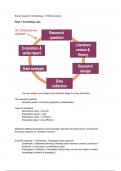
- You can always come back to the literature stage to revise the theory
The research question:
- Scientific puzzle, Practical implications, stakeholders
Types of questions
- Descriptive study = how do
- Explanatory study = why
- Exploratory study = inventory
- Evaluative study = how effective
Whats the difference between social scientific research and other forms of research?
Everyday research vs. scientific research
Scientific research = Systematic, Transparent and empirical
- Systematic: Deliberate planning, following clear research process (contrast is
intuitively > could lead to confirmation bias)
- Transparent: Verifiable, Controllable, Being clear on how you came to certain
knowledge (contrast is dogmatic))
, - Empirical evidence; de data ultimately decides instead of belief, speculation etc.
(contrast is between empirical en rational)
Deductive approach
- Derive concrete hypothesis from general theory
- Theory > Observations/findings
Inductive approach
- Outcomes of observation/research guide theory.
- Observations/findings > theory
,Deductive= From theory to > Observation/findings
Inductive= From observations/findings to > theory
In the deduction the starting point is a conclusion and its the other way around for the
induction
Most important criteria for evaluating the quality of a study
1. reliability > are the measures consistent
2. replicability > Is the study repeatable/is it clear what u did and how
3. validity > are conclusions wel founded
The different stages of your research
1. Research strategy(approach/paradigm) > (Philosophical ) What is the best way of
acquiring knowledge
2. Research design > Concrete framework/Outline of the study on how to answer the
research question >> Are dependant on the criteria you find important
3. Research method > The collection and analyses of data (survey, interviews social
media content etc.)
Criteria further explained:
1. Reliability > Zouden antwoorden hetzelfde blijven bij herhaling
- Is there stability and consistency, If you would repeat the measurement would the
answers stay consistent?
- Reliability is a characteristic of a measurement instrument.
- What is the quality of this measurement?
2. Replicability > Is het makkelijk te herhalen
- Is about the researcher reporting in clear details about the procedure (Otherwise
repetition is impossible)
- Replication is applauded by everyone, but hardly practiced
3. Validity > Is de manier op valide?
- Do the measures really represent the concepts they are supposed to be tapping
- Such as:
- Does the IQ test really reflect intelligence
- Harder to measure then reliability because it is more philosophical and subjective, is
hard to be directly observed or tested
Reliability and measurement validity:
- Lying = Invalid measurement
- Inconsistency = Unreliable measurement
- Valid: capture the ‘true’ meaning of a concept
- Reliable: Be consistent, stable
- They are linked to each other and both need to be positive
, Brymann says it is weird to have an unreliable (consistency) but valid (measurements help
true concept) measurement because:
If i ask you every day if you are happy and the answer is always different it can not be valid
Other types of validity (b,c,d) concern the validity of the conclusion
a) measurement validity (the measurements for the true concept?)
b) Internal validity (does x influence y)
c) External validity (Generalizabilty)
d) Ecological validity (In real world or scientific environment?)
B. Internal validity
- Does the independent variable X really influence the dependent variable Y
- Can we really be sure that it is the independent X that causes the variation in the
dependent Y > Or is it something else producing a apparent causal relationship?
When questioning if it is correct, you are questioning the internal validity
When do we know that X is the cause for Y?
- There is an empirically proven relationship between X and Y
- The cause must precede the effect (parent turns on the nightlight, childrens eyesight
worsened > Not the other way around)
- There is no alternative explanation for the association between X and Y (invalid if
you incorporate the variable of the parents eyesight that makes the children inherit
bad eyes and the parents feeling the need to turn on the light)
- For the 5G antennes the other variable could be population density
C) External validity: Generalizability
- Can results be generalized beyond the specific research context
D) Ecological validity
- Are findings attained in (artificial) social science research settings applicable to
peoples everyday, natural settings?
- Do the conclusions of my research hold in the ‘real world’?
- Especially for qualitative research the ecological validity is high
Week 1 Knowledge clips
- You can always come back to the literature stage to revise the theory
The research question:
- Scientific puzzle, Practical implications, stakeholders
Types of questions
- Descriptive study = how do
- Explanatory study = why
- Exploratory study = inventory
- Evaluative study = how effective
Whats the difference between social scientific research and other forms of research?
Everyday research vs. scientific research
Scientific research = Systematic, Transparent and empirical
- Systematic: Deliberate planning, following clear research process (contrast is
intuitively > could lead to confirmation bias)
- Transparent: Verifiable, Controllable, Being clear on how you came to certain
knowledge (contrast is dogmatic))
, - Empirical evidence; de data ultimately decides instead of belief, speculation etc.
(contrast is between empirical en rational)
Deductive approach
- Derive concrete hypothesis from general theory
- Theory > Observations/findings
Inductive approach
- Outcomes of observation/research guide theory.
- Observations/findings > theory
,Deductive= From theory to > Observation/findings
Inductive= From observations/findings to > theory
In the deduction the starting point is a conclusion and its the other way around for the
induction
Most important criteria for evaluating the quality of a study
1. reliability > are the measures consistent
2. replicability > Is the study repeatable/is it clear what u did and how
3. validity > are conclusions wel founded
The different stages of your research
1. Research strategy(approach/paradigm) > (Philosophical ) What is the best way of
acquiring knowledge
2. Research design > Concrete framework/Outline of the study on how to answer the
research question >> Are dependant on the criteria you find important
3. Research method > The collection and analyses of data (survey, interviews social
media content etc.)
Criteria further explained:
1. Reliability > Zouden antwoorden hetzelfde blijven bij herhaling
- Is there stability and consistency, If you would repeat the measurement would the
answers stay consistent?
- Reliability is a characteristic of a measurement instrument.
- What is the quality of this measurement?
2. Replicability > Is het makkelijk te herhalen
- Is about the researcher reporting in clear details about the procedure (Otherwise
repetition is impossible)
- Replication is applauded by everyone, but hardly practiced
3. Validity > Is de manier op valide?
- Do the measures really represent the concepts they are supposed to be tapping
- Such as:
- Does the IQ test really reflect intelligence
- Harder to measure then reliability because it is more philosophical and subjective, is
hard to be directly observed or tested
Reliability and measurement validity:
- Lying = Invalid measurement
- Inconsistency = Unreliable measurement
- Valid: capture the ‘true’ meaning of a concept
- Reliable: Be consistent, stable
- They are linked to each other and both need to be positive
, Brymann says it is weird to have an unreliable (consistency) but valid (measurements help
true concept) measurement because:
If i ask you every day if you are happy and the answer is always different it can not be valid
Other types of validity (b,c,d) concern the validity of the conclusion
a) measurement validity (the measurements for the true concept?)
b) Internal validity (does x influence y)
c) External validity (Generalizabilty)
d) Ecological validity (In real world or scientific environment?)
B. Internal validity
- Does the independent variable X really influence the dependent variable Y
- Can we really be sure that it is the independent X that causes the variation in the
dependent Y > Or is it something else producing a apparent causal relationship?
When questioning if it is correct, you are questioning the internal validity
When do we know that X is the cause for Y?
- There is an empirically proven relationship between X and Y
- The cause must precede the effect (parent turns on the nightlight, childrens eyesight
worsened > Not the other way around)
- There is no alternative explanation for the association between X and Y (invalid if
you incorporate the variable of the parents eyesight that makes the children inherit
bad eyes and the parents feeling the need to turn on the light)
- For the 5G antennes the other variable could be population density
C) External validity: Generalizability
- Can results be generalized beyond the specific research context
D) Ecological validity
- Are findings attained in (artificial) social science research settings applicable to
peoples everyday, natural settings?
- Do the conclusions of my research hold in the ‘real world’?
- Especially for qualitative research the ecological validity is high