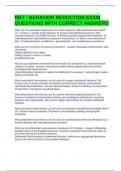
RBT - BEHAVIOR REDUCTION EXAM
QUESTIONS WITH CORRECT ANSWERS
What are the essential components of a written behavior reduction/intervention plan?
(7) - Answer-1. Identify target behavior 2) Assess antecedent/consequence that
maintains behavior 3) Identify function. 4) Identify possible replacement behaviors. 5)
Select/implement antecedent/consequence interventions. 6) Make crisis intervention
plan. 7) Implementation, modification, generalization, and maintenance procedures.
What are the 4 common functions of behavior? - Answer-Automatic reinforcement: self-
stimulatory
Getting attention from others
Getting access to items or activity
Avoidance/escape
How do you implement interventions that modify the antecedent to create behavioral
change? (2 ways) - Answer-Using discriminative stimuli signals behavior and are
associated with reinforcement.
Using Motivating Operations creates the likelihood of a behavior - being hungry makes
eating more likely, etc.
What antecedent interventions can be used on escape maintained behavior? (8) -
Answer-Use of visual schedule, functional communication training, social stories,
systematic desensitization, stimulus demand fading, errorless teaching, increase pace
of instruction, intersperse easy/hard tasks.
What antecedent interventions can be used on attention seeking behaviors? (3) -
Answer-Functional communication training, non-contingent reinforcement, ignoring
behavior when appropriate. May need to apply interventions for escape maintained
behavior.
What antecedent interventions can be used on behaviors maintained by tangible items?
(4) - Answer-Visual schedules, functional communication training, wait program,
transitions
What antecedent interventions can be used on automatically reinforced behaviors? (2) -
Answer-Sensory diet and replacement behaviors
What are the differential reinforcement procedures (3)? Explain. - Answer-Differential
Reinforcement of Incompatible Behavior: reinforce a behavior that cannot be done at
the same time as the problem behavior.
Differential Reinforcement of Alternate Behavior: reinforce an appropriate alternative
(serves the same function) to the problem behavior
QUESTIONS WITH CORRECT ANSWERS
What are the essential components of a written behavior reduction/intervention plan?
(7) - Answer-1. Identify target behavior 2) Assess antecedent/consequence that
maintains behavior 3) Identify function. 4) Identify possible replacement behaviors. 5)
Select/implement antecedent/consequence interventions. 6) Make crisis intervention
plan. 7) Implementation, modification, generalization, and maintenance procedures.
What are the 4 common functions of behavior? - Answer-Automatic reinforcement: self-
stimulatory
Getting attention from others
Getting access to items or activity
Avoidance/escape
How do you implement interventions that modify the antecedent to create behavioral
change? (2 ways) - Answer-Using discriminative stimuli signals behavior and are
associated with reinforcement.
Using Motivating Operations creates the likelihood of a behavior - being hungry makes
eating more likely, etc.
What antecedent interventions can be used on escape maintained behavior? (8) -
Answer-Use of visual schedule, functional communication training, social stories,
systematic desensitization, stimulus demand fading, errorless teaching, increase pace
of instruction, intersperse easy/hard tasks.
What antecedent interventions can be used on attention seeking behaviors? (3) -
Answer-Functional communication training, non-contingent reinforcement, ignoring
behavior when appropriate. May need to apply interventions for escape maintained
behavior.
What antecedent interventions can be used on behaviors maintained by tangible items?
(4) - Answer-Visual schedules, functional communication training, wait program,
transitions
What antecedent interventions can be used on automatically reinforced behaviors? (2) -
Answer-Sensory diet and replacement behaviors
What are the differential reinforcement procedures (3)? Explain. - Answer-Differential
Reinforcement of Incompatible Behavior: reinforce a behavior that cannot be done at
the same time as the problem behavior.
Differential Reinforcement of Alternate Behavior: reinforce an appropriate alternative
(serves the same function) to the problem behavior