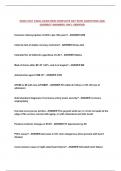
NURS 5461 FINAL EXAM NEW COMPLETE SET WITH QUESTIONS AND
CORRECT ANSWERS 100% VERIFIED
Common initial symptom of ACS in pts >80 years? - ANSWER SOB
Initial dx test of stable coronary ischemia? - ANSWER Stress test
Indicated for all CAD pts regardless of LDL? - ANSWER Statins
Med of choice after MI, EF <40%, and tx of angina? - ANSWER BB
Antischemic agent if BB CI? - ANSWER CCB
STEMI or MI with new left BBB? - ANSWER PCI within 6-12hour or 90-120 min of
admission
Gold standard diagnosis of coronary artery lesion severity? - ANSWER coronary
angiography
Corneal arcus (arcus senilis) - ANSWER This grayish white arc or circle not quite at the
edge of the cornea; normal with aging, or with cholesterol and LDL levels
Positive ischemic change on ECG? - ANSWER ST depression by.08
PVCs cause? - ANSWER decrease in CO, more dangerous when present with heart
disease
most common cause of right sided heart failure? - ANSWER left sided heart failure
,left ventricle thickens without enlargement? - ANSWER Hypertropic Cardiomyopathy
paresis - ANSWER weakness
plegia - ANSWER paralysis
when to start daily ICS in COPD patients? - ANSWER FEV1 <60%, Gold 3- severe
Tiotropium (Spiriva)? - ANSWER LAMA
Ipratropium (Atrovent)? - ANSWER SAMA
confirms persistent airflow obstruction in COPD? - ANSWER FEV1/FVC <70% post
bronchodilator
Renal problems associated with normal aging
Decreased GFR, decreased diluting capacity, decreased concentration ability,
decreased sodium conservation (volume depletion) decreased sodium excreation (salt
sensitivity/HTN), decreased ammonium & bicarb production (metabolic acidosis)
Most sensitive indicator of renal function in aging
GFR - declines 8mls per decade starting at age 40
Microalbuminuria
Chronic nephrosclerosis from HTN
, renal artery stenosis
partial or complete blocking of one or both renal arteries - THIS ACTIVATES THE RENIN
ANGIOTENSION ALDOSTERONE SYSTEM AND CAUSES SYSTEMIC HYPERTENSION TO
ATTEMPT TO PERFUSE THE KIDNEY - if pt has a 30% increase in creatinine after
starting an ACE or ARB - think renal artery stenosis - risk factors include smoking, HTN,
hyperlipidemia, DM, aneurysms - renal stenting isn't indicated except in extreme cases
when you can't control BP or there is progressive kidney failure.
Most common cause of AKI
Acute tubular necrosis (ATN) followed by prerenal azotemia
Acute Tubular Necrosis (ATN)
Damage to the renal tubules due to presence of toxins in the urine or to ischemia.
Results in oliguria.
Prerenal azotemia
Due to decreased blood flow to kidneys; common cause of acute renal failure - increase
bun and decreased renal flow - treat with volume resuscitation
acute tubular necrosis diagnostic criteria
DIAGNOSIS: URINE SEDIMENT WILL CONTAIN TUBULAR EPITHELIAL CELLS &
GRANULAR MUDDY BROWN CASTS - in oliguria FENa >2% - TREATMENT IS
SUPPORTIVE CARE AND OFTEN TIMES REVERSIBLE
Acute interstitial nephritis
Drug-induced hypersensitivity involving the interstitium and tubules; results in acute
renal failure (intrarenal azotemia) - most commone antibiotics to cause this are
PENICILLINS, CEPHLOSPORINS, AND FLUOROQUINOLONES (floxacins)
multiple myeloma "myeloma kidney"
CORRECT ANSWERS 100% VERIFIED
Common initial symptom of ACS in pts >80 years? - ANSWER SOB
Initial dx test of stable coronary ischemia? - ANSWER Stress test
Indicated for all CAD pts regardless of LDL? - ANSWER Statins
Med of choice after MI, EF <40%, and tx of angina? - ANSWER BB
Antischemic agent if BB CI? - ANSWER CCB
STEMI or MI with new left BBB? - ANSWER PCI within 6-12hour or 90-120 min of
admission
Gold standard diagnosis of coronary artery lesion severity? - ANSWER coronary
angiography
Corneal arcus (arcus senilis) - ANSWER This grayish white arc or circle not quite at the
edge of the cornea; normal with aging, or with cholesterol and LDL levels
Positive ischemic change on ECG? - ANSWER ST depression by.08
PVCs cause? - ANSWER decrease in CO, more dangerous when present with heart
disease
most common cause of right sided heart failure? - ANSWER left sided heart failure
,left ventricle thickens without enlargement? - ANSWER Hypertropic Cardiomyopathy
paresis - ANSWER weakness
plegia - ANSWER paralysis
when to start daily ICS in COPD patients? - ANSWER FEV1 <60%, Gold 3- severe
Tiotropium (Spiriva)? - ANSWER LAMA
Ipratropium (Atrovent)? - ANSWER SAMA
confirms persistent airflow obstruction in COPD? - ANSWER FEV1/FVC <70% post
bronchodilator
Renal problems associated with normal aging
Decreased GFR, decreased diluting capacity, decreased concentration ability,
decreased sodium conservation (volume depletion) decreased sodium excreation (salt
sensitivity/HTN), decreased ammonium & bicarb production (metabolic acidosis)
Most sensitive indicator of renal function in aging
GFR - declines 8mls per decade starting at age 40
Microalbuminuria
Chronic nephrosclerosis from HTN
, renal artery stenosis
partial or complete blocking of one or both renal arteries - THIS ACTIVATES THE RENIN
ANGIOTENSION ALDOSTERONE SYSTEM AND CAUSES SYSTEMIC HYPERTENSION TO
ATTEMPT TO PERFUSE THE KIDNEY - if pt has a 30% increase in creatinine after
starting an ACE or ARB - think renal artery stenosis - risk factors include smoking, HTN,
hyperlipidemia, DM, aneurysms - renal stenting isn't indicated except in extreme cases
when you can't control BP or there is progressive kidney failure.
Most common cause of AKI
Acute tubular necrosis (ATN) followed by prerenal azotemia
Acute Tubular Necrosis (ATN)
Damage to the renal tubules due to presence of toxins in the urine or to ischemia.
Results in oliguria.
Prerenal azotemia
Due to decreased blood flow to kidneys; common cause of acute renal failure - increase
bun and decreased renal flow - treat with volume resuscitation
acute tubular necrosis diagnostic criteria
DIAGNOSIS: URINE SEDIMENT WILL CONTAIN TUBULAR EPITHELIAL CELLS &
GRANULAR MUDDY BROWN CASTS - in oliguria FENa >2% - TREATMENT IS
SUPPORTIVE CARE AND OFTEN TIMES REVERSIBLE
Acute interstitial nephritis
Drug-induced hypersensitivity involving the interstitium and tubules; results in acute
renal failure (intrarenal azotemia) - most commone antibiotics to cause this are
PENICILLINS, CEPHLOSPORINS, AND FLUOROQUINOLONES (floxacins)
multiple myeloma "myeloma kidney"