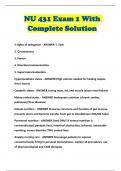
NU 431 Exam 1 With
Complete Solution
5 rights of delegation - ANSWER 1. Task
2. Circumstance
3. Person
4. Direction/communication
5. Supervision/evaluation
Hypermetabolic states - ANSWER High calories needed for healing (sepsis,
fever, burns)
Catabolic states - ANSWER Losing mass, fat, and muscle (acute renal failure)
Malnourished states - ANSWER Inadequate nutrition (chronic cardiac,
pulmonary/liver diseases)
Enteral nutrition - ANSWER Preserves structure and function of gut mucosa,
prevents ulcers and bacteria transfer from gut to bloodstream (NG/OG tube)
Parenteral nutrition - ANSWER Used ONLY if enteral nutrition is
contraindicated, paralytic ileus, intestinal obstruction, ischemia, intractable
vomiting, severe diarrhea (TPN, central line)
Anxiety nursing care - ANSWER Encourage patients to express
concerns/needs, bring in personal items/photos, explain all procedures, use
of pharmacological and CAM therapies
,Delirium - ANSWER State of temporary but acute mental confusion (80% of
patients in ICU)
Causes: age, drug abuse, sleep deprivation, hypercarbia, infections, benzos,
lasix, antimicrobials
CAM, ICDSC - ANSWER Confusion assessment method, Intensive care
delirium screening checklist
Delirium management - ANSWER Frequent assessments, medications
(Haldol, Seroquel), ABCDE bundle, removing cause, avoid malnutrition, avoid
physical restraints, d/c unnecessary equipment
Palliative care - ANSWER Specialized form of care that focuses on pain relief
and symptom/stress management associated with a severe illness (think
open heart surgery!)
Hospice - ANSWER Focuses on care of patients with a TERMINAL illness who
have less than 6 months to live
End of life - ANSWER Final phase in patient illness when death is imminent
Advance directive - ANSWER Document communicating patient medical
wishes when they cannot
Living will - ANSWER Specifies medical care they want/dont want at end of
life
DPOA (durable power of attorney) - ANSWER When another person is chosen
to make decisions for the patient
What are some things normally seen at end of life? - ANSWER Death rattle
(airway secretions), mottling, cool extremities, irregular vitals
, Medication control at end of life - ANSWER Respiratory distress: opioids,
benzos
Secretions: atropine, scopolamine
Comfort care - ANSWER Remove all appropriate lines/support, maintain IV
access for medications, turn all monitors off, bathe patient PRN when
lines/tubes are removed, consider cultural/spiritual needs
SEDATION IS NOT PAIN MEDICATION
Tasks upon death - ANSWER Funeral home coordination, identifying death
and calling doc to pronounce, determine if a medical examiner is needed,
removing all other lines/tubes, bathe pt, provide family support, prep for the
morgue
PCA dosing - ANSWER Loading dose given on start, PCA/demand dose by pt
with pre set amounts and time, Maximum doses, Basal dose: continuous
infusion (low dose over an hour), Break through dose PRN
PCA nursing care - ANSWER Assessment Q4 and PRN, check LOC, resp status
(CO2 35-45mmHg), vitals, IV site, pain/sedation scale
Which organ was the first to be transplanted successfully? - ANSWER Kidney
(1954)
Complete Solution
5 rights of delegation - ANSWER 1. Task
2. Circumstance
3. Person
4. Direction/communication
5. Supervision/evaluation
Hypermetabolic states - ANSWER High calories needed for healing (sepsis,
fever, burns)
Catabolic states - ANSWER Losing mass, fat, and muscle (acute renal failure)
Malnourished states - ANSWER Inadequate nutrition (chronic cardiac,
pulmonary/liver diseases)
Enteral nutrition - ANSWER Preserves structure and function of gut mucosa,
prevents ulcers and bacteria transfer from gut to bloodstream (NG/OG tube)
Parenteral nutrition - ANSWER Used ONLY if enteral nutrition is
contraindicated, paralytic ileus, intestinal obstruction, ischemia, intractable
vomiting, severe diarrhea (TPN, central line)
Anxiety nursing care - ANSWER Encourage patients to express
concerns/needs, bring in personal items/photos, explain all procedures, use
of pharmacological and CAM therapies
,Delirium - ANSWER State of temporary but acute mental confusion (80% of
patients in ICU)
Causes: age, drug abuse, sleep deprivation, hypercarbia, infections, benzos,
lasix, antimicrobials
CAM, ICDSC - ANSWER Confusion assessment method, Intensive care
delirium screening checklist
Delirium management - ANSWER Frequent assessments, medications
(Haldol, Seroquel), ABCDE bundle, removing cause, avoid malnutrition, avoid
physical restraints, d/c unnecessary equipment
Palliative care - ANSWER Specialized form of care that focuses on pain relief
and symptom/stress management associated with a severe illness (think
open heart surgery!)
Hospice - ANSWER Focuses on care of patients with a TERMINAL illness who
have less than 6 months to live
End of life - ANSWER Final phase in patient illness when death is imminent
Advance directive - ANSWER Document communicating patient medical
wishes when they cannot
Living will - ANSWER Specifies medical care they want/dont want at end of
life
DPOA (durable power of attorney) - ANSWER When another person is chosen
to make decisions for the patient
What are some things normally seen at end of life? - ANSWER Death rattle
(airway secretions), mottling, cool extremities, irregular vitals
, Medication control at end of life - ANSWER Respiratory distress: opioids,
benzos
Secretions: atropine, scopolamine
Comfort care - ANSWER Remove all appropriate lines/support, maintain IV
access for medications, turn all monitors off, bathe patient PRN when
lines/tubes are removed, consider cultural/spiritual needs
SEDATION IS NOT PAIN MEDICATION
Tasks upon death - ANSWER Funeral home coordination, identifying death
and calling doc to pronounce, determine if a medical examiner is needed,
removing all other lines/tubes, bathe pt, provide family support, prep for the
morgue
PCA dosing - ANSWER Loading dose given on start, PCA/demand dose by pt
with pre set amounts and time, Maximum doses, Basal dose: continuous
infusion (low dose over an hour), Break through dose PRN
PCA nursing care - ANSWER Assessment Q4 and PRN, check LOC, resp status
(CO2 35-45mmHg), vitals, IV site, pain/sedation scale
Which organ was the first to be transplanted successfully? - ANSWER Kidney
(1954)