Final Exam Study Guide
Sociology 173 | Professor Rossman, G. | UCLA
Week 6
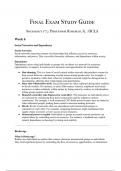
Social Networks and Dependence
Social Networks
Social networks represent systems of relationships that influence access to resources,
information, and power. They can reflect hierarchy, influence, and dependence within society.
Dependence
Dependence arises when individuals or groups rely on others in a network for resources,
opportunities, or support. It creates power dynamics and opportunities for exploitation.
● Slut-shaming: This is a form of social control within networks that punishes women for
their sexual behavior, maintaining societal norms around gender roles. For example, a
person’s reputation within their school or workplace network might be damaged due to
slut-shaming, affecting their relationships and opportunities.
● Race riots within labor strife: Racial divisions are often exploited during labor conflicts
to divide workers. For instance, in early 20th-century America, employers used racial
tensions to weaken solidarity within unions by hiring minority workers as strikebreakers,
pitting groups against each other.
● Bonacich centrality (aka Eigenvector centrality): This measures an individual's power
in a network by considering their direct connections and the influence of those
connections. For example, a well-connected CEO holds power because they are linked to
other influential people, making them central in decision-making networks.
● Rivals: Rivals in networks often use dependence and structural advantages to
outmaneuver each other. For example, competing businesses might manipulate their
supply chains to restrict a rival’s access to key resources.
● Structural power to exploit: Individuals or groups in central network positions can
exploit others by controlling access to resources. For instance, a landlord may exploit
tenants' dependence on housing by raising rents unfairly.
Brokerage
What is Brokerage?
Brokers are individuals or entities that connect otherwise unconnected groups or individuals.
They hold significant power by controlling the flow of resources, opportunities, or information.
, Forms of Brokerage
● Liaison: Temporary, transactional connections between two parties for a specific
purpose. Example: A recruiter connects a job seeker with an employer for a one-time job
opportunity.
● Itinerant: Brokers establish ongoing relationships, like a professional sports agent who
continuously negotiates deals for athletes.
● Coordinator: Brokers facilitate interactions within a group to enhance efficiency.
Example: A project manager ensures smooth communication between departments in a
company.
● Gatekeeper/Representative: Brokers control access to resources or opportunities. For
example, a university admissions officer acts as a gatekeeper for students seeking entry
into the institution.
Brokers Between Clusters
Brokers link different clusters of people or organizations within a larger network. For example, a
diplomat connects two countries during negotiations, ensuring communication and cooperation
between groups that might otherwise remain isolated.
Betweenness Centrality
This measures how critical a broker is to the network. Individuals with high betweenness
centrality control communication between groups. For example, a logistics manager in a
company ensures that information flows effectively between suppliers and distributors.
Historical Examples of Brokerage
● The Medici in Florence: The Medici family leveraged brokerage during the Renaissance
by aligning with different political factions, ensuring their indispensable role in both
politics and commerce.
● 1st Century BCE Rome: Julius Caesar and Pompey acted as brokers by building
alliances between political factions, consolidating their own power.
● US Congress: Politicians often act as brokers, negotiating deals between interest groups,
committees, or parties to pass legislation.
Status
What is Status?
Status refers to an individual’s or group’s position within a hierarchy, often symbolized by
power, respect, and influence. Higher-status individuals typically receive greater rewards and
deference.
Examples and Theories of Status
● 18th Century Parisian Courtesans (Kushner): Courtesans in Paris gained status by
forming relationships with powerful patrons. Despite their marginalized roles, they used
networks to achieve influence in elite society.
Sociology 173 | Professor Rossman, G. | UCLA
Week 6
Social Networks and Dependence
Social Networks
Social networks represent systems of relationships that influence access to resources,
information, and power. They can reflect hierarchy, influence, and dependence within society.
Dependence
Dependence arises when individuals or groups rely on others in a network for resources,
opportunities, or support. It creates power dynamics and opportunities for exploitation.
● Slut-shaming: This is a form of social control within networks that punishes women for
their sexual behavior, maintaining societal norms around gender roles. For example, a
person’s reputation within their school or workplace network might be damaged due to
slut-shaming, affecting their relationships and opportunities.
● Race riots within labor strife: Racial divisions are often exploited during labor conflicts
to divide workers. For instance, in early 20th-century America, employers used racial
tensions to weaken solidarity within unions by hiring minority workers as strikebreakers,
pitting groups against each other.
● Bonacich centrality (aka Eigenvector centrality): This measures an individual's power
in a network by considering their direct connections and the influence of those
connections. For example, a well-connected CEO holds power because they are linked to
other influential people, making them central in decision-making networks.
● Rivals: Rivals in networks often use dependence and structural advantages to
outmaneuver each other. For example, competing businesses might manipulate their
supply chains to restrict a rival’s access to key resources.
● Structural power to exploit: Individuals or groups in central network positions can
exploit others by controlling access to resources. For instance, a landlord may exploit
tenants' dependence on housing by raising rents unfairly.
Brokerage
What is Brokerage?
Brokers are individuals or entities that connect otherwise unconnected groups or individuals.
They hold significant power by controlling the flow of resources, opportunities, or information.
, Forms of Brokerage
● Liaison: Temporary, transactional connections between two parties for a specific
purpose. Example: A recruiter connects a job seeker with an employer for a one-time job
opportunity.
● Itinerant: Brokers establish ongoing relationships, like a professional sports agent who
continuously negotiates deals for athletes.
● Coordinator: Brokers facilitate interactions within a group to enhance efficiency.
Example: A project manager ensures smooth communication between departments in a
company.
● Gatekeeper/Representative: Brokers control access to resources or opportunities. For
example, a university admissions officer acts as a gatekeeper for students seeking entry
into the institution.
Brokers Between Clusters
Brokers link different clusters of people or organizations within a larger network. For example, a
diplomat connects two countries during negotiations, ensuring communication and cooperation
between groups that might otherwise remain isolated.
Betweenness Centrality
This measures how critical a broker is to the network. Individuals with high betweenness
centrality control communication between groups. For example, a logistics manager in a
company ensures that information flows effectively between suppliers and distributors.
Historical Examples of Brokerage
● The Medici in Florence: The Medici family leveraged brokerage during the Renaissance
by aligning with different political factions, ensuring their indispensable role in both
politics and commerce.
● 1st Century BCE Rome: Julius Caesar and Pompey acted as brokers by building
alliances between political factions, consolidating their own power.
● US Congress: Politicians often act as brokers, negotiating deals between interest groups,
committees, or parties to pass legislation.
Status
What is Status?
Status refers to an individual’s or group’s position within a hierarchy, often symbolized by
power, respect, and influence. Higher-status individuals typically receive greater rewards and
deference.
Examples and Theories of Status
● 18th Century Parisian Courtesans (Kushner): Courtesans in Paris gained status by
forming relationships with powerful patrons. Despite their marginalized roles, they used
networks to achieve influence in elite society.