HESI Biology
Study online at https://quizlet.com/_essfnf
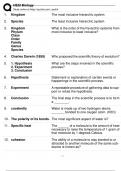
1. Kingdom The most inclusive hierarchic system
2. Species The least inclusive hierarchic system
3. Kingdom What is the order of the hierarchic systems from
Phylum most inclusive to least inclusive?
Class
Order
Family
Genus
Species
4. Charles Darwin (1859) Who proposed the scientific theory of evolution?
5. 1. Hypothesis What are the steps involved in the scientific
2. Experiment process?
3. Conclusion
6. Hypothesis Statement or explanation of certain events or
happenings in the scientific process.
7. Experiment A repeatable procedure of gathering data to sup-
port or refute the hypothesis.
8. Conclusion The final step in the scientific process is to form
a ________.
9. covalently Water is made up of two hydrogen atoms
_______ bonded to one oxygen atom. (H2O)
10. The polarity of its bonds. The most significant aspect of water is?
11. Specific heat The ______ of a molecule is the amount of heat
necessary to raise the temperature of 1 gram of
that molecule by 1 degrees Celsius.
12. cohesion The ability of a molecule to stay bonded to or
attracted to another molecule of the same sub-
stance is known as?
, HESI Biology
Study online at https://quizlet.com/_essfnf
13. carbohydrates, lipids, The most important molecules involved in biolo-
proteins and nucleic gy are?
acids.
14. Carbohydrates generally long chains, or polymers of sugars.
15. Storage, structure and en- What are the most important functions of carbo-
ergy. hydrates?
16. Lipids better known as "fats"
17. Fatty Acids Lipids fall into 3 catagories, they are:
Phospholipids
Steroids
18. Fatty acids ______ vary greatly but are generally grouped
into two categories: Saturated and unsaturated.
19. Saturated ______ fats contain no double bonds in their
hydrocarbon tail.
20. Unsaturated ______ fats have one or more double bonds in
their hydrocarbon tail. Liquid at room tempera-
ture.
21. Saturated Type of fat that is solid at room temperature
and are considered detrimental and can cause
cardiovascular problems absorbed in excess.
22. Phospholipid Consist of two fatty acids of varying lengths
bonded to a phosphate group.
23. hydrocarbon tail The phosphate group in a phospholipid is
charged making it polar, however the ______ is
non-polar.
24. The molecules combine What is particularly important about Phospho-
in a way that creates a lipids?
barrier to protect the cell;
and therefore, are impor-
, HESI Biology
Study online at https://quizlet.com/_essfnf
tant in the function of cel-
lular membranes.
25. Steroids Important component of membranes but more
important, many are important precursors to sig-
nificant hormones.
26. Proteins Polymers of 20+ molecules called Amino Acids.
27. Proteins Most complex, consist of several structure types
and are the largest of the biological molecules.
28. Enzymes ____ are particular types of proteins that act to
catalyze different reactions or processes.
29. Proteins What is the most significant contributor to cellu-
lar function?
30. Nucleic Acids Components of the molecules of inheritance.
31. DNA Nucleic Acids consist of what?
RNA
32. Deoxyribonucleic acid A unique molecule specific to a particular organ-
(DNA) ism and contains the code that is necessary for
replication.
33. Ribonucleic acid (RNA) Is used in transfer and as a messenger in most
species of the genetic code.
34. Metabolism The sum of all chemical reactions that occur in
an organism is referred to as?
35. Metabolic pathways In a cell, reactions take place in a series of
steps called, _____________ progressing from
a standpoint of high energy to low energy.
36. Cell The fundamental unit of biology.
37. Prokaryotic
Study online at https://quizlet.com/_essfnf
1. Kingdom The most inclusive hierarchic system
2. Species The least inclusive hierarchic system
3. Kingdom What is the order of the hierarchic systems from
Phylum most inclusive to least inclusive?
Class
Order
Family
Genus
Species
4. Charles Darwin (1859) Who proposed the scientific theory of evolution?
5. 1. Hypothesis What are the steps involved in the scientific
2. Experiment process?
3. Conclusion
6. Hypothesis Statement or explanation of certain events or
happenings in the scientific process.
7. Experiment A repeatable procedure of gathering data to sup-
port or refute the hypothesis.
8. Conclusion The final step in the scientific process is to form
a ________.
9. covalently Water is made up of two hydrogen atoms
_______ bonded to one oxygen atom. (H2O)
10. The polarity of its bonds. The most significant aspect of water is?
11. Specific heat The ______ of a molecule is the amount of heat
necessary to raise the temperature of 1 gram of
that molecule by 1 degrees Celsius.
12. cohesion The ability of a molecule to stay bonded to or
attracted to another molecule of the same sub-
stance is known as?
, HESI Biology
Study online at https://quizlet.com/_essfnf
13. carbohydrates, lipids, The most important molecules involved in biolo-
proteins and nucleic gy are?
acids.
14. Carbohydrates generally long chains, or polymers of sugars.
15. Storage, structure and en- What are the most important functions of carbo-
ergy. hydrates?
16. Lipids better known as "fats"
17. Fatty Acids Lipids fall into 3 catagories, they are:
Phospholipids
Steroids
18. Fatty acids ______ vary greatly but are generally grouped
into two categories: Saturated and unsaturated.
19. Saturated ______ fats contain no double bonds in their
hydrocarbon tail.
20. Unsaturated ______ fats have one or more double bonds in
their hydrocarbon tail. Liquid at room tempera-
ture.
21. Saturated Type of fat that is solid at room temperature
and are considered detrimental and can cause
cardiovascular problems absorbed in excess.
22. Phospholipid Consist of two fatty acids of varying lengths
bonded to a phosphate group.
23. hydrocarbon tail The phosphate group in a phospholipid is
charged making it polar, however the ______ is
non-polar.
24. The molecules combine What is particularly important about Phospho-
in a way that creates a lipids?
barrier to protect the cell;
and therefore, are impor-
, HESI Biology
Study online at https://quizlet.com/_essfnf
tant in the function of cel-
lular membranes.
25. Steroids Important component of membranes but more
important, many are important precursors to sig-
nificant hormones.
26. Proteins Polymers of 20+ molecules called Amino Acids.
27. Proteins Most complex, consist of several structure types
and are the largest of the biological molecules.
28. Enzymes ____ are particular types of proteins that act to
catalyze different reactions or processes.
29. Proteins What is the most significant contributor to cellu-
lar function?
30. Nucleic Acids Components of the molecules of inheritance.
31. DNA Nucleic Acids consist of what?
RNA
32. Deoxyribonucleic acid A unique molecule specific to a particular organ-
(DNA) ism and contains the code that is necessary for
replication.
33. Ribonucleic acid (RNA) Is used in transfer and as a messenger in most
species of the genetic code.
34. Metabolism The sum of all chemical reactions that occur in
an organism is referred to as?
35. Metabolic pathways In a cell, reactions take place in a series of
steps called, _____________ progressing from
a standpoint of high energy to low energy.
36. Cell The fundamental unit of biology.
37. Prokaryotic