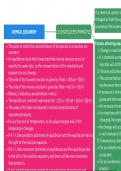
If a chemical system is
changed so that the sy
counteract the externa
CHEMICAL EQUILIBRIUM LE CHÂTELIER’S PRINCIPLE
Factors affecting equi
The point at which the concentrations of all species in a reaction are
constant. 1. Change in reactan
At equilibrium, both the forward and the reverse reaction occur at If a chemical syste
exactly the same rate, so the concentration of the reactants and reaction will shift t
products do not change. 2. Volume and pressu
The rate of the forward reaction is given by: Rate = kf[A]^a × [B]^b The concentration
The rate of the reverse reaction is given by: Rate = kr[C]^c × [D]^d we decrease the vo
Where [ ] indicates concentration in mol.L-¹ If pressure is increa
The equilibrium constant expression: Kc = ([C]^c × [D]^d) ÷ ([A]^a × [B]^b) gases and decreas
The value of Kc does not depend on initial concentrations of An increase in pres
reactants/products. In a reaction with t
Kc is a function of temperature, so its value changes only if the changing the press
temperature changes. No change will occ
If K > 1, then products dominate at equilibrium and the equilibrium lies to is not involved in th
the right of the reaction equation. 3. Temperature chan
If K < 1, then reactants dominate at equilibrium and the equilibrium lies For an endothermic
to the left of the reaction equation, and there will be more reactants a reactant.
than products. For an exothermic
product.
changed so that the sy
counteract the externa
CHEMICAL EQUILIBRIUM LE CHÂTELIER’S PRINCIPLE
Factors affecting equi
The point at which the concentrations of all species in a reaction are
constant. 1. Change in reactan
At equilibrium, both the forward and the reverse reaction occur at If a chemical syste
exactly the same rate, so the concentration of the reactants and reaction will shift t
products do not change. 2. Volume and pressu
The rate of the forward reaction is given by: Rate = kf[A]^a × [B]^b The concentration
The rate of the reverse reaction is given by: Rate = kr[C]^c × [D]^d we decrease the vo
Where [ ] indicates concentration in mol.L-¹ If pressure is increa
The equilibrium constant expression: Kc = ([C]^c × [D]^d) ÷ ([A]^a × [B]^b) gases and decreas
The value of Kc does not depend on initial concentrations of An increase in pres
reactants/products. In a reaction with t
Kc is a function of temperature, so its value changes only if the changing the press
temperature changes. No change will occ
If K > 1, then products dominate at equilibrium and the equilibrium lies to is not involved in th
the right of the reaction equation. 3. Temperature chan
If K < 1, then reactants dominate at equilibrium and the equilibrium lies For an endothermic
to the left of the reaction equation, and there will be more reactants a reactant.
than products. For an exothermic
product.